
My Father Bought His Ticket 45 Minutes After the Match Started
On the 2nd of January 1988, India beat the West Indies in a one-day international at Eden Gardens for the first time ever on Indian soil. I was there. I was twelve, and I still count it among the best days of my childhood.
But this isn’t a story about the match. It’s a story about my father, and a ticket, and something he understood about panic that took me about thirty years to properly learn.
Let me set it up.
My uncle had managed to get three tickets. One each for me and my two cousins. My father didn’t have one. Getting tickets for a game like that was hard in those days, and there simply wasn’t a fourth.
When we reached the ground it was already packed, and outside the gates there were touts selling tickets at wild prices. My father looked at what they were asking and showed no interest at all. He walked us to the gate, sent the three of us in, and I assumed he was going home.
He didn’t go home.
I only found this out afterwards. He hadn’t gone anywhere. He’d stayed near the gate, and he’d kept one particular tout in the corner of his eye. His reasoning was simple. The moment the match starts, a man holding unsold tickets stops holding an asset and starts holding a problem. Nobody wants a ticket to a game that has already begun.
So he waited. The match started. And exactly as he’d predicted, the tout began to panic, because every passing minute made those tickets worth less. My father let him sweat. Then he walked over and bought his way in for ten rupees over the printed price, roughly 45 minutes after the first ball.
He watched most of the match. He paid almost nothing. And he taught me something without saying a word about it.
Here’s the sentence I wrote about him years later, in my first book. Patience was his virtue.
Now here’s the part I actually want to talk about, because it took me most of my career to connect it to my working life.
My father wasn’t being cheap. He could have bought a tout’s ticket at the inflated price and walked in with us. What he refused to pay wasn’t the money. It was the price of panic. The premium that a seller charges you precisely when you feel you have to decide right now.
Once you start noticing that premium, you see it everywhere.
You see it when you shop online and the site tells you there are “only 3 left” and “12 people are viewing this”. None of that is there to inform you. It’s there to switch off the patient part of your brain and switch on the part that grabs. It’s the tout’s stall, rebuilt in software, and it works on most of us most of the time.
And here is where it stops being a shopping story and starts being about the thing I actually do for a living.
Legacy modernization is sold to you with exactly the same stall.
If you run engineering or technology at a mid-sized company, you already know the pitch, because some version of it lands in your inbox most months. Your stack is a ticking bomb. Your competitors are already AI-native and pulling away. Every month you wait, the migration gets more expensive and more dangerous. Sign now. Start now. There’s no time to assess.
It is the tout, holding a ticket, telling you the match is about to start.
And I want to be honest with you, because I’m in this industry and I benefit from your urgency. Some of that pitch is even true. Some legacy systems genuinely are a growing risk. Some competitors genuinely are moving faster. The urgency isn’t always manufactured.
But notice what the pitch always needs you to skip.
It needs you to skip the assessment.
Because the assessment is the one thing that tells you how much of the panic is real. It’s where you find out whether your system needs a full rebuild or a careful refactor. It’s where you find out which parts of it are genuinely holding you back and which parts are fine and just old. It’s where you often find out that the AI capability you’re being sold can’t even run on your data yet, so the real first job is smaller and cheaper than the thing in the proposal.
A seller who is confident in the work wants you to assess first, because the assessment qualifies the job.
A seller who is selling you panic needs you not to, because the assessment is where the panic evaporates.
My father’s move at that gate wasn’t to refuse the ticket. He wanted to watch the match as much as I did. His move was to refuse the price of the ticket while the seller was using urgency to inflate it. He separated the thing he wanted from the pressure he was being sold, and he waited for the pressure to burn off.
That is exactly what a scoped assessment is, in our world. It is not saying no to modernization. It is saying: I’ll find out where I actually stand before I commit to anything, and I’ll make the big decision from knowledge instead of from fear.
You walk out of it with a roadmap and a business case. Then, and only then, you decide how big the job is. Sometimes it’s the full rebuild after all. Often it’s a great deal less than you were about to sign for.
So if there’s a modernization decision in front of you right now, and it comes wrapped in urgency, ask yourself my father’s question before you reach for your wallet.
Is the match really about to start? Or is somebody just holding a ticket they need me to buy in a hurry?
You can find out. That’s what an assessment is for. It costs you a fraction of the decision it protects, and it turns a leap of faith into a piece of arithmetic.
Be a buyer or be a seller. You only really win when you have the patience to find out what something is actually worth.
If you’d like us to look at where your systems actually stand before you commit to anything, that’s precisely what our Modernization and AI Readiness Assessment is for. It’s scoped, it’s fast, and it ends with a roadmap and a business case you own, whatever you decide to do next.

Recent Comments
Related blog posts
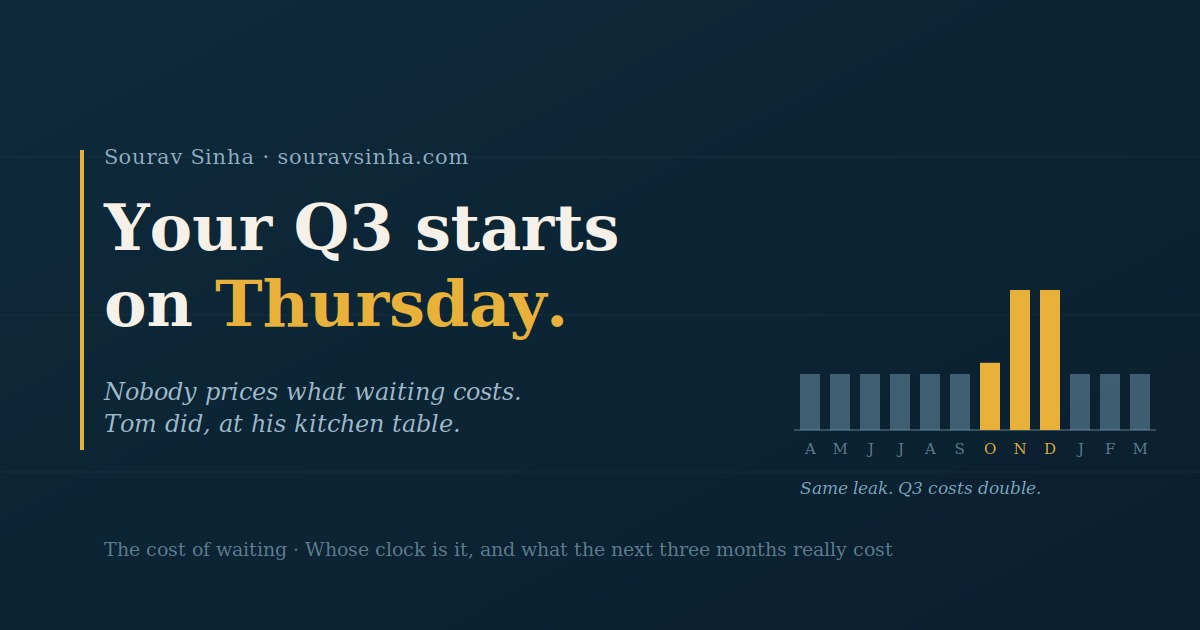
Your Q3 Starts on Thursday
Tom found the problem on a Tuesday in the last week of September, which, as it turned out, was about the most expensive week of the year to find anyth
Read More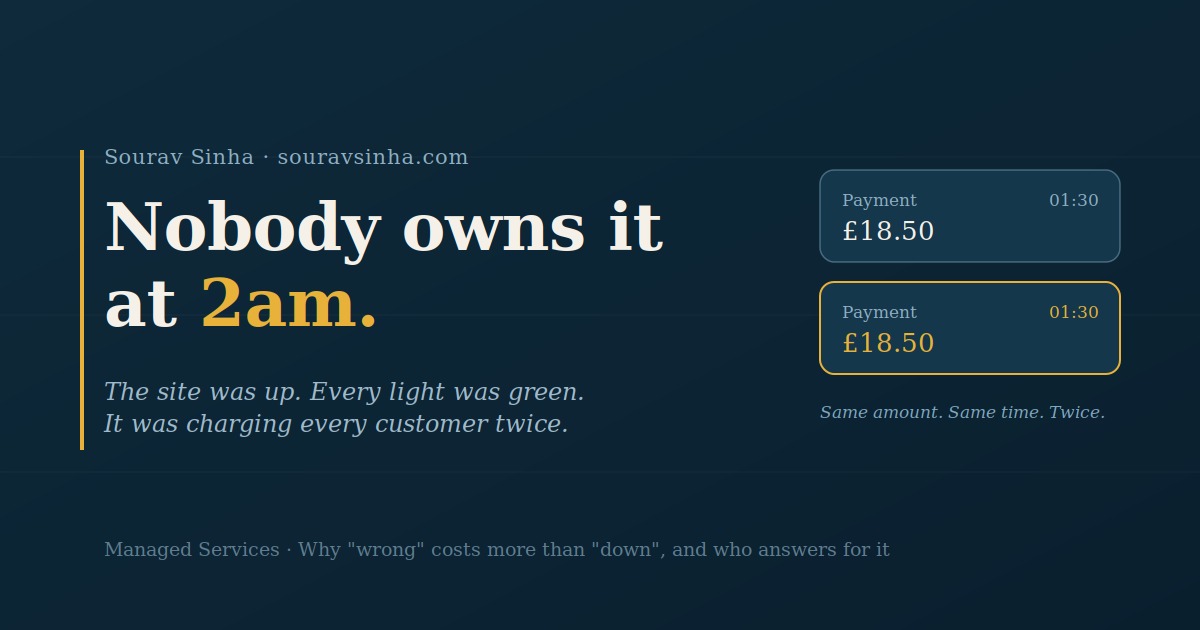
Nobody Owns It at 2AM
At half past one in the morning, Hannah's phone lit up on the bedside table with a notification from her bank. £18.50, paid to her own company. Tha
Read More
The Phone Isn’t India’s Story
This morning, before the second cup of coffee, I opened Twitter and read nine hundred words from a man I'd never spoken to. Carl Pei had posted an es
Read More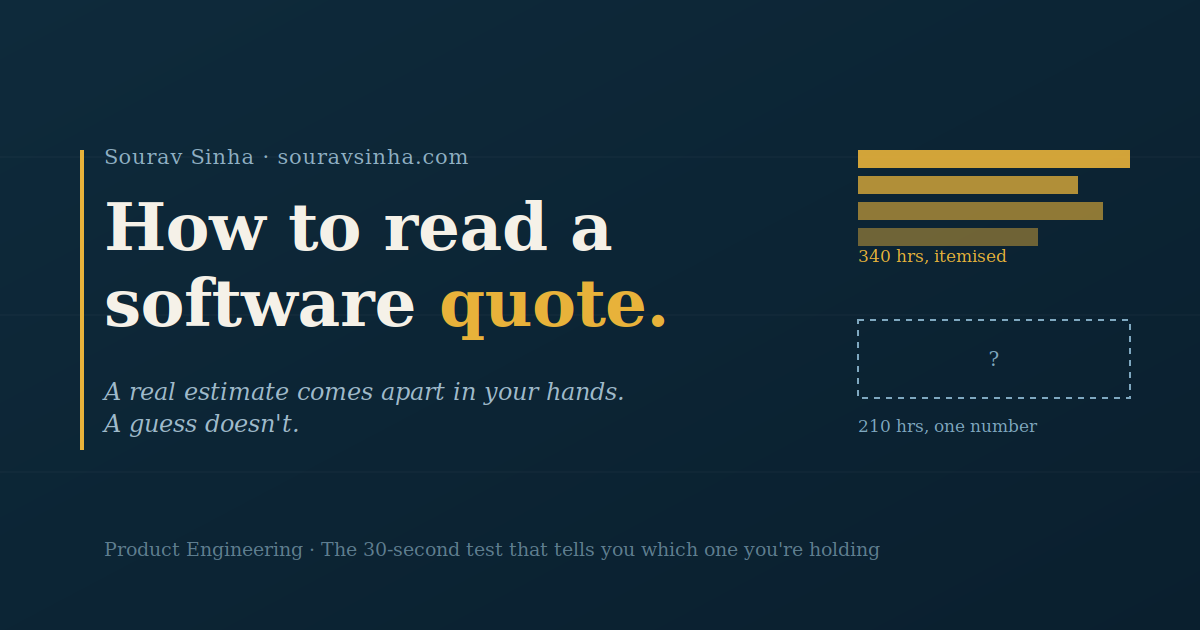
How to Read a Software Quote
Priya had two quotes on her desk and a decision to make by Friday. Priya isn't one person. Like Daniel from last week, she's a composite of CTOs and
Read More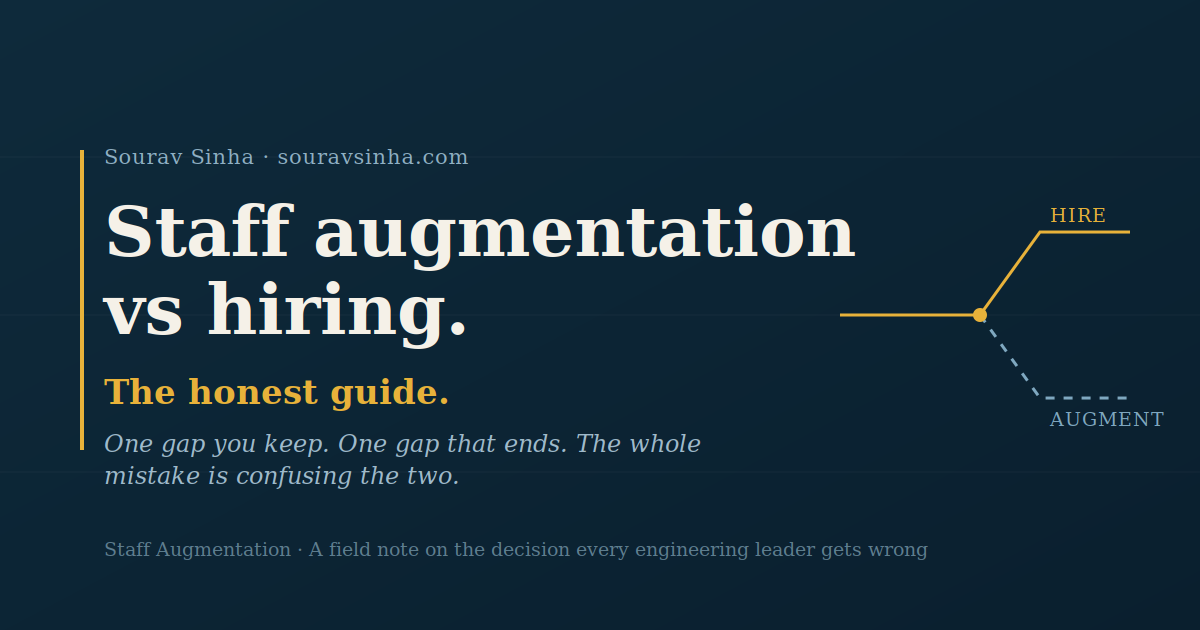
Staff Augmentation vs Hiring: The Honest Guide Nobody Selling It Will Give You
Let me tell you about Daniel. Daniel isn't one person. He's a version of a manager I have sat across from dozens of times over the years, in Kolkata
Read More
I like it . Patience is the key to get suceess .