
The Phone Isn’t India’s Story
This morning, before the second cup of coffee, I opened Twitter and read nine hundred words from a man I’d never spoken to.
Carl Pei had posted an essay titled India Is Inevitable. I knew the name the way most of us in this business know it, the founder who left OnePlus, started Nothing in London, and built a cult around a transparent phone. What I didn’t expect was an essay that read less like a press release and more like a confession. He wasn’t selling me a product. He was making an argument, and it was a good one, and for about ten minutes I agreed with almost all of it.
He’d spent eight years in Shenzhen watching China do something no one had done before it, take a country that assembled other people’s electronics and turn it into one that designed its own. He watched it happen from the inside, and now he was betting that India was about to do the same thing, with his company’s budget brand, CMF, as the vehicle. Spin it out of Nothing entirely, majority Indian owned, headquartered here, its own engineering team, its own research and development, a hundred million phones a year as the target that turns a brand into a platform. Nothing stays on as a shareholder and a partner, not the parent.
I read it twice. And somewhere on the second read, a specific line stopped being inspiring and started being a test I couldn’t unsee.
The test that won’t let you cheat
Pei gives five questions, and he means them as a filter, not a slogan. Who actually engineers the structure of the device, the materials, the thermals, beyond picking a colour. Who selects the camera sensors and builds the software that turns raw sensor data into a photo people love. Who writes the operating system and commits to years of updates rather than shipping once and walking away. Who re-certifies the antennas every time the design changes, a detail so unglamorous that most brands never think to ask who owns it. And who sits across the table from the people making displays and chipsets, co-engineering the next generation rather than choosing from what already exists on a supplier’s shelf.
If the honest answer to most of those is “our manufacturing partner handles that,” Pei says, you’re not a phone company. You’re a customer with a logo. And the thing about that kind of company is that it can only ever compete on price, and there is always, eventually, someone cheaper.
I sat with that test longer than I expected to, because I’ve watched this exact failure happen in this country, in real time, close enough to remember the names.
I’ve seen this movie before, and it didn’t end well
Between 2015 and 2017, a wave of Indian smartphone brands had their moment. One of them briefly outsold Samsung in India. For about eighteen months it genuinely looked like the beginning of something, a homegrown industry finally arriving at scale, the kind of story this country loves to tell about itself.
Then the foreign brands showed up with something the domestic ones didn’t have. Not marketing. Not distribution. Engineering. A camera that was measurably better than last year’s. A design language that evolved instead of repeating. An operating system somebody was actually maintaining. The Indian brands, it turned out, had been doing exactly what Pei warns against, licensing an off-the-shelf design, swapping the back cover, putting their logo on the box. By 2025, the brands that had once led this market held less than one percent of it combined.
That’s not a story I read about. That’s a story I watched from inside this industry, the kind of collapse you don’t forget because you recognise the shape of it every time it threatens to repeat.
So when I read Pei’s five questions, I wasn’t reading them as praise for his ambition. I was reading them as the exact autopsy report I’d want run on his own company two years from now.
Here’s the part I can’t let go of
CMF’s actual paper trail so far doesn’t answer the test yet, it postpones it. What’s committed is a joint venture with an Indian contract manufacturer, a jobs number attached to assembly, and a promise, a real one, that research and development will happen here going forward. A promise is not the same claim as headcount. Majority ownership on a cap table tells you who gets paid if this works. It doesn’t tell you who’s in the room deciding what the camera pipeline looks like next year.
I want to be fair to him here, because this is exactly the kind of thing I’d want a mentor to say to me if I made a big public bet and left a gap in the argument. Pei set a test rigorous enough to indict the last decade’s failures. I intend to hold his own company to it. If two years from now the antenna certification, the OS roadmap, and the camera tuning are still sitting in London while India gets the assembly line and a local name on the box, this is 2015 again with a better story attached. If they’re not, if the engineering headcount actually moves here, this could be the real thing. I don’t know yet. Neither does he, honestly, not with certainty. That’s what makes it a bet and not a plan.
But here’s where the essay, for all its rigor, sent me looking in the wrong direction. And it took me a full day to see why.
A test I’d already seen India pass
Pei’s five questions aren’t really about phones. They’re about who owns the hard part. So I ran them again, against something else entirely, and the answers stopped me mid-thought.
Who wrote the software. India did. UPI isn’t a licensed platform with an Indian skin painted over someone else’s architecture, it’s homegrown, built by the National Payments Corporation of India from the rails up. Who owns the system and keeps improving it rather than freezing it after launch. NPCI does, and they’ve kept shipping, UPI Lite for people without steady connectivity, UPI 123PAY so a feature phone can pay a vendor, cross-border expansion into new countries this year. Has an ecosystem actually formed around it, the way Pei says ecosystems only form around whoever asks the hardest questions first. Completely. This August alone, UPI processed 24.51 billion transactions, a monthly number that’s nearly quadrupled in four years, and the IMF has already called it the world’s largest real-time payments system by volume.
Nobody handed India that. Nobody in Seoul or Shenzhen or London engineered UPI and then let India assemble it. India wrote the operating system for its own economy, in-house, from a blank page, and then didn’t stop iterating on it. That’s not a services story. That’s not even really a fintech story. That’s the exact five-question test Pei just wrote, already passed, sitting in plain sight, in an industry nobody thinks to compare to consumer electronics because it doesn’t come in a box you can photograph.
Now here’s the thing that actually decides the next decade
Extend that same logic one step further and you land on where I think this country’s real opportunity sits, and it isn’t in a factory.
Foundation models are a capital and compute race that the United States and China locked up years ago, and no honest read of the board says India shows up as the frontrunner there. But there’s a layer above the model that nobody has locked up yet, the work of actually getting AI into the hands of a billion people across dozens of languages, deployed, localised, governed responsibly rather than dumped on a population and left to cause damage. That layer rewards exactly the muscle India has already spent a decade building.
The numbers say this louder than I can. India’s Global Capability Centres generated close to 98 billion dollars in revenue this fiscal year and now account for over a third of the country’s AI hiring, adding nearly twice as many net employees as traditional IT services firms. Software and business services exports already sit near 205 billion dollars a year, 8.5 percent of GDP, built on the one resource no supply chain shortcut can replicate quickly, English-fluent engineering talent at a scale no other country can field. That’s not a moat someone else is fifteen years ahead on. That’s a moat India is standing inside of, right now, this fiscal year, getting wider every quarter.
I’ll say the part that makes this more than an armchair opinion. Brainium has spent the better part of the last year moving away from pure services delivery and toward AI middleware and applied agent products, and I’m telling you where I think the bigger pie sits partly because I’ve already put the company’s runway behind that answer. I could be exactly as wrong about that as I’ve just suggested Pei might be about hardware. The difference is I’m not asking you to wait a decade to find out whether the bet paid off. We’ll know inside two or three years, the same window I’d give CMF before I ask whether the engineering actually moved here.
Where I’ve placed my chips, and where I think you should look
Pei is right that India is inevitable. I don’t think he’s wrong about that claim for a single sentence, and if CMF does what it says it will, ships a hundred million India-engineered phones a year with the R&D actually sitting here, that’s a genuine national achievement and I’ll be the first to write the piece admitting I underestimated it.
But if you ask me to rank where the next decade’s real economic weight lands, a factory racing to catch a country with a ten-year head start, or a talent base that already wrote the operating system for its own economy and is now writing the deployment layer for AI, I’m not undecided. Applied AI implementation, vertical agents for sectors this country still badly underserves like healthcare and agriculture, and governance frameworks India can export the way it already exported UPI, that’s the bet with the shorter runway to proof and the deeper moat underneath it.
I read an essay this morning that made a rigorous case for a fifteen-year climb up a hill someone else is already standing on top of. What I keep coming back to is that India already owns the top of a different hill, and most of us are still looking at the wrong one.

Recent Comments
Related blog posts
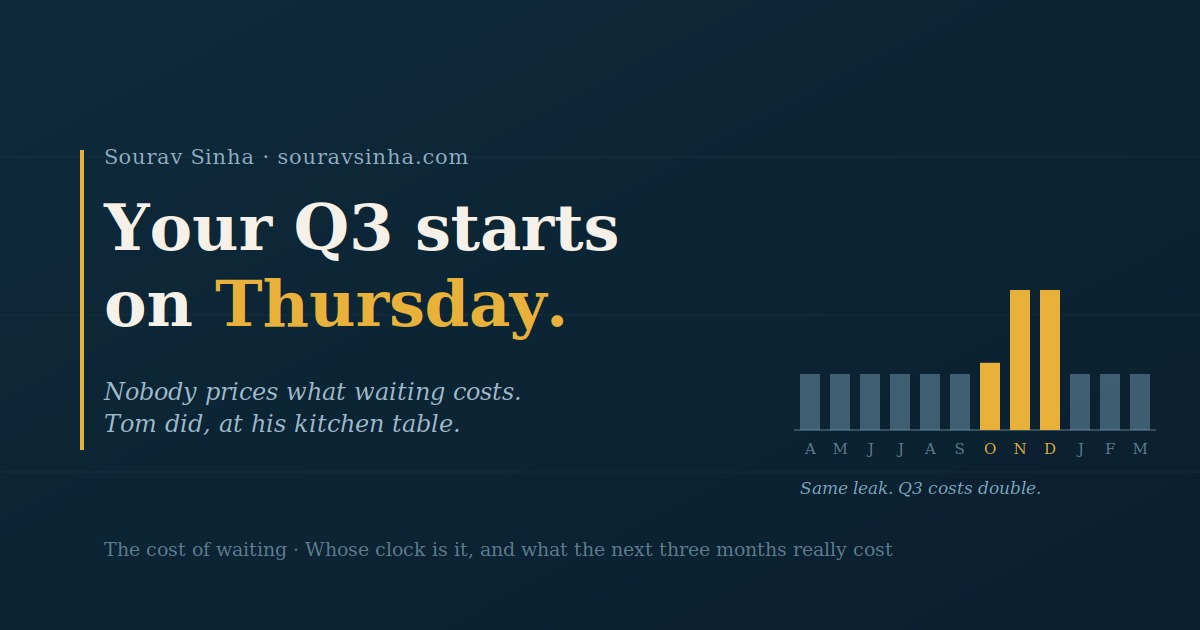
Your Q3 Starts on Thursday
Tom found the problem on a Tuesday in the last week of September, which, as it turned out, was about the most expensive week of the year to find anyth
Read More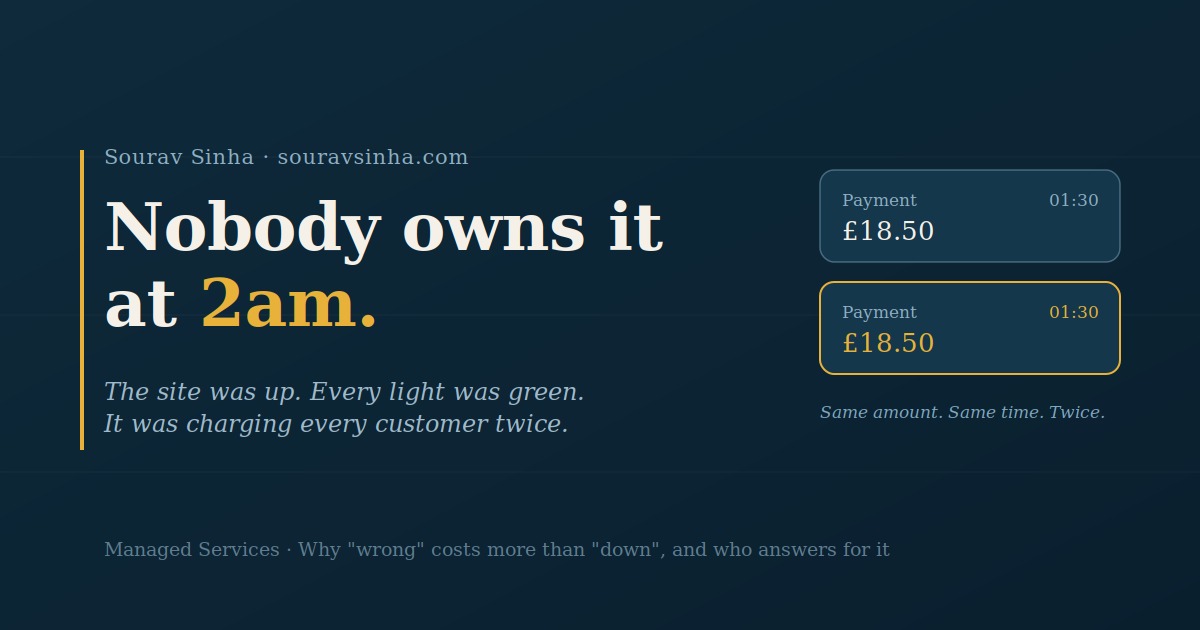
Nobody Owns It at 2AM
At half past one in the morning, Hannah's phone lit up on the bedside table with a notification from her bank. £18.50, paid to her own company. Tha
Read More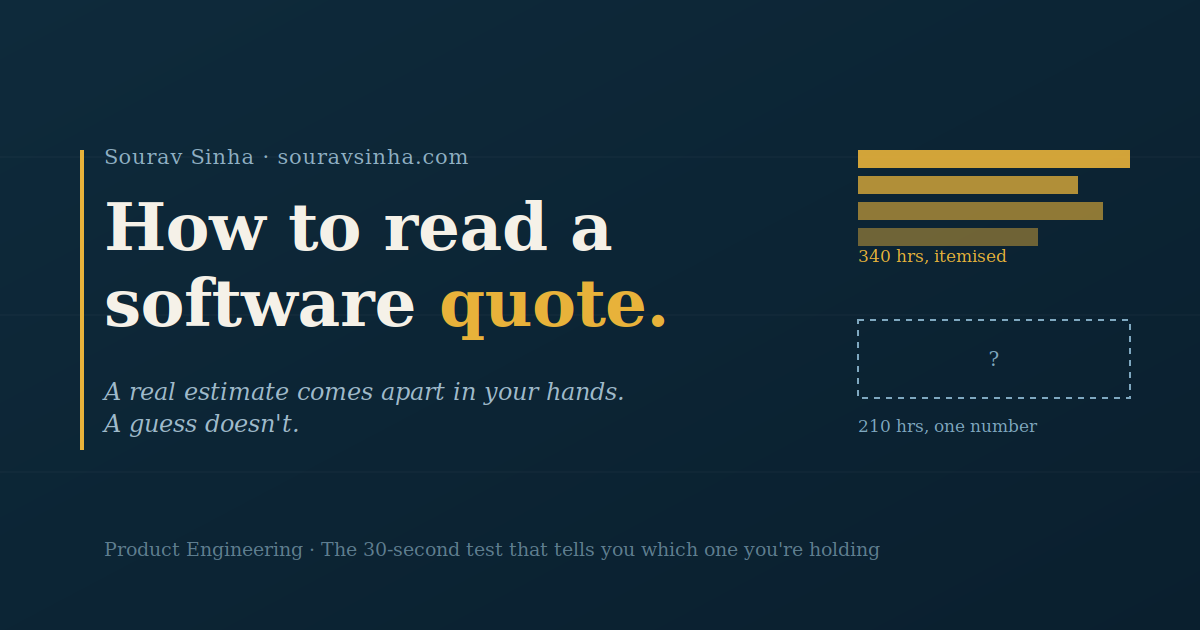
How to Read a Software Quote
Priya had two quotes on her desk and a decision to make by Friday. Priya isn't one person. Like Daniel from last week, she's a composite of CTOs and
Read More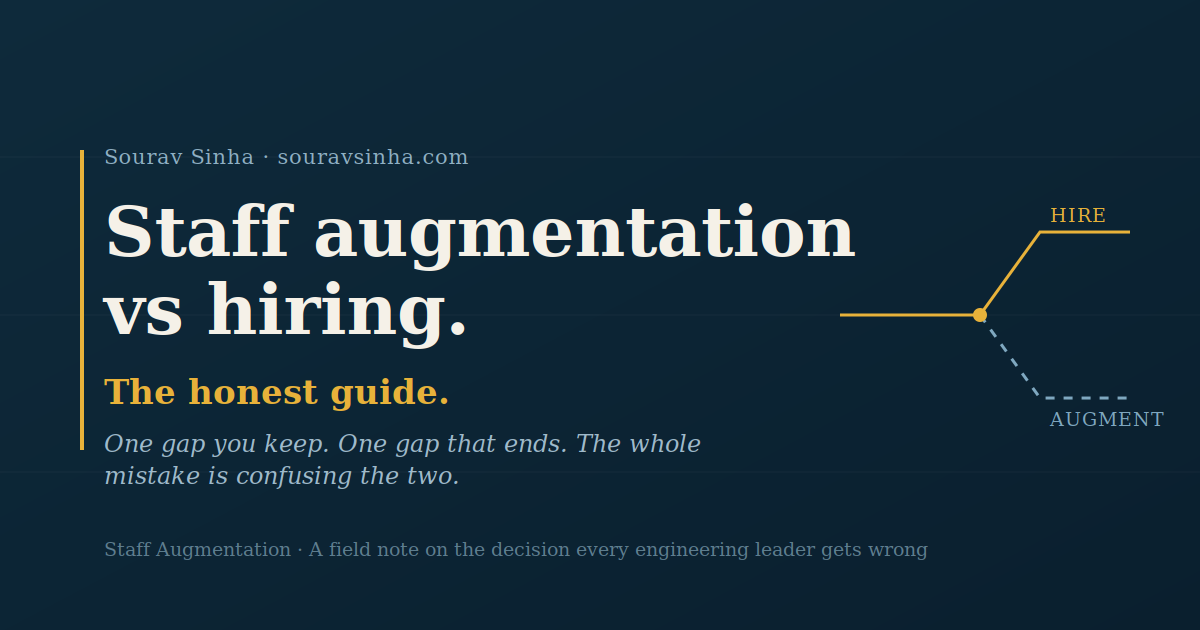
Staff Augmentation vs Hiring: The Honest Guide Nobody Selling It Will Give You
Let me tell you about Daniel. Daniel isn't one person. He's a version of a manager I have sat across from dozens of times over the years, in Kolkata
Read More
The Most Valuable Thing a Vendor Can Do Is Say No
A few years ago a man came to us wanting to build a betting portal. He had a clear vision, real capital behind him, and every intention of spending it
Read More
The real shift is from “Made in India” to “Engineered in India.” UPI proved that India can build foundational technology at massive scale, and applied AI could be the next big opportunity. The factory may create capacity, but owning the intelligence creates the moat.