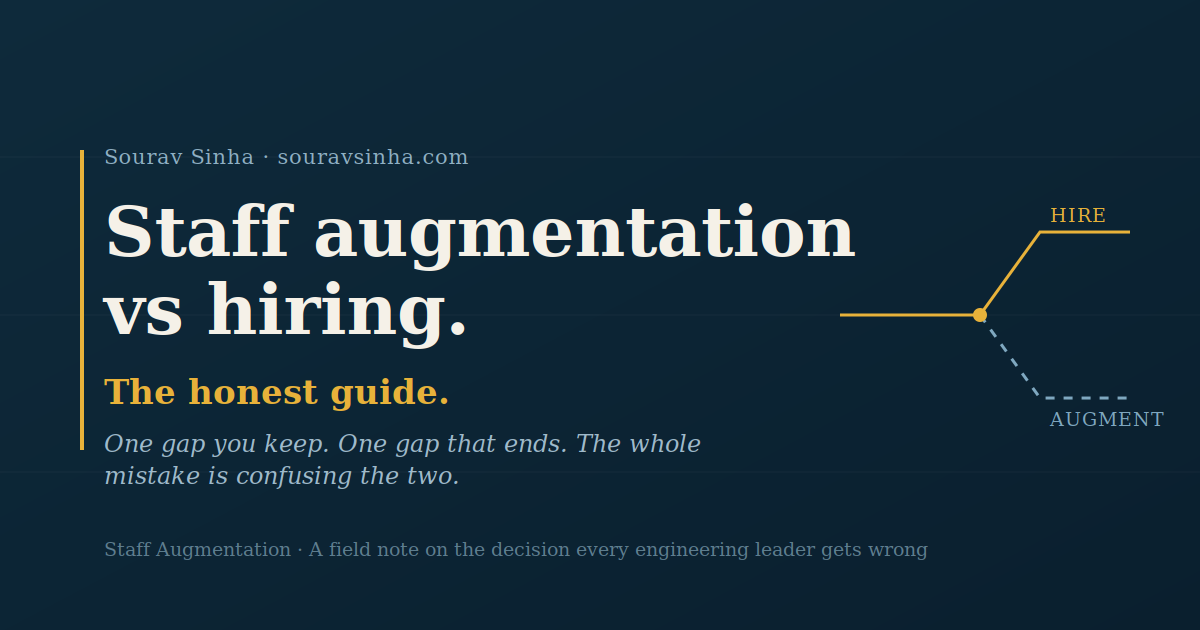
Staff Augmentation vs Hiring: The Honest Guide Nobody Selling It Will Give You
Let me tell you about Daniel.
Daniel isn’t one person. He’s a version of a manager I have sat across from dozens of times over the years, in Kolkata and London and on video calls at odd hours, and I’ve put all of them into one man so the story holds together. But everything that happens to him has happened, more than once, to someone real.
Daniel runs engineering at a mid-sized retail company. Good business, real revenue, the kind of company that isn’t a startup gambling on a dream but isn’t a giant with infinite bench either. About ninety engineers. He’s competent, he’s tired, and it’s the second week of July.
His problem is a date. The company has committed to a major platform launch for the first week of October, tied to peak season, promised to the board, promised to partners, the sort of date that does not move because too many other things have been chained to it. And Daniel is short. He has a senior backend role that has been open since March. Four months. He’s interviewed maybe fifteen people. Two were good and both took offers elsewhere while his own hiring process ground through its third round of approvals. The rest were, to be honest, the one-year-of-experience-repeated-ten-times kind, confident on paper and hollow the moment you pushed.
So here he is in July, ninety days from a launch he cannot miss, carrying a gap he has not been able to close in four months of trying. His team is already doing overtime. Two of his best people have started giving him that look, the one that says they’re updating their own CVs. The board has begun asking, in that gentle way that isn’t gentle at all, whether the date is safe.
Daniel is about to make a decision. And in my experience, at exactly this moment, most managers make one of two mistakes.
The two doors, and why both of them are trapdoors
The first door is the one marked panic hire.
Daniel goes back into his candidate pool and this time he lowers the bar. That confident backend developer from three weeks ago, the one whose answers sounded fine until you looked closely, the one Daniel passed on because something felt thin. Maybe Daniel was being too fussy. The date is coming. A body in the seat is better than an empty seat. He makes the offer.
I understand this decision completely, and it is almost always a disaster. Because Daniel isn’t actually solving his October problem. Hiring a permanent employee takes weeks to close, weeks of notice period, and then months of ramp before that person is contributing at full weight to a codebase they’ve never seen. Daniel needs velocity in ninety days. A new permanent hire, even a good one, is barely productive in ninety days. And he’s just handed a permanent seat, permanent salary, and permanent presence on his team to someone he settled for under pressure. He has taken a short-term deadline problem and solved it by creating a long-term quality problem that will outlive the launch by years.
The second door is marked just throw bodies at it.
Daniel calls a staffing agency, the cheapest one that answers fast, and says he needs backend developers, now. Within two days a shortlist of twelve CVs lands in his inbox with a covering note: strong senior candidates, available immediately. Daniel is relieved. This is speed. This is the thing he needs.
I understand this decision too, and it fails him for a different reason. We’ll come back to those twelve CVs, because that covering note is hiding something, and it’s the most important part of this whole story.
Both doors feel like decisions. Neither one is. They’re both just ways of making the discomfort stop for an afternoon.
The question that changes everything
Now here is where the story turns, because someone asks Daniel a question that reframes his entire problem. In the real versions of this story that someone has sometimes been me, sometimes a good peer, sometimes just a quiet hour when the manager finally thought clearly. The question is this.
Daniel, is this a gap you’ll still have in two years?
Sit with that, because it’s the whole thing.
Daniel’s instinct has been to ask “hire or augment,” as if those were the two options and he simply had to pick the cheaper or faster one. But that’s the wrong question, and asking it wrong is why both doors are traps. The right question isn’t which solution to buy. It’s what kind of gap he actually has. Because there are two completely different kinds, and they need opposite answers.
Some gaps are permanent. They are capabilities your business will need every day, for years, woven into what makes you you. The person who owns your core product architecture. The engineer who holds the deep knowledge of the system your whole company runs on. The lead who sets the standard everyone else codes to. These are not seats you rent. These are people you hire, invest in, promote, and build your future around. If you try to solve a permanent gap with temporary people, you spend years renting something you should have owned, and you never build the institutional memory that compounds into a real engineering organisation.
Some gaps are temporary. They are bursts, spikes, specialist needs with a shape and an end. A launch ninety days out. A migration that needs three people for six months and one person forever after. A specialist skill you need deeply for this one project and rarely again. A hole to cover while you take the proper time to hire the permanent person well. These gaps do not want a permanent hire, because when the burst is over you’re left carrying a full-time cost for a need that has passed. These gaps want augmentation. You bring in senior capability fast, exactly sized to the need, and when the need ends, so does the cost.
Look at what this does to Daniel’s problem.
Daniel has been treating his October launch as if it revealed a permanent hole in his team. But it doesn’t. The launch is a spike. It’s ninety days of intense need that will subside once the platform ships and stabilises. Trying to fill a ninety-day spike with a permanent hire is why door one is a trap. He’d be hiring for a shape of work that won’t exist in six months.
And Daniel does also have a genuine permanent gap, the senior backend role he’s been failing to fill since March. That one is real, and it deserves a proper, unhurried, high-standard permanent hire. But he has been letting the panic of the launch contaminate that hire, tempting himself to lower the bar and fill a decade-long seat to solve a ninety-day problem.
Two different gaps. Two different answers. The moment Daniel separates them, his impossible situation becomes almost simple.
He augments for the launch. Senior contract engineers, brought in fast, sized to the spike, gone when it’s over. And he keeps hiring, properly and without panic, for the permanent role, now that the launch is no longer holding a gun to that decision. The augmentation buys him the one thing he was missing: the time and the breathing room to make the permanent hire well instead of desperately.
That’s the framework. It isn’t “augmentation is better” or “hiring is better.” Anyone who tells you one of those in the abstract is selling you something. It’s this: hire for the permanent, augment for the temporary, and the expensive mistakes all come from confusing the two.
When augmentation is the wrong answer
I run a company that does staff augmentation. So you should be suspicious when I tell you that you need it. Let me earn back some of that suspicion by telling you plainly when you don’t.
If the gap is permanent, augmentation is the wrong tool, and a good partner will tell you that even though it costs them the easier sale. If your core product knowledge would walk out the door every time a contract ends, you don’t have a staffing need, you have a hiring need, and you should hire. If what you actually need is not more hands but a different structure, or a decision nobody’s willing to make, or a product problem dressed up as a capacity problem, then more people of any kind, permanent or contract, will just help you build the wrong thing faster.
I have talked companies out of augmentation more than once. Not out of virtue. Out of self-interest of the longer kind. Because the client I stop from making an expensive mistake becomes the client who trusts me for a decade, and that relationship is worth more than the contract I declined. A partner who will only ever tell you to buy more of what they sell is not a partner. They’re a vendor with a quota.
So before you augment anything, be honest about which gap you have. If it’s permanent, close this tab and go write a proper job description. I mean that.
Now, those twelve CVs
Let’s say Daniel has done the honest work and he genuinely has a temporary gap. The launch. He’s right to augment. So he calls the agency, and two days later the twelve CVs arrive with that covering note. Strong senior candidates, available immediately.
Here is the thing that note is hiding, and it’s the trap of door two.
That sentence is a claim. Strong senior candidates. And a claim is worth exactly as much as the work that went into it, which you cannot see from the CVs.
You would never accept a prescription from a doctor who named the drug before examining you. But a shortlist is a prescription, and most of them are written without an examination. What usually happens behind that covering note is not assessment. It’s a search. The agency took Daniel’s brief, ran it against a database of available people, filtered on keywords, checked who was free to start, and forwarded whoever matched. No judgement about Daniel’s team. No test of depth. No thought about who would actually survive in his specific environment. The shortlist looks like the output of expertise. It’s often the output of a database query with a covering sentence that claims otherwise.
And if Daniel doesn’t catch that, door two swallows him. He interviews twelve people to discover that maybe two can actually do the work, burns his senior engineers’ scarce time doing it, places someone who looked right on paper, and three weeks into the launch crunch discovers the person is the one-year-repeated-ten-times kind, except now they’re embedded in the most important project of his year.
So how does Daniel tell a real shortlist from a forwarded database? He runs a test that costs him almost nothing.
He gives the exact same brief to two different providers. Same words, same requirements, same day. Then he compares what comes back. If both did real work, the two shortlists will differ in interesting ways. Different people, yes, but more importantly different readings of his brief. One weights the domain experience, another the communication skills, another comes back with a question about a contradiction in his requirements he hadn’t noticed. That variation is the sound of people actually thinking about his problem. If both providers are just forwarding, he gets the same generic senior developers from the same shared talent pools, two lists that look suspiciously alike, because neither was shaped by his brief. Both were shaped by who was available.
The test works because thinking produces difference and forwarding produces sameness. Daniel doesn’t need to be able to judge the candidates himself. He just needs two lists on one desk.
This is the difference between a body shop and a partner. A body shop sends you people who match your keywords. A partner sends you people they have actually assessed against your reality, and can tell you exactly why each one is on the list and who they rejected and why. When you ask a body shop those questions, they stall. When you ask a partner, they were waiting for you to ask.
How the story ends
Daniel separated his two gaps. He augmented for the launch, and he ran the two-brief test, and he noticed that one provider’s shortlist was thoughtful and specific while the other’s was a database dump, which told him everything about which one to work with. He brought in two senior contract engineers who were productive inside a fortnight, because that’s what senior augmentation is for, and because they’d been assessed for exactly his stack and his situation rather than forwarded off a keyword match.
The launch shipped in the first week of October. On time. It was not a miracle. It was the ordinary result of a problem correctly diagnosed.
But here’s the part of the ending I like best, because it’s the part nobody plans for.
One of those contract engineers, in the course of the launch, documented a piece of the system that Daniel’s own team had been quietly terrified of for two years. Wrote it down. Explained it. And when the contract ended and that engineer moved on, the knowledge stayed, because a good augmentation engagement transfers knowledge instead of hoarding it. Daniel’s permanent team came out of the launch stronger than they went in.
And the permanent role? Daniel filled it in November. Properly. No panic, high standard, the right person, because augmentation had bought him the one thing the July version of him was missing. Time to make the decision that mattered without a gun to his head.
That is what winning looks like. Not a heroic scramble. A clear head, an honest diagnosis, and the discipline to treat two different problems as two different problems.
The one thing to take away
If you are somewhere near where Daniel was in July, ninety days from something that can’t slip and short of the people to do it, I want you to do one thing before you reach for either door.
Ask whether the gap in front of you is permanent or temporary. Whether you’ll still have it in two years. Because a permanent gap wants a hire, patiently and to a high standard, and a temporary gap wants augmentation, fast and exactly sized, and almost every expensive mistake in this whole area comes from solving one with the tool meant for the other.
And when you do augment, remember that the shortlist is a claim, and make them prove it was earned.
That’s the honest guide. It doesn’t tell you to always augment, because I’d be lying, and you’d eventually work out that I was lying, and then I’d have a sale and no relationship, which is the worst trade in business.
If you’re staring at a version of Daniel’s July right now and you’re genuinely not sure which kind of gap you have, that’s exactly the conversation I’m happy to have, including the version where I tell you to hire and not to call me back until you have a different problem. Sometimes that’s the most useful hour we’ll spend together.

Recent Comments
Related blog posts
The Person Who Never Complains
In 2012 we went to register our company properly and found out we couldn't have our own name. The name was AMS Technologies. A company in Maharasht
Read More
Your Q3 Starts on Thursday
Tom found the problem on a Tuesday in the last week of September, which, as it turned out, was about the most expensive week of the year to find anyth
Read More
Nobody Owns It at 2AM
At half past one in the morning, Hannah's phone lit up on the bedside table with a notification from her bank. £18.50, paid to her own company. Tha
Read More
The Phone Isn’t India’s Story
This morning, before the second cup of coffee, I opened Twitter and read nine hundred words from a man I'd never spoken to. Carl Pei had posted an es
Read More
How to Read a Software Quote
Priya had two quotes on her desk and a decision to make by Friday. Priya isn't one person. Like Daniel from last week, she's a composite of CTOs and
Read More
[…] isn’t one person. Like Daniel from last week, she’s a composite of CTOs and product leads I’ve sat across from over the years, built […]
[…] isn’t one person. Like Daniel and Priya from the last few weeks, she’s a composite of the CTOs and heads of technology […]