Your Q3 Starts on Thursday
Tom found the problem on a Tuesday in the last week of September, which, as it turned out, was about the most expensive week of the year to find anything.
He was the head of ecommerce and technology at a homeware and gifting retailer in Leeds. Good brand, loyal customers, a website doing a little over eighteen million pounds a year. And like most gifting businesses, a shape to the year that anyone who’s worked in retail will recognise instantly: steady for nine months, then nearly forty percent of the annual revenue arriving between October and December.
The problem wasn’t dramatic. That was part of what made it dangerous.
One of his two engineers, a quiet, careful man called Sam, had been looking at checkout logs for an unrelated reason and noticed something odd. On mobile, at the step where customers type a postcode and pick their address from a list, the address lookup service was timing out. Not often. About one mobile checkout in forty. When it happened, the customer saw a spinner that never finished. Some of them tried again. Roughly half of them didn’t. They just closed the tab.
Sam brought it to Tom with a laptop and a slightly apologetic face, the way good engineers do when they’ve found something nobody asked them to find.
“How long has this been happening?” Tom asked.
Sam scrolled. “At least since June. Maybe longer. The logs don’t go back further.”
Tom is not one person. Like Daniel, Priya and Hannah from the last few weeks, he’s a composite of the heads of technology and ecommerce I’ve sat across from over the years, built from real conversations so the story holds together. But the decision he’s about to face is one I’ve watched real people face every single autumn for a very long time, and it’s the reason I wanted to write this in the last week of September rather than any other.
Tom’s company, like a great many businesses in India and plenty in the UK, ran its financial year from April to March. Which meant that on the first of October, Q3 began. And Q3, October to December, is where the year is really won or lost: peak season, the busiest weeks, the least patient customers, and year-end pressure building underneath all of it, ahead of Q4, when the whole year gets judged. Whatever you haven’t fixed by the time Q3 starts, you’ll be running through it at full speed.
Three voices in one week
Within about four days of Sam’s discovery, Tom was hearing three completely different answers to the same question, and all three of them sounded reasonable.
The first came from his CFO. Tom raised the checkout issue in their weekly catch-up and got the answer he’d half expected. “Not now. The change freeze starts on the thirty-first of October. The last thing we need is somebody poking around the checkout six weeks before Black Friday. Log it, and do it properly in January.”
It’s worth saying that this is not a foolish position. Change freezes before peak exist for very good reasons. Almost every retailer who’s been around long enough has a story about a well-intentioned change in November that took the site down on the busiest weekend of the year. The CFO was trying to protect the quarter. His instinct was to wait, and in a lot of situations, waiting is exactly right.
The second voice came from a vendor. By coincidence, or perhaps not, an email arrived that same week from a platform agency Tom had spoken to briefly in the spring. It was a well-written email. It talked about peak season, about competitors “already on modern stacks,” about the risk of “going into Christmas on a platform that can’t keep up.” It proposed a full replatform, starting immediately, with a discount for signing before the end of October. Six months of work, the email said, but they could “prioritise the checkout rebuild” to get something live before peak.
I’ve been in sales for twenty-seven years. I know exactly how that email gets written, and why it arrives in late September. The urgency in it was real, but it didn’t belong to Tom. It belonged to a sales team with a quarter to close. A six-month replatform started in October doesn’t land before Christmas. It lands in the middle of Christmas, half built, with your checkout team split between the old system and the new one at exactly the moment you need all of them on one.
The third voice was Sam’s. It was the quietest of the three, and it came with a complication. Sam thought the fix was small. Swap the address lookup provider for one that handled load better, put the new one behind a switch so it could be turned off instantly, and roll it out gradually. Three weeks of careful work, maybe a little less. But Sam had also told Tom, a fortnight earlier, that he’d accepted a job in Manchester. His last day was the fourteenth of November.
Sam was the only person in the building who fully understood the checkout.
So there it was. Wait until January and the start of Q4, when the person who understood the checkout would be gone. Rebuild everything now, on somebody else’s sales calendar. Or try to squeeze a careful fix into the four and a half weeks before the freeze, with an engineer who was already halfway out of the door.
Tom told me later that for about three days he really didn’t know which of them was right, and that the uncomfortable truth was that each of them was right about something.
The Sunday at the kitchen table
What broke the deadlock was not a meeting. It was Tom sitting at his kitchen table on a Sunday afternoon with a spreadsheet, doing something none of the three voices had done yet. He put a price on waiting.
He’d realised that everyone was arguing about the cost of acting. The CFO was worried about the risk of changing the checkout. The vendor was selling the cost of not modernising. Sam was worried about whether three weeks was enough. Nobody had actually written down what it would cost to leave things exactly as they were.
So he did the arithmetic, and it went roughly like this.
In a normal month, the site had about four hundred thousand mobile sessions. Mobile converted at around two percent, so about eight thousand mobile orders a month, at an average order value of about sixty pounds.
One mobile checkout in forty was hitting the timeout, and about half of those customers were leaving. That’s a little over one percent of mobile orders, about a hundred orders a month, or roughly six thousand pounds a month walking quietly out of the door.
Six thousand pounds a month is annoying. It’s not a crisis. Over three ordinary months, it’s eighteen thousand pounds, and if you’d asked Tom in July, he’d probably have agreed with the CFO that it could wait until the new year.
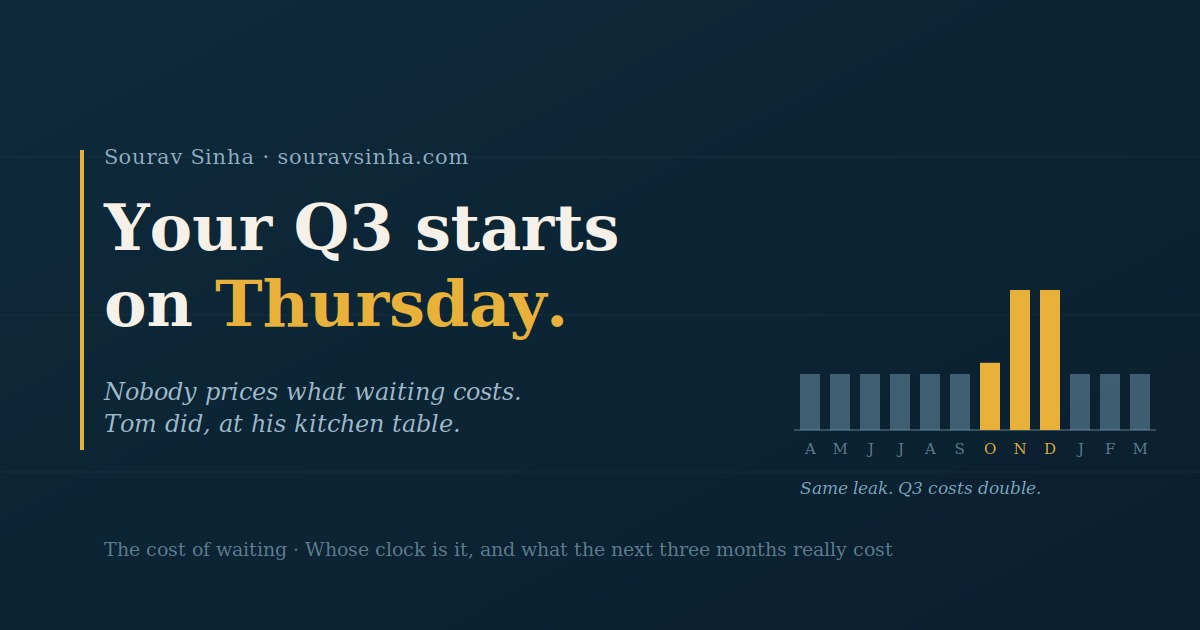
But October, November and December are not ordinary months. Tom pulled last year’s traffic. October ran at about one and a fifth times a normal month. November and December each ran at about two and a half times. Put those multipliers against the same leak, and the three months of Q3 weren’t worth three normal months of lost orders. They were worth a little over six.
Thirty-seven thousand pounds, instead of eighteen.
The same problem, left alone for the same three months, would cost roughly double, purely because of which three months they were.
And then Sam added the part that made Tom put his pen down. The timeouts weren’t random. They got worse under load. On one busy Saturday in September, the failure rate had jumped from one in forty to about one in fifteen for a couple of hours. On Black Friday, with several times the traffic, nobody could say how bad it would get. The honest answer was: at least double, and possibly a great deal more, at precisely the moment it would hurt most.
Then there was January. Waiting until January didn’t just mean living with the leak through peak. It meant doing the fix after Sam had gone, with someone who’d never touched the checkout, reading code they didn’t write, in a quarter when the business would already be explaining its year. The fix itself would take longer and cost more. The waiting would have made both halves of the problem more expensive: the leak, and the repair.
I want to be careful with the word “double,” because I’m about to lean on it. There’s no law of nature that says delay costs exactly twice as much. For some businesses, with flat traffic and no peak, waiting a quarter costs almost nothing, and they should wait. For others, it’s a great deal worse than double. Tom’s number happened to come out at roughly twice, on traffic alone, before load and before Sam’s leaving date. Your number will be different. The point isn’t the multiple. The point is that the price of the same problem is almost never constant across the calendar, and most people have never looked at which part of the calendar they’re about to wait through.
Whose clock is it?
What Tom worked out that Sunday, and what I think is the most useful thing in this whole story, was a way of telling the three voices apart.
Every one of them was urgent about something. The question was whose clock each urgency was running on.
The vendor’s urgency ran on the vendor’s clock. The discount expired because their quarter ended, not because anything in Tom’s business changed on the thirty-first of October. That’s the kind of urgency you can almost always afford to wait out. Nothing gets worse for you while their offer expires.
The CFO’s caution ran on a real clock, the change freeze, but it was protecting against the wrong risk. It priced the danger of touching the checkout, and it priced the danger of waiting at zero.
The leak itself ran on Tom’s own clock. It got worse every week that traffic rose, and it would get worse again the day Sam left. That’s the kind of urgency you can’t wait out, because the thing itself is deteriorating while you wait.
So the test Tom arrived at, which I’ve since borrowed and used more times than I can count, is a simple one. When someone tells you something is urgent, ask whose clock it’s running on. If the urgency belongs to the person selling to you, it’s usually safe to wait, and often smart to. If it belongs to your own systems, your customers, or the people who know how things work, you’re probably already late.
The meeting on Monday
Tom went back to the CFO on Monday morning with one page. Not a deck. One page, with the arithmetic on it, and a proposal that wasn’t any of the three options he’d been offered.
Not a replatform. He’d already replied to the vendor, politely, saying he’d look at modernisation properly in the new year, with a proper assessment first, and not before. He told me that sending that email felt oddly good, like refusing to be rushed by someone who wasn’t going to be there when it went wrong.
Not January either. January meant paying the peak price for the leak and then paying more for a slower fix without Sam.
Instead, a small, reversible fix, now, designed specifically so the CFO’s real worry, touching the checkout before peak, could be answered on its own terms.
The new address lookup would sit behind a switch that anyone on the team could turn off in seconds, putting every customer straight back on the old one. It would go live to ten percent of mobile traffic first, then half, then everyone, with a hard deadline: fully live by the twenty-first of October, which left ten clear days of watching it before the freeze on the thirty-first. If anything looked wrong at any stage, the switch went off and they’d wait until January after all, having lost nothing but a few weeks of effort.
And the part Tom was proudest of: Sam wouldn’t build it alone. The second engineer, Aisha, would build it with him, side by side, every line. By the time Sam left for Manchester, the person who knew the checkout best wouldn’t be leaving. It would be Aisha, and she’d have learned it the only way people really learn a system, by changing it with someone who already understood it.
The CFO read the page twice. He asked one question: “If this goes wrong on the twentieth of November, how long until it’s back the way it was?”
“About ten seconds,” Tom said. “We’ve tested it.”
The CFO signed it off before lunch.
October
I’d love to tell you it went perfectly. It nearly did.
The first ten percent went live on the fourteenth of October. Within a day, the timeout rate for that slice of customers dropped from one in forty to something too small to measure on a normal Tuesday. On the sixteenth, Aisha noticed that a handful of addresses in rural Scotland were being formatted differently by the new provider, which was upsetting the courier’s label printer. They turned the switch off for four hours, fixed the formatting, and turned it back on. Nobody outside the team ever knew.
That’s what a switch is for. It turns a potential disaster into a slightly irritating afternoon.
Everyone was on the new lookup by the twentieth, a day early. The freeze came down on the thirty-first with ten days of clean data behind it. Sam left on the fourteenth of November with a leaving card, a curry, and a checkout that someone else fully understood.
Black Friday
Tom watched the dashboard for most of Black Friday, the way you do. Traffic ran at several times a normal day. At the peak hour, the old address lookup would, by Sam’s September estimates, have been failing somewhere between one checkout in fifteen and one in ten.
The new one failed less than once in a thousand.
When Tom ran the numbers in January, the recovered mobile orders across the quarter came to a little over forty thousand pounds by his own reckoning, slightly more than his kitchen-table estimate, because peak load had been heavier than the year before. The fix had cost three weeks of two engineers’ time. And the thing that doesn’t show up on any spreadsheet: in January, when the business started its proper modernisation assessment, the person leading the checkout workstream already knew the checkout inside out, because she’d rebuilt a piece of it in October.
The vendor emailed again in January too, as it happens. Different discount, same deadline language. Tom forwarded it to the assessment folder and got on with his day.
What Tom got right
It would be easy to take the wrong lesson from this and say: always act before peak. That isn’t what Tom did, and it isn’t what I’d tell you.
He said no to one urgent thing and yes to another, and the difference between them wasn’t how loud they were. It was whose clock they ran on, and what waiting would actually cost.
Here’s the method, stripped down to the parts you can use this week.
Write down the thing you’ve been putting off. Not all of them. The one that nags at you. There’s almost always one.
Ask whose clock it’s on. Does it get worse on its own as traffic rises, as load increases, or as someone who understands it gets closer to leaving? If yes, it’s on your clock. If the only deadline is somebody else’s offer or quarter end, it’s on theirs.
Price the wait, not just the fix. Take whatever it’s costing you in a normal month and multiply it by your own peak. Use last year’s traffic. For a lot of businesses, the next three months are worth considerably more than three normal ones. That multiplier is the real price of “we’ll do it in January.”
Split the fix. The choice is rarely between rebuilding everything now and doing nothing until the new year. There’s usually a small, reversible version you can do now, with a way to switch it off instantly, and a proper, assessed piece of work that belongs in the next quarter. Do the first before the freeze and plan the second calmly.
Check who’s leaving. If the person who understands the thing is going before the end of the year, the cheapest knowledge transfer you’ll ever get is having them fix it alongside someone who’s staying.
The honest caveat
Not everything should be done before Thursday. If you can’t make the change reversible, if you can’t test it properly in the weeks you have, or if your traffic doesn’t really spike, then waiting until the new year is often the right call, and I’d tell you so. A rushed change in October that breaks something in November is worse than the leak it was trying to fix. The CFO in this story was right to be nervous. He just needed the other half of the sum.
What I’d ask you to do
So here’s the offer, and it’s the same one I’d have made to Tom that Sunday afternoon.
Send me the one thing you’ve been putting off, and a rough idea of how your traffic moves over the next three months. I’ll price the cost of waiting for you, properly, the way Tom did at his kitchen table: what it costs if you leave it until January, what a small reversible fix before your freeze would look like, and what should honestly wait for a proper assessment in the new year. You’ll have it in writing within a week.
And if the answer is that it can wait, which it sometimes is, I’ll tell you that too. You’ll have lost nothing but an email, and you’ll go into the busiest three months of the year knowing the price of what you’re carrying, rather than finding out on Black Friday.
Your Q3 starts on Thursday. The cheapest day this year to fix the thing on your mind is probably one of the next two.

Recent Comments
Related blog posts
Nobody Owns It at 2AM
At half past one in the morning, Hannah's phone lit up on the bedside table with a notification from her bank. £18.50, paid to her own company. Tha
Read More
The Phone Isn’t India’s Story
This morning, before the second cup of coffee, I opened Twitter and read nine hundred words from a man I'd never spoken to. Carl Pei had posted an es
Read More
How to Read a Software Quote
Priya had two quotes on her desk and a decision to make by Friday. Priya isn't one person. Like Daniel from last week, she's a composite of CTOs and
Read More
Staff Augmentation vs Hiring: The Honest Guide Nobody Selling It Will Give You
Let me tell you about Daniel. Daniel isn't one person. He's a version of a manager I have sat across from dozens of times over the years, in Kolkata
Read More
The Most Valuable Thing a Vendor Can Do Is Say No
A few years ago a man came to us wanting to build a betting portal. He had a clear vision, real capital behind him, and every intention of spending it
Read More