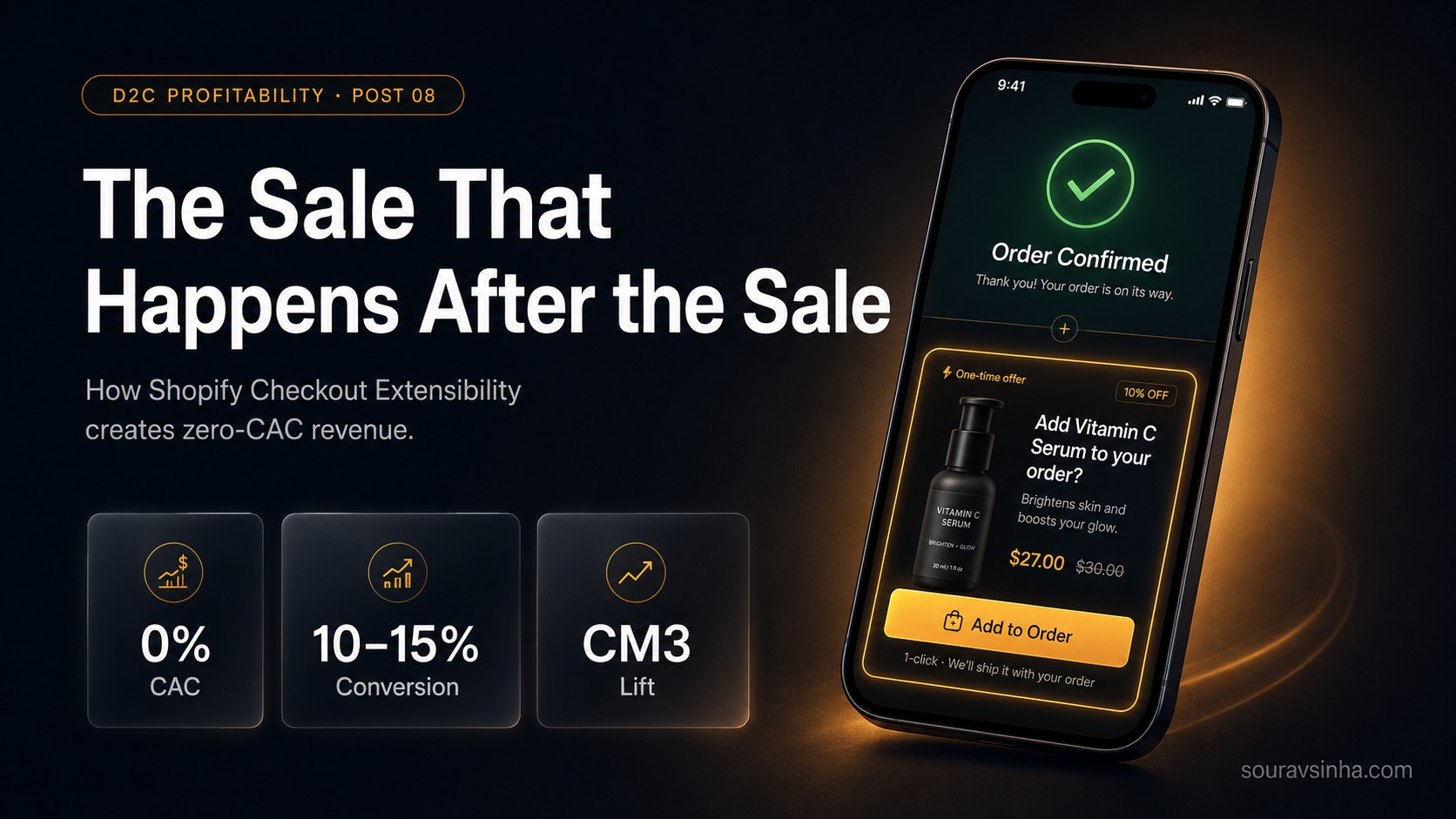
The Sale That Happens After the Sale
He had the creative dialed in.
Three years running a skincare brand out of Bengaluru, and he had finally cracked the short-form video formula that bigger labels spend lakhs trying to reverse engineer. Real skin, not airbrushed. Before-and-after content with actual customers, not models. His cost per click had been falling for four months straight and his conversion rate on the product page was sitting at 3.2 percent, which in his category is genuinely good.
But his AOV had not moved in two years. Every order was still going out at roughly the same ticket. When I looked at the numbers with him, the problem was immediately obvious.
He had built a perfect machine for getting people to buy one thing. He had never once asked them to buy two.
I asked him to walk me through what a customer sees after they complete a purchase on his store. He pulled up a test order on his phone. Payment confirmation. Shopify’s default thank-you page. Order number, delivery estimate, a link to return to the homepage.
I asked him: what is the highest-trust moment in your entire relationship with this customer?
He thought about it. “When they place a second order?”
It is not. It is the thirty seconds immediately after the first one goes through.
The window that closes before most brands notice it
There is a specific psychological state that exists in the moments immediately after someone completes an online purchase. The anxiety of the decision is gone. The credit card has been charged and the order accepted. They are not yet in delivery anxiety, because the product has not shipped. They are in a narrow window of pure satisfaction, fully engaged with the screen, waiting for the confirmation email that tells them everything went through correctly.
Compare it to every other channel you use to generate secondary revenue. An email sent three days after purchase lands in an inbox between a bank statement and a school circular. An SMS notification gets read while they are doing something else. A retargeting ad interrupts content they were trying to consume.
The post-purchase window asks for none of that goodwill. It does not interrupt. The customer is already there, already paying attention, already in a buying frame of mind. The decision to buy something more has the lowest possible activation energy it will ever have.
Most Shopify stores treat this window as administrative. Here is your order number. Here is your delivery timeline. Goodbye.
Why the cart is the wrong place to upsell
The instinct most founders reach for when they want to increase AOV is to add cross-sells inside the cart. A small panel that says “customers also bought” before the checkout button. Or a pop-up that fires when someone tries to leave the cart page.
I understand the logic. You already have someone deep in the funnel. Why not show them one more thing?
Here is what actually happens. A person who has decided to buy something is in a state of managed commitment. They have weighed the cost, justified the spend to themselves, made peace with the number on the screen. When you introduce a new product into that calculation, you are not adding a simple decision. You are reopening the entire negotiation they just finished having with themselves.
Some customers add the extra item. But a meaningful percentage of them, instead of adding, start subtracting. They look at the total. They recalculate. They decide the cart is getting expensive and they will come back. Sometimes they do. Most of the time they do not.
The post-purchase upsell removes this risk entirely. The primary order is confirmed, paid, and sent to your fulfilment backend. Nothing you say or do on the next screen can affect that transaction. A rejected offer costs you nothing. An accepted one is pure incremental revenue.
This is the only channel in your entire growth stack where a “no” carries zero downside.
What Checkout Extensibility actually changes
Until recently, building a post-purchase upsell experience on Shopify that was native, fast, and secure required patchwork. Third-party apps that loaded after the checkout sequence. Custom scripts injected into thank-you page templates. Solutions that worked until a Shopify update broke them, and then required frantic fixes at the worst possible time.
Shopify has deprecated all of this in favour of Checkout Extensibility. The architecture is different in a way that matters for brands at scale.
The upsell logic runs inside a sandboxed environment that executes independently of your storefront theme. It does not touch your Core Web Vitals. It does not slow your main site. It does not carry the performance tax that legacy checkout modifications used to impose. Your mobile page speed, which determines your search ranking and your paid media quality scores, stays clean.
More importantly, it connects directly to Shopify’s inventory ledger in real time. The single worst thing a post-purchase upsell can do is offer a product that is out of stock. The operational fallout downstream, the customer service tickets, the expectation failures, costs more than the missed upsell was ever worth. When inventory drops below a threshold you define, the system swaps the offer automatically. The customer never sees the gap. Your team never gets the email.
And the offer itself is not a guess. The post-purchase application reads what the customer just bought and makes a contextual recommendation based on the actual line items in that order. The person who just bought your face wash does not see a random product. They see the matching moisturiser from the same range. Relevance is not a bonus feature. It is the reason one-click attachment rates on a well-built post-purchase page are meaningfully higher than anything an email cross-sell campaign will ever deliver.
The math that makes this different from every other revenue lever
Every other growth initiative you run has a cost attached to it. Better ads cost more in creative and media. Better retention infrastructure costs in tooling and automation. A better PDP requires engineering and design time. These are worth it, and we have spent the previous posts in this series establishing exactly why.
Post-purchase revenue is structurally different. The customer was already acquired. The CAC for that transaction was spent the moment they arrived on your site from an ad, an organic search, or a referral. By the time they reach your post-purchase offer, that acquisition cost is fixed and sunk. Every rupee that comes in from a one-click upsell carries no share of that cost.
What this means in practice: a 10 to 15 percent post-purchase conversion rate on a product that costs you 35 percent of revenue to fulfil generates contribution margin at a rate your primary acquisition business cannot match. The revenue is real. The CAC allocation is zero. The CM3 improvement is direct and immediate.
If you have been building toward a 5:1 lifetime value to customer acquisition cost ratio, and that benchmark has been running through this entire series, post-purchase extensibility is one of the fastest structural moves available to close the gap. It does not require you to acquire more customers. It requires you to ask the ones you have already paid for whether they want one more thing.
The founder’s second number
He rebuilt the post-purchase experience over three weeks. One offer, contextually matched to the product just purchased, one-click authorisation using the payment credentials already on file.
The first month the system ran, his AOV moved from Rs. 1,240 to Rs. 1,490. Not from better ads. Not from a pricing increase. From a screen that used to say “order confirmed” and now says “while you wait, you might want this.”
The acquisition cost on those Rs. 250 increments is exactly zero.
He called me after the first month’s numbers landed. He said the same thing everyone says when this particular logic clicks into place: “Why did we not do this earlier?”
There is no satisfying answer to that question. The better one is: the next order is going out today.
This is post eight in the series on D2C profitability on Shopify. The earlier posts cover retailer margin costs, ad attribution, discounting’s hidden tax, store design, membership commerce, the 90-day retention flow, and the product page. If you have not read them, start from the beginning.
If you want to implement native Checkout Extensibility for your Shopify brand, Brainium builds this end to end.

Recent Comments
Related blog posts
How to Read a Software Quote
Priya had two quotes on her desk and a decision to make by Friday. Priya isn't one person. Like Daniel from last week, she's a composite of CTOs and
Read More
Staff Augmentation vs Hiring: The Honest Guide Nobody Selling It Will Give You
Let me tell you about Daniel. Daniel isn't one person. He's a version of a manager I have sat across from dozens of times over the years, in Kolkata
Read More
The Most Valuable Thing a Vendor Can Do Is Say No
A few years ago a man came to us wanting to build a betting portal. He had a clear vision, real capital behind him, and every intention of spending it
Read More
The Billion-Dollar SAP Blind Spot
I keep coming back to a number. 35,000. That's roughly how many SAP ECC customers exist globally, and by Gartner's count, less than 40% of them had ac
Read More
My Father Bought His Ticket 45 Minutes After the Match Started
On the 2nd of January 1988, India beat the West Indies in a one-day international at Eden Gardens for the first time ever on Indian soil. I was there.
Read More