How to Build a Shopify Membership Model Customers Actually Want
The launch numbers were good. Really good.
A supplements brand, clean formulations, strong community, founders who actually believed in what they were selling had rolled out “Subscribe & Save” on their Shopify store. Within the first six weeks, nearly four hundred customers had signed up. Monthly recurring revenue had a number against it for the first time. The team celebrated.
Twelve months later, they were at two hundred and twenty subscribers. The cohort had quietly halved. No dramatic cancellation spike, no bad reviews, no single moment they could point to. Just a slow, steady bleed.
When they came to us, the first thing they said was: “We don’t understand. The product works. The customers love it. Why are they leaving?”
We had seen this before. The product was not the problem. The model was.
The box in the basement
The standard “Subscribe & Save” model was built for convenience. In 2020, that was enough. But convenience is now a commodity. Every supplement brand on Shopify offers it. The 10% discount that once felt like a reward now feels like a transaction. And transactions, unlike relationships, end the moment a better price appears elsewhere.
What actually kills subscriptions is subtler than price. It is guilt.
A customer buys a protein supplement with genuine intention. They subscribe because they plan to be consistent. Then life happens. The pouch from last month is still half full. The new one arrives. Now there are two. A third is coming. At some point, the subscription stops representing a health goal and starts representing a failure to keep up with it. The easiest way to make that feeling go away is to cancel.
A fixed 30-day shipment interval does not know any of this. It just ships.
This is the structural flaw at the heart of the 2020 subscription model. It was designed around the brand’s logistics, not the customer’s life. In 2026, that gap is fatal.
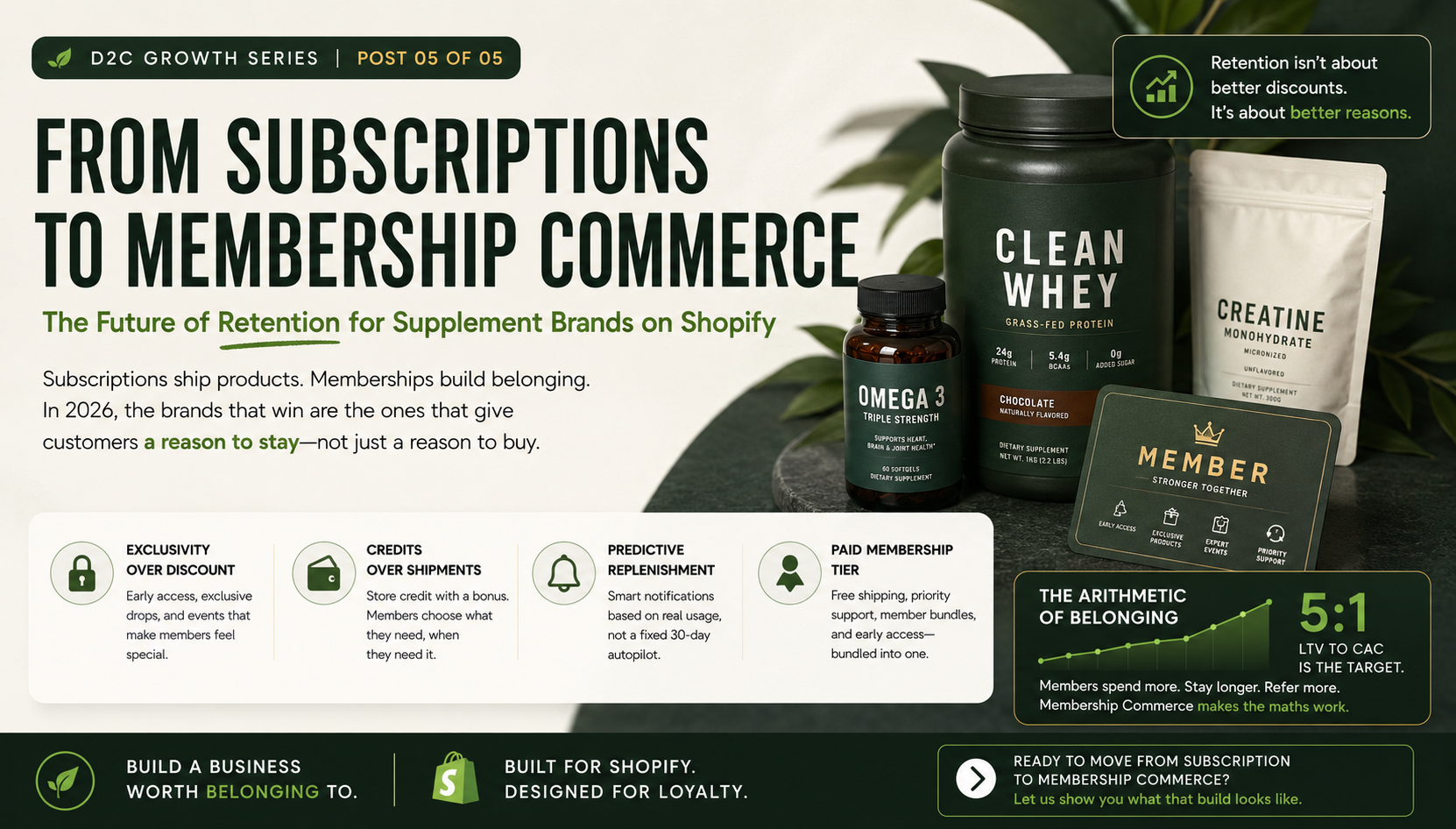
The future of retention on Shopify is not a recurring transaction. It is a recurring reason to stay.
What membership commerce actually means
Membership Commerce is not a rebrand of subscription. It is a different philosophy entirely. A subscription asks the customer to commit to a delivery schedule. A membership invites them into something worth belonging to.
The distinction matters because it changes what the customer is paying for. They are no longer paying for a product on a timer. They are paying for access, for status, for the feeling that this brand sees them as more than an order number. When you build that feeling into your Shopify architecture, churn stops being a logistics problem and becomes something you can actually engineer against.
Here is how it translates into real Shopify build decisions.
Exclusivity over discount
A 10% discount is forgettable. Early access to a new drop is not.
Shopify’s customer tagging system and Metaobjects let you build a genuinely gated storefront experience. Members see products before anyone else does. They get access to formulations or variants that are not available to the general store. They receive invitations to digital events, a live Q&A with the founder, a formulation walkthrough with the nutritionist behind the product.
None of this requires a new platform or a custom app. It requires a deliberate decision, at the theme level, about what your members see and when they see it. The technical lift is modest. The psychological effect on retention is not.
Credits over shipments
The box in the basement problem has a direct engineering solution: stop shipping a specific SKU on a fixed date and start giving members credit they can spend when they choose.
A member pays a recurring fee. That fee converts into store credit with a small bonus built in say, five hundred rupees a month becomes six hundred in credit. The member decides what to order and when. If they are well-stocked on protein, they spend the credit on something else from the range. If they need a double order one month and nothing the next, the credit accommodates that.
The guilt loop disappears because there is no unsolicited box. The relationship continues because the credit is already sitting in their account. This is not a workaround. It is a structurally superior model for any brand whose customers have variable consumption patterns which, in health and supplements, is almost every customer.
Predictive replenishment instead of autopilot delivery
The brands that will define D2C retention in the next three years are not the ones sending the most messages. They are the ones sending the right message at the moment it is actually useful.
Shopify’s data hooks let you track purchase patterns and model consumption timelines at the customer level. Instead of shipping every thirty days regardless of reality, you send a single “running low?” notification when your data suggests they are approaching the end of a product. A one-click refill from that message feels like attentive service. A box that arrives before the previous one is finished feels like being ignored.
The difference between these two experiences, at scale, is the difference between a brand people recommend and a brand people quietly unsubscribe from.
The paid membership tier
Amazon Prime did not win because it offered free shipping. It won because once you had paid for the membership, your brain stopped considering alternatives. Every search for a product began and ended inside the Prime ecosystem because leaving it felt like waste.
A paid membership tier on your Shopify store can replicate this lock-in without replicating Amazon’s infrastructure. Free expedited shipping, priority support, member-only bundles, and early access bundled into a single annual fee shifts the customer’s mental model from “should I reorder from this brand?” to “I have already paid to be here, so yes.”
The customer who has paid for membership is also the customer most likely to refer a friend. Not because of a referral incentive, but because membership creates identity. People recommend the things they belong to.
The arithmetic of belonging
We established in earlier posts in this series that a 5:1 LTV to CAC ratio is the only sustainable target for D2C in 2026. Membership Commerce is, at its core, an architectural decision to raise the numerator rather than endlessly fight the denominator.
A member spends more, stays longer, churns less, and refers more than a subscriber on a 10% discount. The maths are not close. The only question is whether your Shopify store is built to support this model or whether it is still running the 2020 playbook on a 2026 problem.
The supplements brand that came to us with two hundred and twenty subscribers did not need a better discount. They needed a better reason to stay. Once we rebuilt their retention architecture around membership logic rather than shipment logic, the bleed stopped.
The product had always been good enough. The model just needed to catch up.
This is the fifth post in my series on building a smarter D2C business on Shopify. The earlier posts covered why your retailer margin is costing you more than you think, why your ads might be lying to you, the hidden tax of discounting, and how to engineer a higher basket size without touching your traffic. Each one builds on the last.
If you want to move your Shopify store from a subscription model to a membership model, let us show you what that build looks like.

Recent Comments
Related blog posts
Your Q3 Starts on Thursday
Tom found the problem on a Tuesday in the last week of September, which, as it turned out, was about the most expensive week of the year to find anyth
Read More
Nobody Owns It at 2AM
At half past one in the morning, Hannah's phone lit up on the bedside table with a notification from her bank. £18.50, paid to her own company. Tha
Read More
The Phone Isn’t India’s Story
This morning, before the second cup of coffee, I opened Twitter and read nine hundred words from a man I'd never spoken to. Carl Pei had posted an es
Read More
How to Read a Software Quote
Priya had two quotes on her desk and a decision to make by Friday. Priya isn't one person. Like Daniel from last week, she's a composite of CTOs and
Read More
Staff Augmentation vs Hiring: The Honest Guide Nobody Selling It Will Give You
Let me tell you about Daniel. Daniel isn't one person. He's a version of a manager I have sat across from dozens of times over the years, in Kolkata
Read More
Great perspective. The real issue with “Subscribe & Save” is that it often trains customers to stay for the discount, not the relationship. Membership commerce feels like a stronger long-term play because it shifts the value from recurring transactions to recurring relevance access, experience, personalization, and belonging. That’s a much healthier foundation for retention on Shopify.