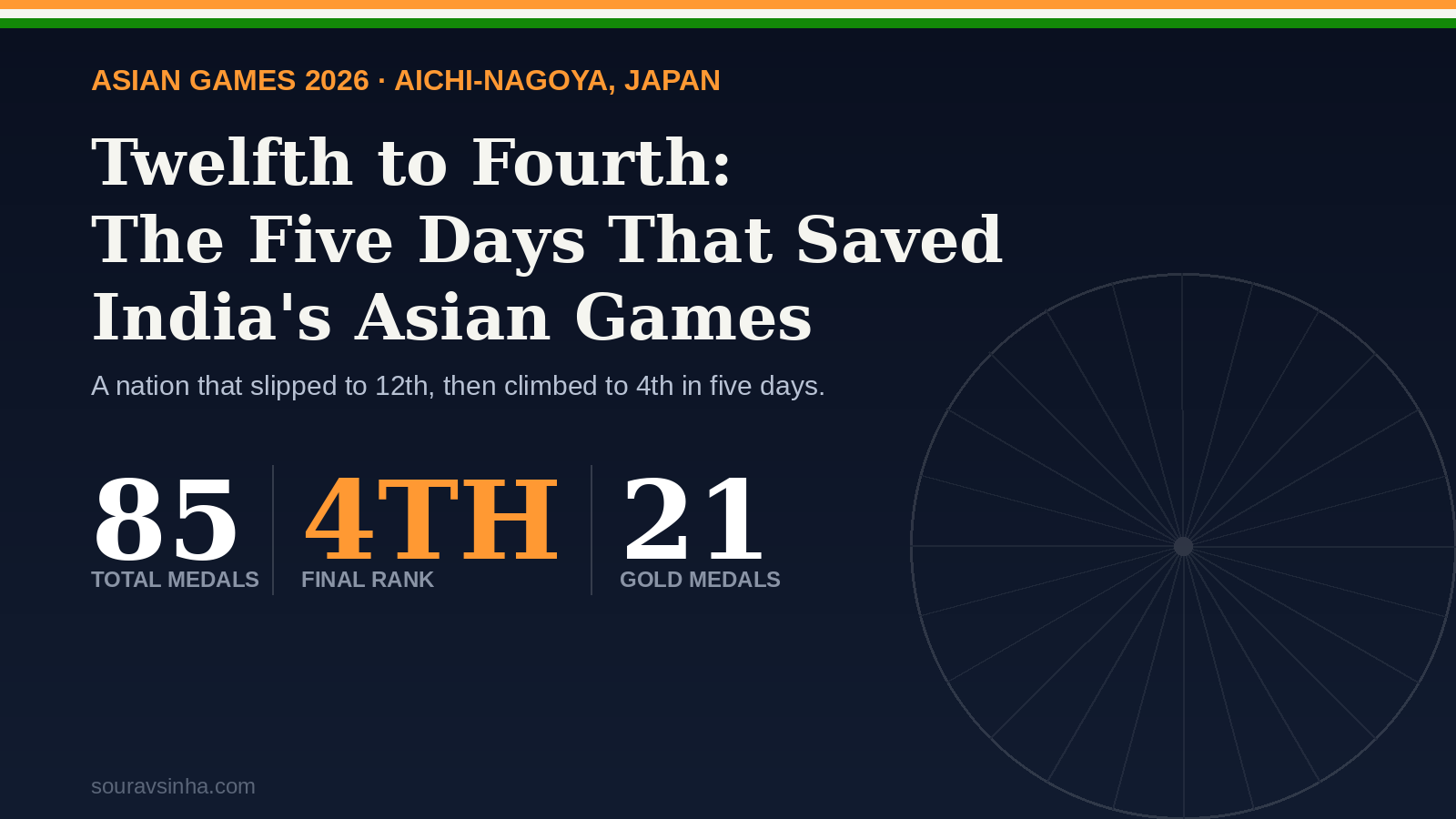
Twelfth to Fourth: The Five Days That Saved India’s Asian Games
Three weeks before the Aichi-Nagoya Games opened, I sat down and made a bet in public. I called the piece “The Fire Returns to Asia,” and in it I told anyone reading that India would land somewhere between 100 and 112 medals, that beating Hangzhou’s record of 107 was more likely than not, and that 24 to 30 golds was a coin flip tilting slightly in our favour. I was specific about the sports too. Archery would need five golds just to match Hangzhou. Shooting would dip from 22 medals to something closer to 15 or 18, with Manu Bhaker and Esha Singh carrying the discipline’s best gold hopes. Boxing, badminton, hockey, kabaddi and cricket would all be as strong as Hangzhou, maybe stronger.
I want to come back to that bet before this piece is done, because a prediction only means something if you’re willing to grade it afterward. But first, the story, because for nine days it looked like I’d badly misjudged the whole thing.
Nine days in, India sat 12th on the medal table. Twelfth. Behind Kazakhstan. Behind Chinese Taipei. For a country carrying the weight of a historic 107-medal haul from three years earlier, that number on the screen felt like a verdict nobody wanted to read out loud, and it felt like my own prediction piece had aged badly within a week of being published.
Shooting told the story first, and not the way I’d hoped. I’d written that the discipline would land somewhere between 15 and 18 medals, a managed decline from Hangzhou’s 22. The medals arrived roughly on schedule by the end, 15 in total, but the golds did not. Five days went by without a single one, and for a discipline carrying genuine world champions in pistol and rifle, that’s not a minor stumble. That’s a program built on some of the most consistent performers in the world failing to convert pedigree into podiums exactly when it mattered, and it set an uneasy tone for everything that followed.
Athletics was the sport where I got the direction right and the scale badly wrong. I’d expected the golds to dip from Hangzhou’s six, because losing Neeraj removes a certain gold and there’s no quietly replacing an Olympic and world champion. What I didn’t expect was for the dip to turn into a collapse. One gold against nine silvers and fourteen bronzes. Twenty four medals is not a small return, and in a strange way it matches the “respectable volume” I’d forecast. But a program that finds the podium twenty four times and the top step only once is a program that kept circling the thing it actually came for, and in the medal table that gets printed in the newspapers, that counts for a lot less than the number twenty four suggests.
Then there were the disciplines that simply didn’t show up at all. I’d grouped badminton with boxing, hockey, kabaddi and cricket as sports that would be as strong as Hangzhou or stronger. Three of those four calls held up completely. Badminton did not. It left with a single bronze, no gold, nothing close to what a growing talent base and real individual players on tour should have produced. Tennis left with nothing. Table tennis managed one bronze, same as badminton. For a country with real strength building in all three sports, that’s a hard set of results to explain away, and the honest answer is probably the one that applies to most underperformance at a multi-sport Games: the draw was unkind in places, the form wasn’t there in others, and sometimes the better athlete on the day was simply standing across the net.
Squash stings a little more than the others, because India has genuine pedigree here. The team events, where we’ve historically matched the best in Asia, came away with silvers and bronzes but no gold, and anyone who has followed Indian squash over the past decade knows that’s a shortfall against what the pipeline should be delivering.
Nine days of that, and 12th place stopped looking like an anomaly. It started looking like a fair reflection of how the Games were actually going, and like a fair rebuke of a prediction piece written three weeks earlier with more hope than evidence behind the headline number.
Then something changed, and it changed fast, in two bursts that will get replayed for years.
On October 2nd, India won six golds in a single day. The women’s hockey team ended a forty four year wait for gold. A teenager won India’s first ever women’s individual recurve archery title. Wrestling and boxing supplied the rest between them. India’s previous best single day at any Asian Games had brought three golds, at the Hangzhou 2022 Games. This doubled it, in one afternoon, and nobody saw it coming on the morning of October 2nd, least of all me.
The very next day, October 3rd, India delivered five more golds across five different sports, including Pranavi Urs’s historic individual golf gold, finishing fifteen under par across four rounds, with the team adding a silver alongside it. Two more Olympic quotas for LA 2028 were confirmed the same day. Archery finished the Games on top of its own medal table outright, five golds from nine total medals, exactly the number I’d said we needed just to match Hangzhou, and we didn’t just match it, we topped the discipline entirely.
Boxing and wrestling deserve to be read together, because they tell two versions of the same thing: a discipline doing better than it looked capable of nine days earlier. Boxing topped its own medal table outright, three golds and three bronzes, Lovlina Borgohain, Parveen Hooda and Ankush Panghal all winning on that one October afternoon, ahead of Uzbekistan and Kazakhstan, who each managed two golds. Wrestling’s tally reads smaller on paper, two golds from Aman Sehrawat and Sujeet Kalkal, two silvers, two bronzes, six medals in total, but it’s India’s best wrestling haul at any Asian Games since 1962, and it came from a squad that had already lost entire weight categories to pre-Games doping suspensions before a single bout was wrestled. Six medals out of a weakened squad isn’t a consolation prize. It’s a program finding a way to still show up.
Hockey deserves to be told as two separate stories, because the two golds arrived on two different days for two different reasons. The women’s gold on October 2nd carried the heavier historical weight, their first Asian Games title in forty four years, a result that says the program has crossed from promising to genuinely elite rather than merely improving. The men closed the Games on the final day, beating Malaysia 5-1, continuing a decade-long rebuild into a genuine force. Kabaddi matched both, with the men’s team beating Iran 40-34 and the women’s team beating Iran 37-34 in the same window, two golds exactly as I’d predicted, maybe the one call in this entire piece that aged perfectly. Cricket closed it out the way a cricket nation expects, the men beating Pakistan on the final day to defend their title, a result that was always going to dominate the headlines back home regardless of what happened in the other fifty plus disciplines competing for attention that week.
Final tally: 85 medals. 21 gold, 27 silver, 37 bronze. Second best haul in the country’s history, behind only the 107 from Hangzhou. Fourth place overall, exactly where we finished three years ago, with a smaller pile of medals to show for it this time.
Now here’s the number that matters more than the final count, and it’s the one that should actually decide how this Games gets remembered. Among Olympic program events specifically, the ones that carry weight into LA 2028, India won seventeen golds this time against twelve in Hangzhou. That gold haul now makes up 81 percent of India’s total golds, up from 43 percent three years ago. A separate but related number tells the medal story more broadly: Olympic events accounted for 72 percent of India’s overall medal count this time, up from 61 percent in Hangzhou, on a smaller base of 61 medals against 65. Fewer total medals from these events, in other words, but a sharply higher share of them turning into gold, and a sharply higher share of everything India won coming from the sports that actually matter for the next Olympics. That’s not a country winning less. That’s a country winning narrower and sharper, in exactly the direction that pays off two years from now.
So, back to the bet. I was wrong about the scale, not quietly wrong but wrong by a real margin. 85 medals against a floor I’d set at 100. 21 golds against a floor of 24. I called shooting’s decline roughly right in number and badly wrong in timing, I called athletics’ direction right and its depth badly wrong, and I called badminton’s strength with real confidence and no business doing so. But I was right about archery needing five golds to hold its ground, and we didn’t just hold it, we topped the table. I was right that hockey, kabaddi and cricket would be as strong as Hangzhou or stronger, and two of those three were stronger by a margin I hadn’t actually allowed for in the piece. The pattern, if there is one, is that I trusted the macro number more than I trusted the sports I actually know, and the sports I know came through while the top-line arithmetic didn’t.
The worry from these Games is obvious and I won’t dress it up. A team that needs nine days to find its rhythm at a multi-sport Games is leaving performance on the table early that a better prepared campaign would have banked before anyone started counting days. Shooting’s gold drought, the near shutout in racket sports, the missed depth in athletics, these aren’t footnotes to wave away with the archery and hockey golds that came later. They’re the actual homework for the next four years, and no prediction piece I write before LA 2028 should pretend otherwise.
The optimism is just as real, and it’s not the kind that needs rounding up to feel good. A country that can produce eleven golds across two days, more than half its final gold count inside forty eight hours, that can end a forty four year wait for hockey gold and open a new chapter in Olympic golf in the same week, has genuine, broad based strength across more disciplines than it’s had at any point since these Games began mattering to the national conversation. The quotas banked in hockey and archery mean LA 2028 starts with places already secured rather than qualification campaigns still to be run. That’s real value, locked in now, regardless of how the next two years of form go.
My own target for the next two editions of these Games is top three, and I’ll say plainly that it requires closing the gap in shooting, finding genuine depth in racket sports, and most of all finding the Aichi-Nagoya version of this team on day one instead of day eleven. The talent that produced the final five days clearly exists inside this contingent. The job now is building a program that doesn’t need to fall to 12th before it remembers how to find it, and writing a prediction piece in four years that trusts the sports I actually understand a little more than the headline number I want to be true.
LA 2028 is the next real marker. The quotas are banked. The harder work, closing the distance between the team that showed up for the first nine days and the one that showed up for the last five, starts now. And the next time I put a number in print before a Games begins, I’ll remember exactly how this one went.

Recent Comments
Related blog posts
Where the Men Fell, the Women Rose at Lord’s
It has been a wretched few weeks to be an Indian cricket fan. The kind of stretch where you stop opening the score updates because you already know wh
Read More
IPL 2020: Match day 10: Royal Challengers Bangalore Vs. Mumbai Indians
This IPL is different. Not only is the tournament being held amidst a global pandemic - the matches have been spectacular too. That two days in a row
Read More
IPL 2020: Match 9: Rajasthan Royals Vs. KingsXI Punjab
Sharjah is having the smallest ground amongst the 3 venues at this year's IPL. When Rajasthan Royals played Chennai Super Kings in their first match a
Read More
IPL 2020: Match 8: Kolkata Knight Riders Vs. Sunrisers Hyderabad
Sunrisers Hyderabad and Kolkata Knight Riders were two teams who had yet to open their accounts after the first 7 days in IPL 2020. Both were desperat
Read More
IPL 2020: Match 6: KingsXI Punjab Vs. Royal Challengers Bangalore
Kings XI Punjab snatched defeat from the jaws of victory in their last match. On the other side, Royal Challengers Bangalore won their inaugural match
Read More
Its Amazing