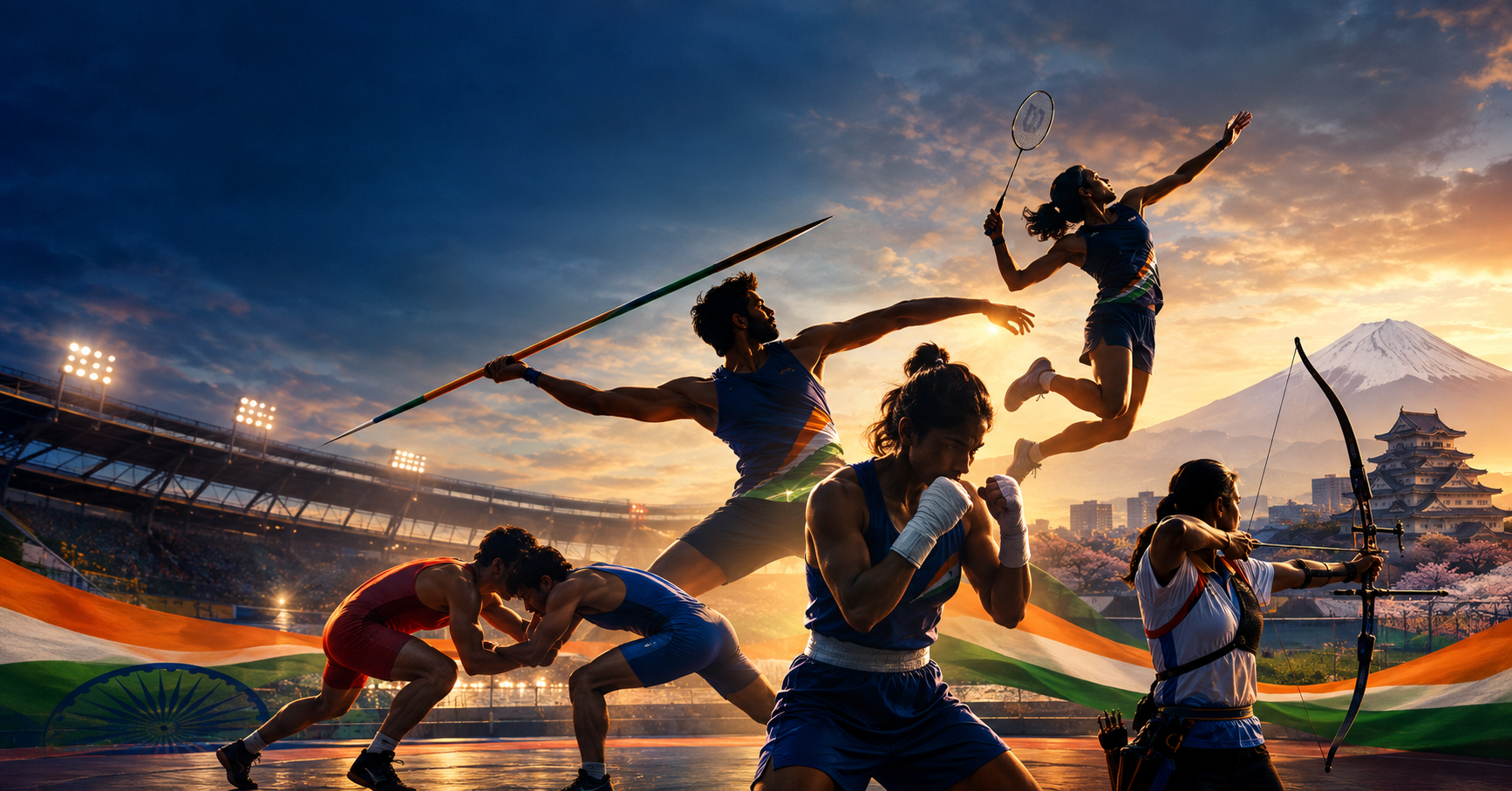
The Fire Returns to Asia: India’s Date with Destiny at Aichi-Nagoya
Tomorrow, the flame lights up again. On September 19, 2026, the Paloma Mizuho Stadium in Nagoya will host the opening ceremony of the XX Asian Games, and for the third time an Indian contingent will walk in carrying not just a flag but the weight of a number: 28. That is how many gold medals India won at Hangzhou in 2023, still the best campaign in the country’s Asiad history. The question every Indian sports fan is asking this week is: can we go past it?
Let me take you through this properly. History first. Then the state of Indian sport walking into Japan. Then, sport by sport, where the medals are actually going to come from, and where they might not. And finally, an honest number.
Where It All Began: An Idea Born at the London Olympics
The Asian Games did not begin in a boardroom in Lausanne or Kuwait City. It began with an Indian. At the 1948 London Olympics, Guru Dutt Sondhi, India’s IOC representative, proposed that Asian nations needed their own continental sporting stage, distinct from the Far Eastern Championship Games and West Asian Games that had come and gone between 1913 and 1938, disrupted by war and geopolitics. Sondhi’s proposal at London 1948 led China and the Philippines to meet on the sidelines, and out of that came a more inclusive competition. By 1949 the Asian Athletic Federation, soon renamed the Asian Games Federation, was formed, and India made the boldest move of all. It was India’s offer to host, made in February 1949, that actually set the wheels in motion.
So on March 4, 1951, at the National Stadium in New Delhi, 489 athletes from 11 nations gathered for what was officially called the First Asian Games, opened by Dr. Rajendra Prasad, India’s first President. Six sports were contested: athletics, aquatics, basketball, cycling, football and weightlifting, across 57 medal events. Boxing, ironically now one of India’s strongest medal sports, was considered but dropped that year. Nehru saw it as more than sport. Coming four years after Partition and independence, a fractured young nation needed a stage to announce itself, and a war-ravaged continent needed a reason to link arms rather than draw lines. That is the emotional DNA of these Games, something worth remembering every time we complain about a scoreline: the Asian Games were built as an act of unity, not just competition.
The administrative story that followed is instructive too. The Asian Games Federation ran the show from 1949 until it was dissolved in November 1982, when it was succeeded by the Olympic Council of Asia. That handover happened, fittingly, in New Delhi, which hosted the Games again in 1982. Since that modest beginning of 11 nations, the Asiad has grown into one of the largest multi-sport events on the planet, second only to the Olympics themselves. Aichi-Nagoya 2026 will host 46 nations and roughly 10,840 athletes across 469 events in 43 sports and 71 disciplines, a staggering leap from where it all started. This edition also marks the 75th anniversary of that original 1951 New Delhi Games. There is something poetic about that. Seventy-five years after India gave Asia this platform, India arrives as a genuine medal superpower on it.
India’s Long Climb: From 51 Medals to a Century
For decades, India’s Asian Games story was one of quiet consistency rather than dominance. India actually finished second overall at the very first Games in 1951, winning 51 medals, 15 gold, 16 silver and 20 bronze, behind only Japan’s 60. It remains India’s best-ever finish in the overall medal table. India briefly touched third place again at Jakarta 1962 with 10 gold, 13 silver and 10 bronze, and that stayed India’s last top-three overall finish until Hangzhou, six decades later.
What followed was a long, unglamorous middle period. India’s medal count crept from 51 in 1951 to 57 in 1982, then 65 at Guangzhou in 2010. The country was competitive in patches, brilliant through individuals like P.T. Usha, who finished with four gold and seven silver medals across her career, and Leander Paes, whose five golds and eight total medals came in tennis, and sprint legend Milkha Singh, who won four Asian Games golds, but never assembled the strength in depth to threaten the continental elite.
Then came the inflection point. Jakarta-Palembang 2018 was the first real step change, with India winning 16 gold and 70 medals in total. And then Hangzhou happened. Delayed a year by COVID and finally staged in 2023, a 655-member Indian contingent turned in a campaign for the ages: 107 medals, 28 gold, 38 silver and 41 bronze, comfortably beating the previous record of 70 from Jakarta. It was only the second time in India’s history, across the Olympics, Commonwealth Games and Asian Games combined, that the country had crossed the 100-medal mark in a major multi-sport event. India finished fourth in the overall standings, behind a dominant China (201 gold), Japan (52) and South Korea (42), and only four nations broke the 100-medal barrier that year.
Look at where those 107 medals came from, because it tells you everything about the engine India is bringing to Japan. Shooting was the standout, delivering an unprecedented 22 medals including seven gold. Athletics remained the single biggest overall contributor with 29 medals, six gold, 14 silver and nine bronze. India topped the medal table outright in archery, cricket, kabaddi and hockey, and history was made in badminton, where Satwiksairaj Rankireddy and Chirag Shetty won India’s first-ever Asiad gold in the sport, while Jyothi Surekha Vennam and Ojas Deotale each claimed three gold medals apiece in compound archery. Squash, tennis and equestrian rounded out the golden haul. Across the entire history of the Games, athletics remains India’s most decorated sport by a wide margin, with 85 gold, 102 silver and 96 bronze, 283 medals in total, followed by shooting on 80 and wrestling on roughly 65. And in kabaddi, the sport India essentially owns at the Asiad, the country has won eight of the nine editions since it was introduced in 1990, losing only once, to Iran at Jakarta 2018.
That is the mountain India built. Now comes the harder part: climbing it again, from a higher base, with a few pieces missing.
Aichi-Nagoya 2026: The Stage
This is the XX Asian Games, officially returning to the traditional four-year cycle after the pandemic pushed Hangzhou from 2022 into 2023. Nagoya becomes the third Japanese city to host after Tokyo in 1958 and Hiroshima in 1994. The motto, “Imagine One Asia,” runs from the opening ceremony on September 19 through closing on October 4, though competition in several disciplines, soft tennis, teqball, women’s cricket, actually started before the ceremony itself. Forty-three sports will be staged across 53 venues, some outside the main host prefecture entirely, making the real competition calendar considerably longer than the official 16-day window.
For India, the numbers on the ground are: this is India’s twentieth appearance at the Games, with a contingent of 503 athletes, competing across 36 sports. Genuinely large squads have gone in shooting, hockey and cricket.
There is also a bigger stake attached to this edition than mere medal count. Both the men’s and women’s hockey tournaments in Aichi-Nagoya double as continental qualification events for the LA 2028 Olympics, with tournament winners securing direct qualification. That turns Harmanpreet Singh’s men and Salima Tete’s women into something more than gold-medal contenders. They are playing for a ticket to Los Angeles.
The Elephant in the Room: No Neeraj
India’s single biggest, most reliable gold medal of the last two Games will not be available this time. Two-time Olympic medallist and two-time defending Asian Games javelin champion Neeraj Chopra will miss Aichi-Nagoya entirely because of an ankle ligament injury. Chopra had won gold at both Jakarta 2018 and Hangzhou 2023 and was chasing a third straight title; he ended his 2026 season after the ligament tear during training, removing what was arguably India’s single most dependable gold-medal certainty.
This is not a small thing to wave away. Neeraj is not just a medal, he is a guaranteed gold, the kind of banker every ambitious medal tally needs. His absence means athletics has to find that gold elsewhere, and the honest picture is that nobody in the current javelin field, or arguably in Indian track and field as a whole, carries his individual certainty. The strongest remaining gold prospect in athletics is now the long jump, where both Murali Sreeshankar and Ancy Sojan enter as the Asian leaders this season. Beyond that, hopes rest on strong-but-not-certain names: steeplechaser Avinash Sable, 5000m specialist Parul Chaudhary, sprinters and race walkers who can win a medal but the gold is not assured the way Neeraj’s was.
The Doping Cloud
The second uncomfortable truth, is that India’s preparation has been messier than Hangzhou’s. By early September, twelve Indian athletes had failed dope tests or been provisionally suspended since the Glasgow Commonwealth Games, spanning four weightlifters, two judokas, a shooter, a rower, two wrestlers, a distance runner and a wushu competitor. Wrestling took the heaviest direct hit, losing quota places in men’s 86kg freestyle, 130kg Greco-Roman and 67kg Greco-Roman, and shooting lost Gaurav Mansoori from the 10m air pistol event after a failed dope test, forcing a late reshuffle. None of this should overshadow the athletes who have done things right, but it is a real dent in depth, particularly in wrestling, a sport India has traditionally mined for reliable medals.
There is a redemption story buried in this too, and it is worth knowing because it will matter when you watch the mat this month. Aman Sehrawat, India’s brightest current wrestling star, was actually banned by the Wrestling Federation of India for a full year after a weight violation at the 2025 World Championships, a suspension that on paper would have run right through the start of these Games. The federation lifted that ban early in November 2025, and Sehrawat responded by winning his weight category comfortably at the national trials in June 2026 to book his Asiad ticket. That is a genuine comeback story, and it is exactly the kind of narrative that makes these Games worth following as a fan, not just a scoreboard-watcher.
Where the Medals Will Actually Come From: A Sport-by-Sport Reading
Shooting. Hangzhou’s 22 medals from shooting, seven of them gold, was the single biggest driver of India’s record tally. This time the squad is different in composition but not in ambition. India has sent 30 shooters to Aichi-Nagoya, 12 in shotgun and 18 in rifle and pistol, competing across 27 medal events, headlined by Manu Bhaker, Rudrankksh Patil, Suruchi Singh and Esha Singh. There are notable absences: Hangzhou gold medallist Sift Kaur Samra, Paris 2024 medallists Sarabjot Singh and Swapnil Kusale, and reigning air pistol world champion Samrat Rana are all missing from this squad. The realistic read is that China remains the dominant force, having topped shooting’s medal table at the last twelve editions, and edged India in Hangzhou by seven medals largely because China won eight individual golds to India’s two, Palak Gulia and Sift Kaur Samra. The honest expectation this time is a slightly smaller but still substantial haul, something in the range of 15 to 18 medals rather than the full 22 of Hangzhou, with Manu Bhaker and Esha Singh as the sharpest individual gold prospects.
Athletics. Track and field delivered India’s largest medal haul of any sport at Hangzhou, 29 medals, and remains central to any assault on the century mark this time. Without Neeraj, the gold count here will almost certainly dip from six, but the depth built over the last Olympic cycle, in race walking, middle distance, throws and long jump, should keep the overall medal volume respectable even if the top step is harder to reach.
Archery. Archery produced five golds among India’s nine medals at Hangzhou, built almost entirely on compound dominance. This year the squad has been deliberately, refreshed. Defending champions Ojas Deotale in the men’s compound individual and mixed team missed selection entirely, finishing fifth in the trials, and Olympians Deepika Kumari and Atanu Das were also left out of the Games squad despite remaining in World Cup plans. What remains is still formidable: world No. 3 Jyothi Surekha Vennam leads the women’s compound squad after her triple-gold haul at Hangzhou, and the women’s recurve pairing of Ankita Bhakat and Kumkum Mohod recently upset China for gold at the Shanghai World Cup, a genuine signal of strength. Given India swept compound archery at Hangzhou, expectation is: anything under five golds here would count as falling short of India’s own new standard.
Wrestling. The mat has taken the worst of the pre-Games turbulence, losing three Olympic-weight quota places to doping cases. Yet the headline story is Aman Sehrawat’s return, alongside Asian Games silver medallist Deepak Punia and World No. 1 Sujeet Kalkal leading a squad that is smaller in numbers but still carries real individual quality, particularly on the freestyle side.
Boxing. India’s boxers land in Japan fresh off a record-breaking Commonwealth Games campaign, ten medals, seven gold and three silver, with Olympic medallist Lovlina Borgohain and CWG champion Sakshi Chaudhary leading the squad. This is arguably India’s best-form sport walking into the Games and a realistic multi-gold source.
Badminton. The men’s team fields Lakshya Sen, Ayush Shetty, HS Prannoy, Kidambi Srikanth and the reigning Asiad doubles gold medallists Satwiksairaj Rankireddy and Chirag Shetty, while two-time Olympic medallist PV Sindhu headlines the women’s challenge. Satwik-Chirag defending their historic doubles gold is one of the storylines of the Games.
Hockey. Harmanpreet Singh leads the men as defending champions, Salima Tete captains the women, and both are chasing gold not just for the podium but for direct LA 2028 qualification, which raises the intensity considerably.
Kabaddi and cricket. India defends titles in both men’s and women’s kabaddi and both cricket competitions, with Shreyas Iyer leading the men’s cricket team, which includes teenage sensation Vaibhav Sooryavanshi, and Harmanpreet Kaur captaining the women’s side. Barring upsets, these are among the safest gold prospects in the entire contingent.
Weightlifting is anchored by Olympic medallist Mirabai Chanu leading a five-member squad, a smaller but focused unit chasing a podium finish in the 49kg category.
And do not sleep on the fringe sports. Squash, chess and kurash are being flagged as genuine strong medal opportunities, and squash carries a lovely subplot in Anahat Singh, returning after helping India to team and mixed doubles bronze at Hangzhou, now a more mature and dangerous competitor.
So, Can India Cross 28 Gold and 107 Medals?
The case for optimism is real. India’s shooting, badminton, boxing, hockey, kabaddi and cricket squads are all either as strong as Hangzhou or stronger. The stated official ambition is a second consecutive 100-medal haul, and independent assessments before the Games land in a 95 to 110 medal range as the realistic target. That range straddles the Hangzhou number almost exactly, which tells you the informed consensus is “similar total, harder gold count.”
The case for caution is equally real. Losing Neeraj removes a certain gold. The doping suspensions have quietly cost India entire weight categories in wrestling before a single bout has been fought. The archery squad has deliberately rotated out proven gold medal winners like Deotale, Deepika Kumari and Atanu Das for youth, a bet on the future that may cost golds in the present. And shooting, even at full strength, has never actually beaten China at the top of that particular table.
My projection: crossing 107 total medals is genuinely possible and, given the depth India has built across two Olympic cycles now, arguably more likely than not. Crossing 28 gold is the tougher ask. It requires archery to deliver close to Hangzhou levels despite fielding a newer squad, badminton and boxing to convert their current form into golds rather than minor-medal finishes, and at least one or two of the “second tier” sports, squash, wrestling, weightlifting, to overperform and cover for the certainty Neeraj used to provide alone. It is not a stretch to imagine India matching or nudging past 28 gold. It would be a mistake to assume it happens automatically just because the squad is bigger.
If I had to put a single number on it: somewhere between 100 and 112 total medals, and 24 to 30 gold, is where I expect India to land. Beating 28 gold is a coin flip that tilts slightly in India’s favour because of badminton and boxing’s current form; beating 107 medals is more likely than not because of the sheer breadth of the contingent across 36 sports.
What This Really Means
Numbers aside, here is the bigger picture worth sitting with. China will win this medal table by a distance that no other nation, India included, is realistically closing anytime soon; China’s 201 gold at Hangzhou alone was nearly four times Japan’s second-place total. That is not a knock on India, it is a reminder of scale, investment and decades of systemic sporting infrastructure that China has built. India’s real competition is with itself, with the version of India that won 70 medals in 2018 and then blew past 100 in 2023. The question worth asking on October 4, when the flame goes out in Nagoya, is not just “did we beat 28,” but “did the depth we’re building, the young archers replacing legends, the boxers riding Commonwealth Games form, the badminton bench three deep, actually hold up under pressure.” That is the real story of Aichi-Nagoya for India. The scoreline will tell you the result. The performances against expectation, especially in the categories where India walked in without its biggest names, will tell you whether this was a one-off peak or the start of a genuine golden era.
Either way, for the next sixteen days, keep the TV on early mornings IST. This is India’s best generation of multi-sport athletes yet, tested, for the first time in a while, without its most bankable gold medal in the squad.

Recent Comments
Related blog posts
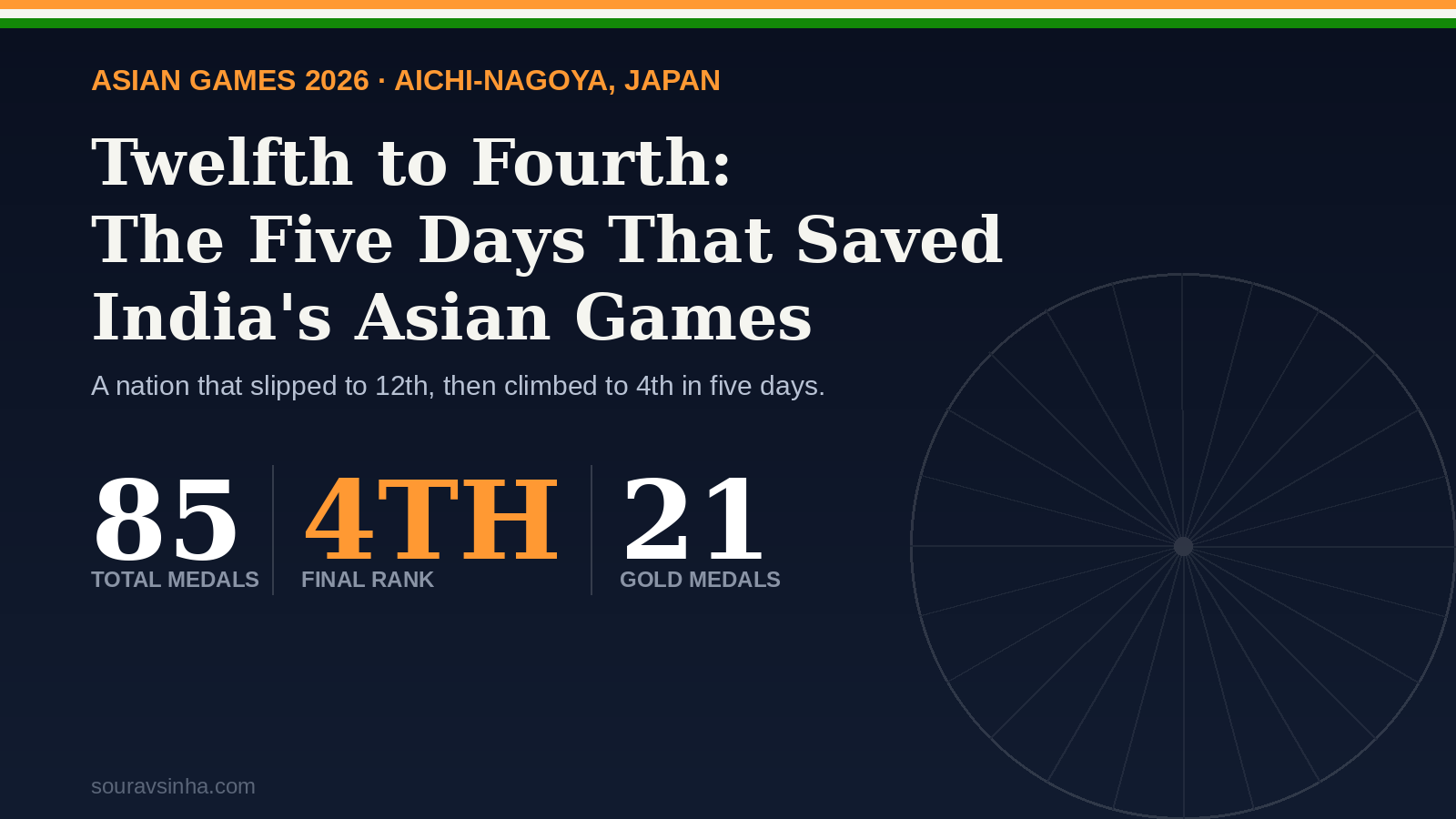
Twelfth to Fourth: The Five Days That Saved India’s Asian Games
Three weeks before the Aichi-Nagoya Games opened, I sat down and made a bet in public. I called the piece "The Fire Returns to Asia," and in it I told
Read More
India’s tryst with Olympics Glory
When I previewed the Indian contingent for Tokyo Olympics 2020, a few weeks back, I had a distinct hope that it would be India's best Olympics perform
Read More
London Dreams – India’s quest for Gold
As I write this, we are less than 24 hours away from the 2012 Olympics opening ceremony. As a sports enthusiast, I am excited. I am excited to see the
Read More