Where the Men Fell, the Women Rose at Lord’s
It has been a wretched few weeks to be an Indian cricket fan. The kind of stretch where you stop opening the score updates because you already know what they’ll say. And then, right at the bottom of it, a group of women walked out at the home of cricket and reminded me why I keep opening those updates in the first place.
Let me start with the pain, because there was plenty of it.
A fortnight of falling
First it was the women’s T20 World Cup. India went in as one of the favourites and walked out at the group stage, undone by South Africa and then by Australia in the final league game. That last match was at Lord’s, of all places. Harmanpreet Kaur smashed 56 off 27 and dragged India to 170, the highest total anyone had managed against Australia at a women’s T20 World Cup, and it still wasn’t enough. Ellyse Perry and Ash Gardner knocked off 171 without much fuss and knocked India out. Second World Cup running that we didn’t make the knockouts. For a side that lifted the fifty-over World Cup only last November, going home early in the shortest format has become a familiar wound. We are champions over fifty overs and strangers over twenty. That gap refuses to close.
While that was unfolding, the men were away in Ireland and England, and somehow they made the women’s exit look like a good day.
Ireland was meant to be the warm-up. The soft part of the tour. It turned into the opposite. India lost 2-0. Not just a series defeat after a long unbeaten run, but the first time in history that Ireland have beaten India in a T20I series. Debutant seamers most of us had never heard of ran through a batting line-up fresh off the flat, forgiving pitches of the IPL and suddenly clueless on a surface that moved. That was the first crack.
And there was a subplot the media had been building for weeks. Vaibhav Suryavanshi was supposed to be the story of this tour. Fifteen years old, the youngest player ever called up to a senior India side, Orange Cap and MVP at IPL 2026 with 776 runs at a strike rate most players can only dream of. This was billed as his coronation. Instead he carried the drinks through both Ireland games, then carried them through the first England match too, and by the time he finally got his debut at Bristol he lasted 15 off 10 before an Archer bouncer did him in. The most anticipated debutant in years, and India managed to make even that feel like an afterthought.
If Ireland was a crack, England was the collapse. A 4-0 drubbing. It wasn’t 5-0 only because rain washed out the opener, which is a strange thing to feel grateful for. Six completed matches on this tour, six defeats in a row, the longest losing streak the Men in Blue have ever put together in this format. And remember, this is the reigning T20 World Cup side. The same group hailed a few months ago as one of the finest T20 units ever assembled.
The management dropped Suryakumar Yadav, the man who lifted the World Cup, and handed the reins to Shreyas Iyer. Iyer has now won the toss again and again and won nothing else. Not one match under his captaincy. A new captain, a new plan, and a lot of questions that Gautam Gambhir and the selectors are going to have to answer, because you don’t dismantle a world-champion set-up and then lose to Ireland without owing everyone an explanation.
The salt in the wound came the day the England series ended. England climbed to the top of the ICC T20I rankings and pushed India down to second, ending a run at number one that had lasted more than 1,600 days, all the way back to February 2022. We were the best team in the world on paper for four and a half years. We ended this fortnight as the second-best team getting bowled out for 76 at Trent Bridge.
That was the ledger. All red ink. And then eleven women picked up a pen and started writing in a different colour.
The same turf, a different ending
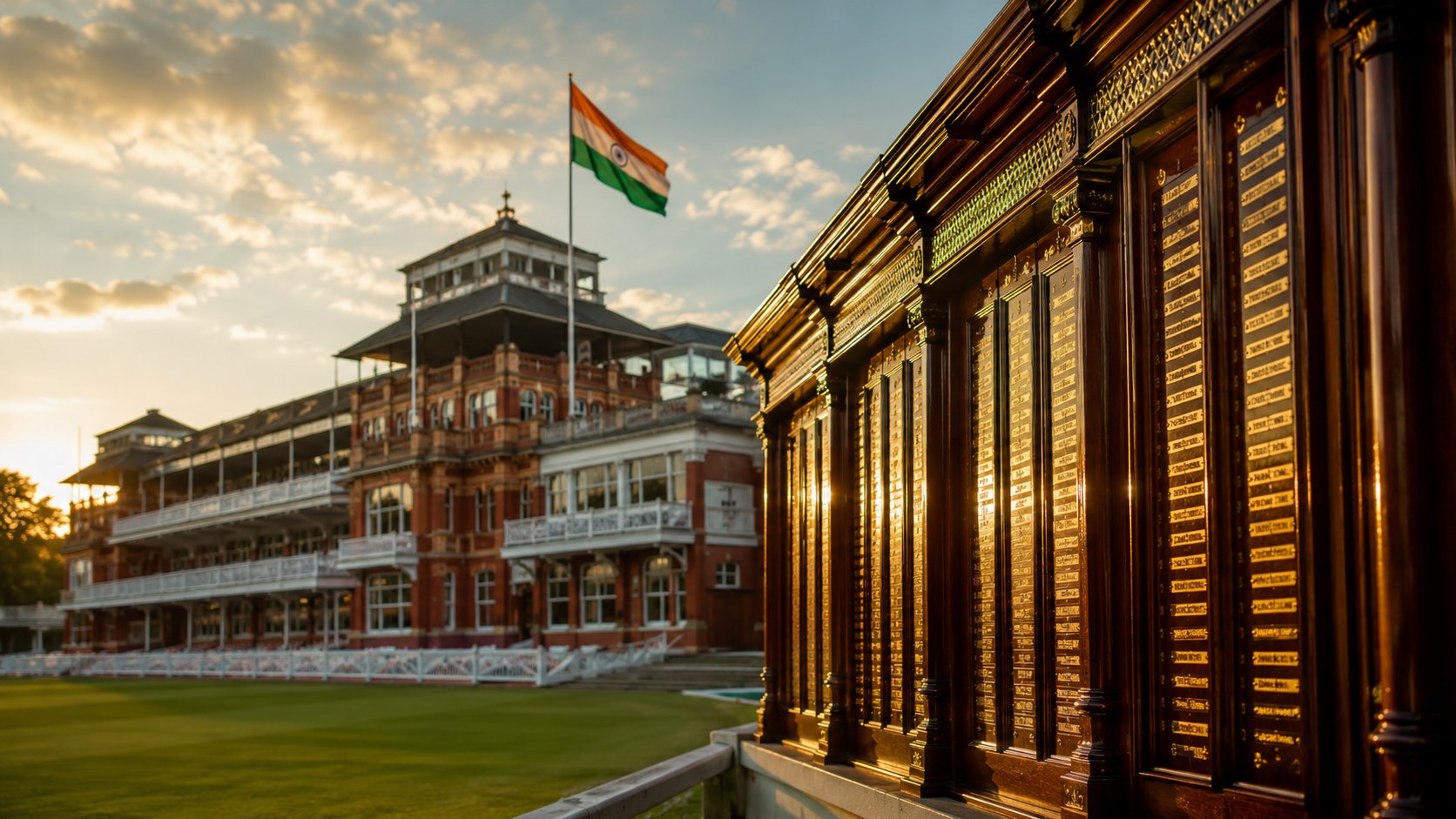
Here is the part that gives me goosebumps. The ground where India’s women were knocked out of the World Cup on the 28th of June was Lord’s. And the ground where they made history two weeks later was Lord’s. Same turf. Same dressing room. Same long walk out through the Long Room. The place that broke their hearts became the place where they became immortal.
For the first time ever, a women’s Test match was played at Lord’s. Fifty years, almost to the week, since Rachael Heyhoe Flint first led an England women’s side out at the ground, and it took half a century for the red-ball game to arrive at cricket’s most sacred address. England versus India. Test number 153 in the history of women’s cricket, and the first at the home of the sport.
The mood around India going in was gloomy, and I understood why. After everything the men had served up, and after the women’s own World Cup heartbreak, who was going to back this side? But I’ll be honest, I wasn’t as worried as most. This India team has always been better over the long format than the short one. The last time they played a Test in England, back in 2021, they held on for a draw. I thought they could compete. What I did not expect was that they would not just compete but demolish.
Four days that belonged to India
India batted first and put up 285, with Smriti Mandhana anchoring it on 83, Harmanpreet chipping in 58 and Deepti Sharma 57. A good total, not a great one. Then Kranti Gaud took over.
Gaud is 22, she bowls genuine pace, and on the second morning she ran through England’s top order to finish with 5 for 37. When she got her fifth, she became the first woman ever to have her name go up on the Test honours board at Lord’s. Think about that. A century of men’s names on those boards, and a young fast bowler from India got there first for the women. England folded for 170, with only Amy Jones offering resistance.
India could have enforced the follow-on and didn’t need to, because the second innings turned a strong position into an unassailable one. Mandhana made 70 to go with her 83, Richa Ghosh finished unbeaten on 50, and then Yastika Bhatia produced the innings of her life, a century, 113 runs, the first ever Test hundred by a woman at Lord’s. Two Indians on the honours board in the same match, one for the ball and one for the bat, at a ground that had never seen a woman’s name up there before. India declared on 341 for 7 and set England 457 to win.
Four hundred and fifty-seven. On this ground, in the fourth innings, that was never a chase. It was a sentence.
England had one flicker of defiance. Sophie Ecclestone, who had bowled her heart out for a eight-wicket match haul, then went and made a maiden half-century with the bat. A eight-for and a fifty in the same Test, and she still finished on the losing side, which tells you exactly how one-sided this was. On the fourth morning Sneh Rana wrapped it up, four wickets in the innings and six in the match, and India had won by 270 runs inside 95 minutes of play. The fourth-largest victory by runs in the history of women’s Test cricket.
Kranti Gaud took the player of the match award. Mandhana never got on the honours board, but her 83 and 70 were the spine of both innings, and she’ll know how much they mattered.
Where the men were found wanting, the women stood tall. A frustrated fan needed this. I needed this.
What the women reminded us
So here is where I land after this fortnight. The men have a reckoning coming, and they’ve earned it. You cannot drop a World Cup-winning captain, lose to Ireland, get swept by England, surrender your number one ranking, and expect the questions to go away. They shouldn’t go away. Accountability is the price of wearing that shirt.
But the same country that produced that collapse also produced the group of women who turned the very ground of their World Cup exit into the ground of their greatest triumph. That is the story I’ll remember from these weeks. Not the 76 all out. The 270-run win. Not the ranking we lost. The honours board we finally reached.
The men will get their chance to answer. The women already have.
Way to go, girls. You carried Indian cricket when it needed carrying the most.

Recent Comments
Related blog posts
My Father Bought His Ticket 45 Minutes After the Match Started
On the 2nd of January 1988, India beat the West Indies in a one-day international at Eden Gardens for the first time ever on Indian soil. I was there.
Read More
The Boy Who Lit Up the Season, and the Man Who Finished It
There are some seasons you watch waiting for the ending. And there are some seasons where the ending was always written, even if you didn't know it a
Read More
Can KKR Still Find a Way Into the IPL Playoffs?
There is a moment in every great sporting season where the narrative stops pretending it is not a story. Where the coincidences stop feeling random.
Read More
From Invincible to Invisible. And the Team That Still Won’t Play Its Ace.
There is a particular cruelty that only cricket can deliver. You spend eight weeks watching a tournament. You watch teams that were supposed to win f
Read More
When Bowlers Became Spectators. And Fielders Became Comedy.
On April 25, two IPL matches produced 986 runs in a single day. Nine hundred and eighty-six runs. In one day of cricket. Across those two matches, 1
Read More