
The Billion-Dollar SAP Blind Spot
I keep coming back to a number. 35,000. That’s roughly how many SAP ECC customers exist globally, and by Gartner’s count, less than 40% of them had actually migrated to S/4HANA by the end of 2024. December 31, 2027 is when mainstream maintenance for ECC 6.0 ends. Extended maintenance buys another three years, until 2030, at a premium. After that, you’re running an unsupported ERP that touches finance, procurement, supply chain and manufacturing at some of the largest companies on the planet.
People have started comparing this to Y2K. I understand the instinct, but I’d frame it differently. Y2K was a fixed technical bug with a fixed technical fix. This is a forced re-platforming of enterprise data at a scale most CIOs have never had to think about, on a timeline they don’t fully control, into an architecture that punishes them economically for bringing along everything they’ve accumulated over twenty or thirty years.
That last part is where I think there’s a real, underappreciated business sitting for a company like Solix Technologies. Let me walk through why, and then let me tell you honestly where I think Solix will fumble it if nothing changes.
The migration math
Do the arithmetic on that 35,000 number. Roughly 14,000 organisations had migrated by end of 2024. Basis Technologies’ own adoption model, built from SAP and Gartner data, projects only about 57% of ECC customers will have completed the move by the time mainstream maintenance ends in 2027. That leaves somewhere between 15,000 and 20,000 enterprises worldwide who still have to move a live, mission-critical ERP system in the next few years, on a services market that is already tight on SAP-certified talent.
Now here’s the thing that most of the coverage misses. Nobody migrating from ECC to S/4HANA is doing a simple lift and shift of their entire database. And that’s not a technical inconvenience, it’s an economic constraint baked into the architecture itself.
Why HANA punishes hoarders
SAP HANA runs on in-memory computing. Data that used to sit comfortably on disk now competes for space in RAM, and RAM at enterprise scale is expensive in a way spinning disk never was. So the moment a company decides to move to S/4HANA, someone in finance is going to ask a very reasonable question: why are we paying premium infrastructure cost to keep twenty years of closed purchase orders, settled invoices and completed projects sitting in active memory?
A 30 TB legacy SAP database is not 30 TB of live, operational data. A meaningful chunk of it, often the majority, is dead weight retained mostly because someone, somewhere, is worried about a tax authority or a regulator asking for it seven years from now. Moving all of that into HANA makes no economic sense, and increasingly, CFOs are the ones saying so, not just the IT architects.
This is precisely the gap that application retirement and data archiving exist to close. Identify what’s actually needed for the go-forward system, archive the rest into a compliant, queryable, low-cost repository, and shrink the database that actually needs to move. Smaller database, faster migration, lower infrastructure bill, lower risk. That’s not a nice-to-have step in an S/4HANA project. For any enterprise with a genuinely old SAP footprint, it’s close to a prerequisite.
Where Solix actually sits in this chain
This is Solix’s home turf, and to be fair to them, they’ve built real product depth here. SOLIXCloud Enterprise Archiving covers database archiving, application retirement, file archiving and email archiving under one roof. Their retirement play doesn’t stop at ECC either, they’ve built out multi-system retirement across SAP satellites like BW, CRM, SRM and GTS, retiring them into a single governed archive with native understanding of SAP’s own archive object semantics through the Archive Development Kit and Information Lifecycle Management framework. That’s not a trivial thing to replicate. Understanding how SAP structures archive objects, and being able to retrieve that data years later in a form that satisfies an auditor, is domain expertise, not generic storage.
Their pitch is straightforward and it’s the right pitch: identify static and rarely used data before migration, archive it to the cloud, shrink the migration footprint, and cut cost, complexity and timeline all at once. If I were running Solix’s SAP go-to-market, I would not change this pitch. I would change how loudly and how often it gets made, and to whom. More on that later.
Why this isn’t a job for Snowflake or Databricks
I’d expect a smart CIO to push back here and ask why they wouldn’t just dump the historical data into Snowflake or Databricks and call it done. It’s a fair question, and the honest answer is that those platforms solve a different problem.
Snowflake and Databricks are built for analytical consumption, structured for querying at scale, optimized for feeding dashboards and machine learning pipelines. What they are not built for, natively, is SAP’s own retention semantics. An SAP archive object carries legal hold logic, country-specific retention rules, ILM-governed deletion schedules, and the ability to reconstruct a business document exactly as it looked inside the SAP transaction it came from, years after the source system is gone. A generic lakehouse can store the bytes. It cannot, out of the box, guarantee an auditor that a purged record was deleted in line with a retention policy tied to a specific SAP archiving object and a specific regulatory clock.
That distinction sounds like a technicality until you’re the general counsel of a company facing a compliance audit or an eDiscovery request, and someone asks you to prove chain of custody on a decommissioned system. At that point, “we moved it to a data lake” is not an answer. “We moved it into a governed archive purpose-built to preserve SAP’s own retention and access semantics” is. That’s the wedge Solix should be driving, hard, in every conversation, because it’s the one place where the hyperscale data platforms genuinely cannot compete on their own terms.
The real prize isn’t the archiving project
Here’s where I think Solix should be far more ambitious than its current messaging suggests. An application retirement engagement is, by nature, a low-drama, back-office project. Nobody gets promoted for archiving old purchase orders. But it is also the single best Trojan horse into a much bigger enterprise data relationship.
Once Solix is inside an account, holding the retired, governed, compliant historical record of the enterprise, the natural next conversation is: now that this data is unified and accessible, what else can we do with it? Data governance. Sensitive data discovery and masking for privacy compliance. Feeding a genuinely AI-ready data fabric instead of a swamp of undocumented legacy tables. Solix already has products in this direction, Enterprise Content Services, Enterprise Data Governance, and their own Enterprise AI layer sitting on top of the Common Data Platform. The archiving engagement is the low-risk entry point. The governance and AI-readiness layer is where the account actually grows.
The mistake would be treating the S/4HANA cycle as a one-time services windfall. The right way to think about it is as thousands of enterprises opening their door for exactly one reason, cost reduction on a forced migration, and Solix having a limited window to prove enough value inside that door to earn a much larger, much stickier data relationship over the following years.
The ROI case
Enterprises don’t buy archiving because it’s elegant. They buy it because the numbers work, and here the numbers genuinely do work in Solix’s favour. A smaller migration footprint means a shorter, cheaper migration project. Fewer TB in HANA means lower ongoing infrastructure and licensing cost, every single month, for as long as the system runs. Retiring legacy applications outright removes maintenance, support and licensing spend on systems that exist purely to give someone occasional read access to old records, replacing an ongoing cost with a low, fixed archiving fee. And a properly governed archive removes compliance risk that, left unmanaged, shows up eventually as an audit finding or a legal exposure nobody budgeted for.
Stack those four together and you have a genuinely defensible ROI story that doesn’t need embellishment. That’s rare in enterprise software pitches. Use it.
Sizing the opportunity
I looked at several market sizing reports for structured data archiving and application retirement software, and I’ll be direct with you, they disagree with each other by an order of magnitude, some pegging the category at under a hundred million dollars globally, others at close to nine billion. That spread itself tells you something useful: this is still an immature, loosely defined category, which is actually good news for a specialist willing to define it clearly for buyers rather than bad news.
Let me build my own back of envelope instead of borrowing someone else’s number. Take the pool of roughly 17,000 to 20,000 SAP ECC customers who still need to migrate before the 2027 to 2030 window closes. Assume a meaningful minority, say 25 to 30%, have legacy databases large and old enough that a pre-migration archiving and retirement engagement is genuinely worth doing, rather than a nice-to-have. That’s somewhere between 4,000 and 6,000 realistic target accounts globally over the next four to five years. Price a typical engagement, software plus services plus the ongoing archive subscription, anywhere from $150,000 to over a million dollars depending on enterprise size. That puts a realistic, serviceable addressable opportunity for SAP-linked archiving and retirement work somewhere in the low single-digit billions of dollars, cumulative, over this cycle. Not the total category TAM you’ll find quoted in a vendor report, but the actual pool of accounts with a genuine, time-boxed reason to buy.
Solix’s own reported revenue is in the range of $7 million, on a base of around 585 to 594 employees. Set that against a multi-billion dollar addressable pool and the gap is not subtle. This is not a company that is short of opportunity. It is a company that has captured a rounding error of the opportunity in front of it.
What capturing even a sliver of this actually means for Solix
Let’s put a number on the upside, because I think this is where the opportunity really comes alive.
Take the low single-digit billions cumulative SAM I built above, call it $3 billion over the next four to five years as a round working number, sitting between my own conservative build and the more optimistic estimates floating around. Now ask a much less ambitious question than “can Solix dominate this market.” Ask: what happens if Solix simply captures 3 to 5% of it, nothing heroic, just a credible, well-executed share for a focused specialist going up against much larger incumbents.
Three percent of $3 billion is $90 million, cumulative, over four to five years. Spread that out, and you’re looking at an incremental $15 to 20 million a year layered on top of their existing $7 million base. That alone doubles or triples current revenue. At 5% capture, you’re at $150 million cumulative, roughly $30 million a year in new SAP-linked revenue, which puts Solix at four to five times its current size purely from this one cycle, before counting a single dollar of expansion revenue from governance, masking or Enterprise AI once they’re inside the account.
This is the part I want to underline. Solix does not need to win this market to be transformed by it. It needs to win a small, defensible slice of it, with discipline, and the company changes shape entirely. That is a far more achievable goal than the market-share fantasies most vendors chase, and it should be the number the leadership team is actually managing towards, quarter by quarter, account by account.
Solix versus OpenText
OpenText is the incumbent here, and it earns that position honestly, deep, certified integration with SAP ArchiveLink and ILM, decades of enterprise content management pedigree, and the comfort of being SAP’s own recommended archiving and document access partner. If a CIO wants the safest, most conventional choice, OpenText is it, and Solix should never pretend otherwise.
But “safest and most conventional” is also OpenText’s weakness. It’s a large, broad ECM platform where SAP archiving is one product line among many, built for the customer who wants everything from one vendor and is willing to pay for that convenience and that complexity. Solix’s honest USP is focus and speed: a company whose entire founding purpose, since 2002, has been enterprise data lifecycle management, purpose-built for this exact use case, without the weight of a sprawling content management suite around it. That should translate into faster deployment, a simpler commercial model, and pricing that doesn’t carry OpenText’s platform overhead.
Whether it actually does translate into that, in practice, on a real deal, is a different question, and it’s one Solix needs to be able to prove with hard numbers, not adjectives, in front of every CIO who defaults to “let’s just ask our SAP account rep who they recommend.”
Where Solix fits in the AI data supply chain
Before any of this legacy SAP data becomes fuel for AI, it has to move through a sequence: classify it, clean it, archive it, govern it, secure it, integrate it, analyse it, and only then apply AI to it. Solix’s strongest, most defensible position is squarely in the middle of that chain, archive, govern and secure. Their retirement and archiving products do that work today, at genuine depth, for SAP-specific data structures that generic platforms don’t understand out of the box.
Where I’d push them to be honest with themselves is the two ends of that chain. Classification and cleaning, the unglamorous front-end work of figuring out what data actually matters before you archive it, and analysis plus AI application, the glamorous back-end work everyone wants to talk about, are both areas where Solix has product ambition (their Enterprise AI and Common Data Platform pushes are clearly aimed there) but not yet the market credibility that IBM, Databricks or Snowflake carry in AI conversations. The right strategic posture is not to pretend Solix is an end-to-end AI platform. It’s to own the archive-govern-secure middle with total authority, and partner or integrate outward at both ends rather than trying to out-market companies with ten times the AI mindshare.
The limitations
A few things need saying plainly, because a company this size, chasing a cycle this large, cannot afford polite silence about its own gaps.
Solix is unfunded and has stayed that way since 2002. That’s either admirable discipline or a structural constraint on how fast they can scale sales and marketing to meet a decade-scale opportunity, and honestly it’s probably both. A ~$7 million revenue base against 585-plus employees, most of the headcount concentrated in India through what looks like a services and delivery-heavy model, tells me this is a company organised more for cost-efficient execution than for aggressive market capture. Their competitive set, per their own positioning, includes IBM, OpenText, Veritas, Commvault, Informatica and Precisely, tier-one vendors with sales and marketing budgets that dwarf Solix’s entire revenue. Product depth alone does not close that gap.
Being right in private helps nobody
I think that’s exactly Solix’s risk right now. The technology is genuinely differentiated for this specific moment in SAP’s history. The economics of the pitch are sound. The timing could not be more favourable, a hard deadline, a forced budget conversation, a CFO already primed to ask why the migration bill is so large. The upside math above is real, not aspirational marketing copy.
None of that matters if the sales motion stays where it currently appears to be, largely inbound, largely content-marketing-led, competing for attention against vendors ten times its size. The best product in the world, sitting quietly on a website waiting to be discovered, loses every single time to a mediocre product with a sales team already in the room. Winning this cycle needs an aggressive, account-based push directly at the 4,000 to 6,000 realistic target enterprises I estimated above, a serious channel and system integrator strategy so Solix rides alongside Accenture, Deloitte, TCS and the other large SI’s who are already inside these accounts running the migration, rather than trying to get discovered independently, and marketing that states the ROI and upside case in numbers a CFO and a board can defend, not adjectives a marketer likes.
The window here is not permanent. By 2030, most of this cycle will have played out, one way or another, for most of these 17,000 to 20,000 accounts. The company that wins isn’t necessarily the one with the best archive engine. It’s the one whose sales team is already in the room, with the CFO, before the CIO has finished writing the migration business case. Solix has the product to earn that seat, and it has a genuinely transformative revenue outcome waiting on the other side of even modest execution. Whether it earns that seat is now entirely a go-to-market question, not a technology question.
If you’re sitting inside Solix, inside a CIO’s office staring down this exact 2027 clock, or you think I’ve got a number wrong somewhere in this piece, I want to hear it. Argue with the math in the comments, or write to me directly. This is exactly the kind of conversation that’s more useful out in the open, before the decisions get made behind closed doors.
Disclosure: I hold shares in TechNVision Ventures, Solix’s parent company.

Recent Comments
Related blog posts
Staff Augmentation vs Hiring: The Honest Guide Nobody Selling It Will Give You
Let me tell you about Daniel. Daniel isn't one person. He's a version of a manager I have sat across from dozens of times over the years, in Kolkata
Read More
The Most Valuable Thing a Vendor Can Do Is Say No
A few years ago a man came to us wanting to build a betting portal. He had a clear vision, real capital behind him, and every intention of spending it
Read More
My Father Bought His Ticket 45 Minutes After the Match Started
On the 2nd of January 1988, India beat the West Indies in a one-day international at Eden Gardens for the first time ever on Indian soil. I was there.
Read More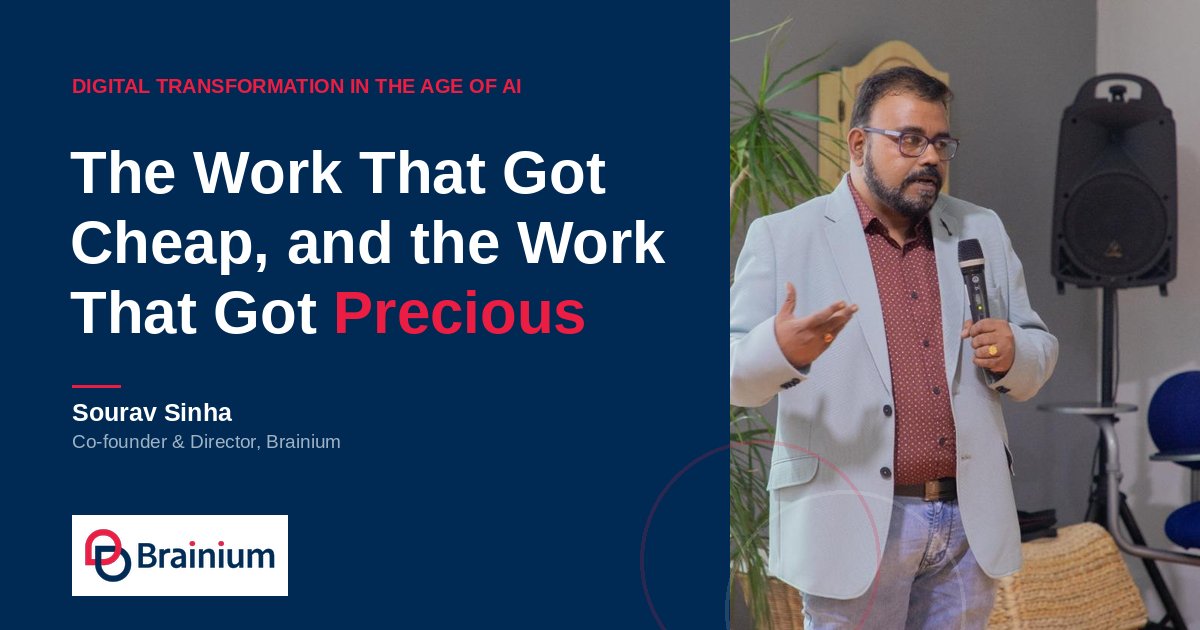
The Work That Got Cheap and the Work That Got Precious
Last week I gave a talk to a hall full of computer science students at Brainware University, and I opened it by telling them that most of what their d
Read More
From Loudon Street to a Garage in Ekdalia
What I learnt over coffee with the man who built Bhojohori Manna There are people who tell you their story and there are people who let you sit insid
Read More