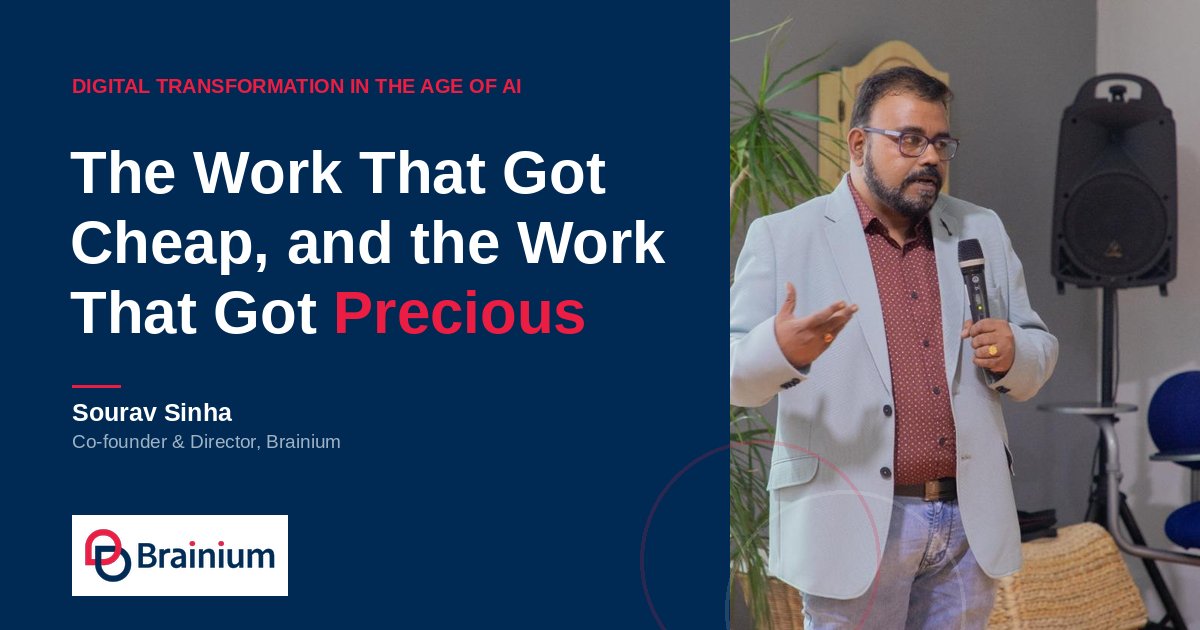
The Work That Got Cheap and the Work That Got Precious
Last week I gave a talk to a hall full of computer science students at Brainware University, and I opened it by telling them that most of what their degree is optimised for is getting cheaper by the month. Not the obvious way to begin a talk you have been invited to give, I know. But I did not travel there to reassure anyone, and reassurance is not what that generation needs from people my age.
I want to set out here the argument I made to them, because it is not really an argument about students. It is about all of us who work in and around technology, and it is about a shift I think we are collectively misreading.
Start with the invoice
The thing that first made me sit up was not a headline or a research report. It was my own P&L.
A few years ago we built a document processing system for a client. Four engineers, eleven weeks. Recently another client asked us for something functionally similar. Two engineers, under three weeks. Same company, better engineers, higher salaries, and a smaller invoice at the end of it.
Sit with that for a second, because the interesting part is not the speed. The interesting part is that the client did not get poorer and we did not get worse. What happened is that the price of writing software fell, and it fell faster than anyone in my industry has been willing to admit out loud.
I have spent twenty-seven years in sales. My whole working life has been spent watching what people are willing to pay for, and watching that list quietly change underneath everyone. And I will tell you, as the person who reads the bank statement on a Monday morning, that the list is changing right now faster than at any point since I started.
So the question I put to the students that afternoon is the one I want to put to you. It is not “will AI take my job.” That question is beneath all of us and it leads nowhere useful. The real question is this. When the making of software gets cheap, what gets expensive? Because whatever gets expensive is where you want to be standing three years from now.
The bottleneck moved
For most of my career, in this industry and in this city especially, the bottleneck was hands. If you wanted more software, you hired more engineers. That was the entire model of the Indian IT industry for thirty years. Bodies in, billing out. It was a good model and it made this country a great deal of money, and I have nothing but respect for what it built.
But when your bottleneck is hands, whoever can supply hands wins. And the bottleneck is no longer hands.
I told the students I have watched this happen four times before, which is why I am not panicking and why they should not either. The internet arrived and the bottleneck moved from distribution to attention. Offshoring matured and it moved from cost to coordination. Cloud arrived and it moved from infrastructure to architecture. Mobile arrived and it moved back to attention, sharper this time. And now AI arrives, and the bottleneck moves from production to judgment.
Every single time, the same thing happened. The people who mourned the old bottleneck lost. The people who ran at the new one won. And here is the part worth noticing, the part I lingered on with them. In every case the new bottleneck was less technical than the old one, not more. That should tell us something about where this is heading, and it is not where most of the anxious commentary assumes.
What we keep getting wrong about transformation
I spend a fair amount of my time reading annual reports, because I research and invest in small companies, and you develop a nose for the gap between what a firm says it is doing and what it is actually shipping. On the subject of digital transformation, that gap is enormous. Most of these programmes fail, and almost none of them fail for the reason people expect.
They do not fail because the technology did not work. They fail for reasons that have nothing to do with code, and this was the part of the talk I asked the students to pay the most attention to, because their syllabus will never cover it.
They fail because a proof of concept has no owner, no budget line, and nobody whose promotion depends on it, so it sits in a demo folder forever. A demo, I have learned the hard way, is not a product. A demo is a request for permission.
They fail because the organisation’s data is a disgrace, and AI is a magnifier. Point it at a mess and you get a faster, more confident mess.
They fail because the people running the programme measure themselves on uptime and accuracy, while the person who actually decides whether it lives measures herself on revenue, and nobody has ever shown her the connection between the two.
And they fail because the org chart eats the idea. The new system quietly makes someone’s job disappear, and that someone has been at the company nineteen years and knows exactly which meetings to be unhelpful in. I do not blame them. They are protecting their families. But if you design a transformation that asks people to volunteer for their own obsolescence, you have not designed a transformation. You have designed a conflict.
I told the students this next part on myself, because I think you earn the right to diagnose failure only after you have admitted your own. A while back we tried to move Brainium from a services business toward more platform work, and we picked an open source ERP as our way in. Sensible plan. We ran the pilot on ourselves first and gave every department a month to adopt it. Every department did, eventually, except one. Six months in, our accounts team still had not moved. They were happy with what they had and saw no reason to change. In the end we scrapped the whole programme.
Notice what failed there. Not the software. We had no vendor problem, no integration problem, no budget problem. We had one team that saw no reason to change, and this was inside my own company, where I could in theory just give the instruction. Now imagine that same dynamic inside a client with four thousand employees. Technology fails last. It fails only after ownership, data, incentives and politics have already failed, and then it takes the blame for all of them.
Being ahead is supposed to feel wrong
The phrase everyone reaches for is “ahead of the curve,” and most people use it to mean adopting new tools early. I think that is close to worthless. I know people who have tried every new AI tool within a week of launch for three years running and are no better off for it. Early adoption of tools is a hobby, not a strategy.
Being ahead of the curve means being positioned where value is going to accumulate, before it accumulates there, and staying put while it does. That is a positioning question, not a tooling question. And here is the uncomfortable part I made the students sit with. The curve is an adoption curve, which by definition means most people are on the wrong part of it, which means being genuinely ahead of it will feel wrong. It will feel like you are working on something slightly embarrassing that your friends do not understand yet. If it feels comfortable and validated, you are not ahead. You are in the middle.
So what actually gets precious as the making gets cheap? I gave them a few candidates, and I stand behind each of them here.
Taste, for one. When you can generate a hundred options in an hour, the scarce act is choosing. The ability to look at eight plausible outputs and know which one is right, and say why, is now worth more than the ability to produce any single one of them. Taste has quietly become a technical skill.
Accountability, for another. Somebody has to sign. When a system makes a decision that harms a customer, “the model did it” is not an answer that survives a regulator, a court, or a board. The person who can put their name under a system’s behaviour and defend it becomes structurally valuable, and that role cannot be automated, because the whole point of it is that a human is liable.
And deep domain knowledge. Not general knowledge, which is now abundant and nearly free. The specific, ugly, hard-won knowledge of how one industry actually works. How a jeweller really hedges gold. How a hospital actually schedules a theatre, as opposed to how the manual says it does. That knowledge lives in people’s heads and in badly written internal documents, and it is the last mile, and the last mile is where the money has always been.
The part I did not plan
I closed the talk with the honest version of career advice. Ship something real to a stranger, not another college project. Pick one industry and learn how the money moves in it. Learn to write, because muddled thinking now scales into confident nonsense at machine speed. Learn to say what your work does to someone’s number. And do not wait for clarity, because there is no year in which this becomes settled and calm. Every senior person you meet is also improvising. The ones who look composed have simply been improvising for longer.
Then something happened that was not in my notes, and it has stayed with me more than anything I said from the stage.
After the talk, a small group of students came up to me. Not the software engineering crowd, as I might have expected. The cybersecurity students. They wanted to talk about their career path specifically, where to point themselves, what was worth betting on.
I had spent a line or two during the talk telling that particular group that the attack surface is now expanding faster than any defence budget, because every organisation is shipping systems it does not fully understand, built partly with tools it does not fully control, on data it cannot fully account for. I had framed it as an opportunity rather than a crisis. And here they were, the ones who had heard that as an invitation rather than a threat.
That is the whole argument, and it walked up to me in a corridor. The people who will do well are not the ones waiting to be told their field is safe. They are the ones who hear “this is unstable and nobody has it figured out” and lean toward it instead of away.
So let me put the argument to you plainly, now that the students have gone home. AI has collapsed the cost of producing things. It has not touched the cost of knowing what is worth producing, and it has arguably raised it. Our education, and frankly a good deal of our industry, is still built almost entirely around the half that got cheap. The other half, judgment, domain depth, the nerve to own a decision, nobody is going to hand to us. But nobody is stopping us from building it either, and that is a far better position than most generations have been handed.
The students who walked up to me afterwards already understood that. I suspect they will be fine.

Recent Comments
Related blog posts
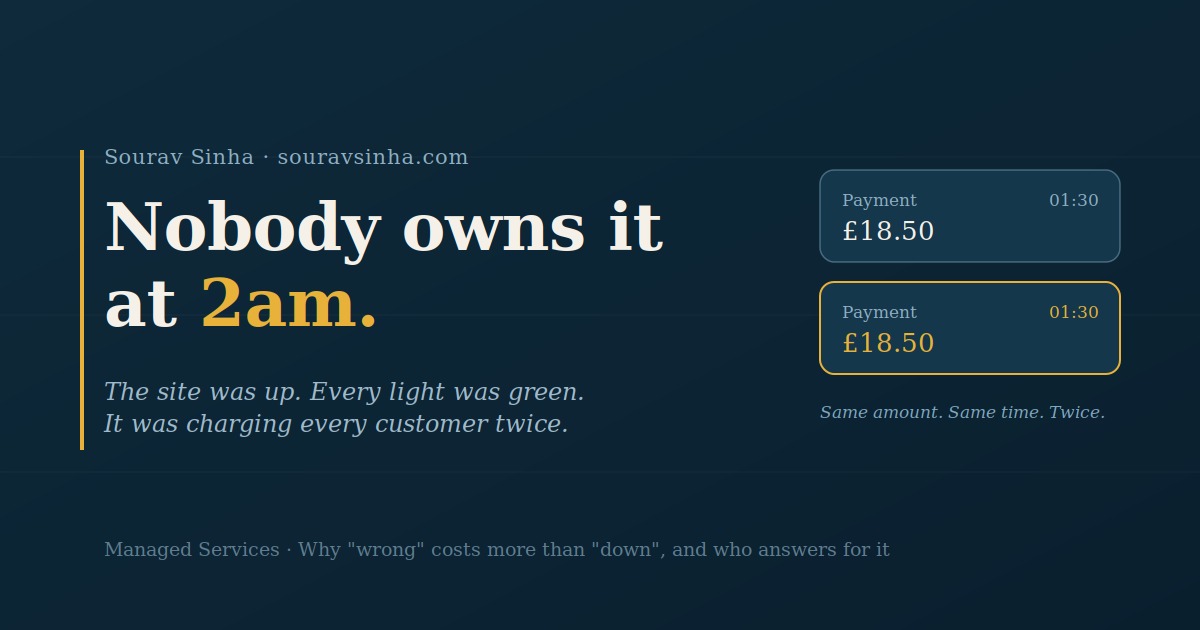
Nobody Owns It at 2AM
At half past one in the morning, Hannah's phone lit up on the bedside table with a notification from her bank. £18.50, paid to her own company. Tha
Read More
The Phone Isn’t India’s Story
This morning, before the second cup of coffee, I opened Twitter and read nine hundred words from a man I'd never spoken to. Carl Pei had posted an es
Read More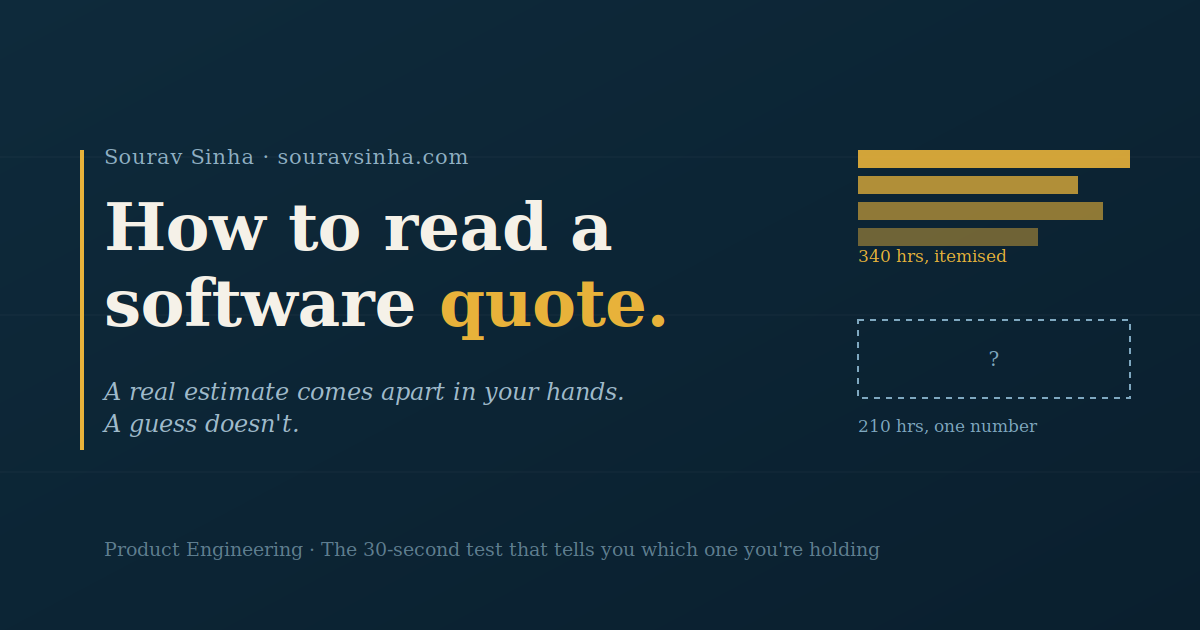
How to Read a Software Quote
Priya had two quotes on her desk and a decision to make by Friday. Priya isn't one person. Like Daniel from last week, she's a composite of CTOs and
Read More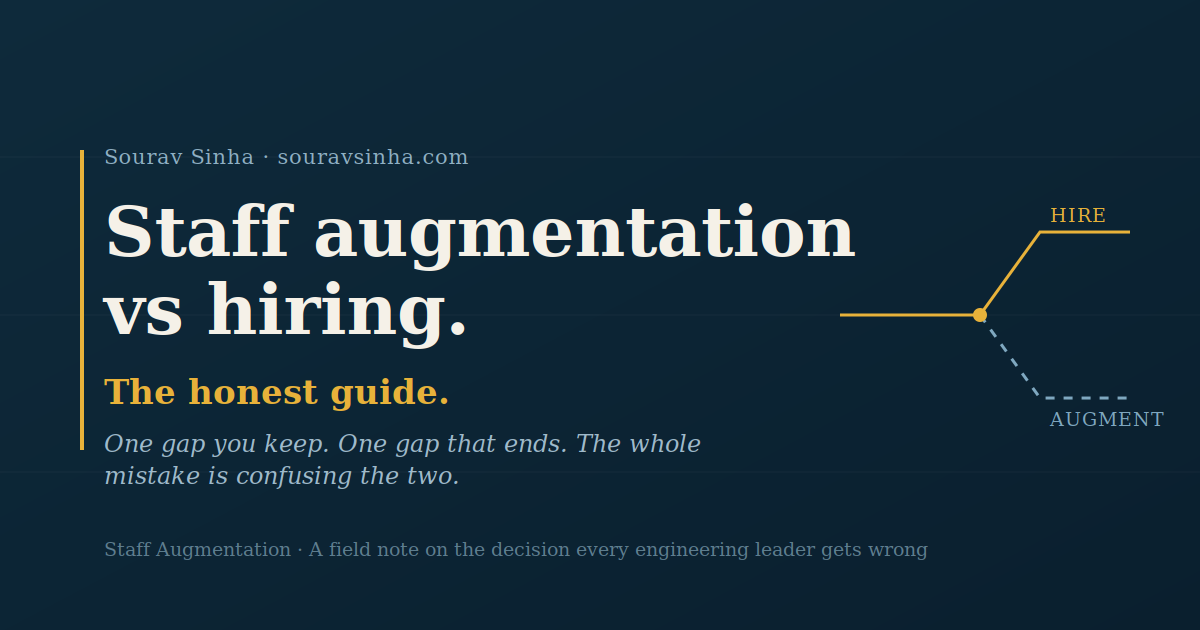
Staff Augmentation vs Hiring: The Honest Guide Nobody Selling It Will Give You
Let me tell you about Daniel. Daniel isn't one person. He's a version of a manager I have sat across from dozens of times over the years, in Kolkata
Read More
The Most Valuable Thing a Vendor Can Do Is Say No
A few years ago a man came to us wanting to build a betting portal. He had a clear vision, real capital behind him, and every intention of spending it
Read More