How to Design a Shopify Store That Naturally Drives Purchases
She had built something real.
Seven years on Amazon and Myntra. A skincare brand that had earned its reviews one customer at a time. A product that genuinely worked. When she finally launched her own Shopify store, she felt like she had arrived.
Three months later, she called us.
Her traffic was healthy. Her conversion rate was acceptable. But her cart abandonment had shot up and nobody could tell her why. She had installed four different apps trying to diagnose the problem. Her site had slowed down. Her customers were leaving with one item in their bag and not coming back.
“On Amazon,” she said, “people always buy more than they came for. On my site, they buy exactly what they searched for and nothing else.”
That sentence told us everything.
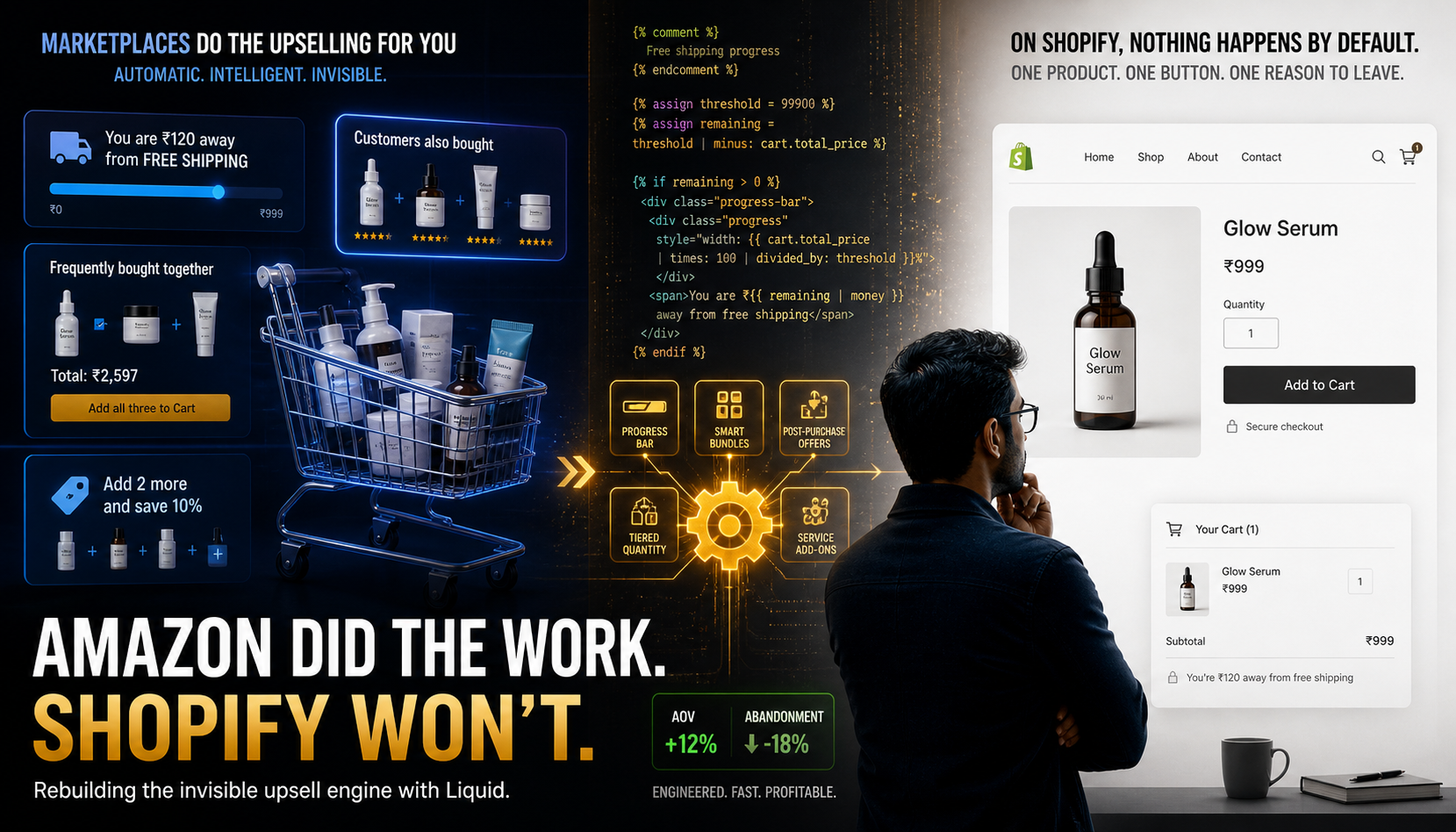
On Amazon and Myntra, the platform does the upselling for you. There is an entire engineering team whose only job is to make sure the customer leaves with a bigger basket. Bundles appear automatically. Progress bars fill themselves. The next logical product is always two scrolls away. The founder never has to think about any of it.
The moment you move to Shopify, that invisible hand disappears. And most brands never replace it.
The cart does not abandon itself. The customer simply sees a single product with a single “Add to Cart” button and no reason to do anything else.
What she needed was not another app. She needed her Shopify theme to do the work that Amazon had been quietly doing for years. And in 2026, Liquid and Shopify’s Checkout Extensibility give you everything you need to build it in.
The dynamic progress bar
A static banner that says “Free Shipping over ₹999” is wallpaper. Nobody reads it. But a cart that says “You are ₹120 away from free shipping” and updates in real time as items are added, that is a game.
Liquid can calculate the difference between cart.total_price and your shipping threshold at every cart update. The moment that gap closes to a small number, the customer’s brain shifts from “shopping” to “completing.” The perk stops feeling like a corporate policy and starts feeling like a personal challenge. The psychological distance between a static rule and a dynamic countdown is enormous and the engineering to close that gap is simpler than most brands think.
Intelligent bundling on the product page
The “Customers also bought” section on most Shopify stores is a graveyard of irrelevance. A wireless speaker next to a yoga mat. A face wash next to a protein shaker. These suggestions do not convert because they do not make sense.
Liquid lets you read the current product’s tags and collection before deciding what to surface. If someone is looking at your premium moisturiser, show them your toner and your SPF. Hard-code those associations in the theme logic itself. Place the block directly beneath the “Add to Cart” button, not buried below the fold.
The difference between a generic recommendation and a contextually logical one is not a bigger dataset. It is a cleaner decision about what belongs next to what. Make that decision once in your theme and let Liquid execute it on every page, every time.
The post-purchase moment
The moment a customer completes a purchase, something shifts. The anxiety of the decision is gone. The trust is at its highest point it will ever be. They are not guarding their wallet anymore.
Shopify’s checkout extensibility now lets you place a one-time offer on the “Thank You” page or the post-purchase intermediate page. The shipping address is saved. The payment method is saved. Adding one more item is a single tap. No re-entering of details. No additional friction.
A complementary product at a slight premium offered at this precise moment can lift your total order value by ten to fifteen percent across your entire store. Not through manipulation. Through timing.
Tiered quantity logic
For consumables, a serum, a supplement, a coffee blend, the repeat purchase is always coming. The only question is whether it comes from your store or a competitor’s the next time.
Liquid can detect how many units of a product are in the cart and respond accordingly. One unit triggers a message: add two more and save ten percent. This is not a discount in the traditional sense. It is a unit economics argument delivered at exactly the right moment. You ship three items in one box instead of one item in three separate orders over three months. Your margins improve. Your customer saves. Neither of you loses.
Services, not just products
Sometimes the fastest path to a higher AOV is not another product. It is a service wrapper around the product the customer has already chosen.
A Liquid toggle in the cart for eco-friendly packaging, gift wrapping, or priority processing, priced at a small premium, costs you almost nothing to deliver but contributes directly to your contribution margin. More importantly, it lets the customer feel like they are customising their experience. That feeling of control is itself a reason to complete the purchase.
Moving it into the engine
The brands that thrive are not the ones with the most apps. They are the ones who understood that the upselling logic belongs inside the theme, not bolted on top of it.
When you move these triggers from external apps into your core Shopify Liquid, you cut site bloat, you recover loading speed, and you create a path to profitability that does not depend on anything outside your own codebase.
The founder who called us three months into her Shopify launch did not have a traffic problem or a product problem. She had an engineering gap. Once we closed it, her basket size moved. Her abandonment rate fell. And she stopped comparing her Shopify store to Amazon as if Amazon had done her some special favour.
Amazon had not done her a favour. Amazon had done the engineering she had never had to think about.
Now it was hers.
This is the fourth blog in my series on building a smarter D2C business on Shopify. If you missed the earlier posts on why your retailer margin is costing you more than you think, why your ads might be lying to you, and the hidden tax of discounting — read them in order. This one makes more sense when you do.
If you want to engineer your Shopify store to do the work that the marketplace used to do for you, we can help.

Recent Comments
Related blog posts
Your Q3 Starts on Thursday
Tom found the problem on a Tuesday in the last week of September, which, as it turned out, was about the most expensive week of the year to find anyth
Read More
Nobody Owns It at 2AM
At half past one in the morning, Hannah's phone lit up on the bedside table with a notification from her bank. £18.50, paid to her own company. Tha
Read More
The Phone Isn’t India’s Story
This morning, before the second cup of coffee, I opened Twitter and read nine hundred words from a man I'd never spoken to. Carl Pei had posted an es
Read More
How to Read a Software Quote
Priya had two quotes on her desk and a decision to make by Friday. Priya isn't one person. Like Daniel from last week, she's a composite of CTOs and
Read More
Staff Augmentation vs Hiring: The Honest Guide Nobody Selling It Will Give You
Let me tell you about Daniel. Daniel isn't one person. He's a version of a manager I have sat across from dozens of times over the years, in Kolkata
Read More
Great perspective on how most Shopify stores overlook the post-purchase phase. Framing it as the missing “invisible hand” really highlights where real retention and loyalty are built. I like the shift from chasing new customers to designing better experiences after the sale. That’s where long-term growth actually happens.
Most founders obsess over building a “store”, not a system that actually sells.
If there’s no invisible hand shaping discovery, trust, and decisions, you’re not running commerce… you’re just hosting products.
[…] the earlier pieces on retailer margin costs, ad attribution, discounting’s hidden tax, and engineering your store to drive purchases naturally, go back and read them in […]