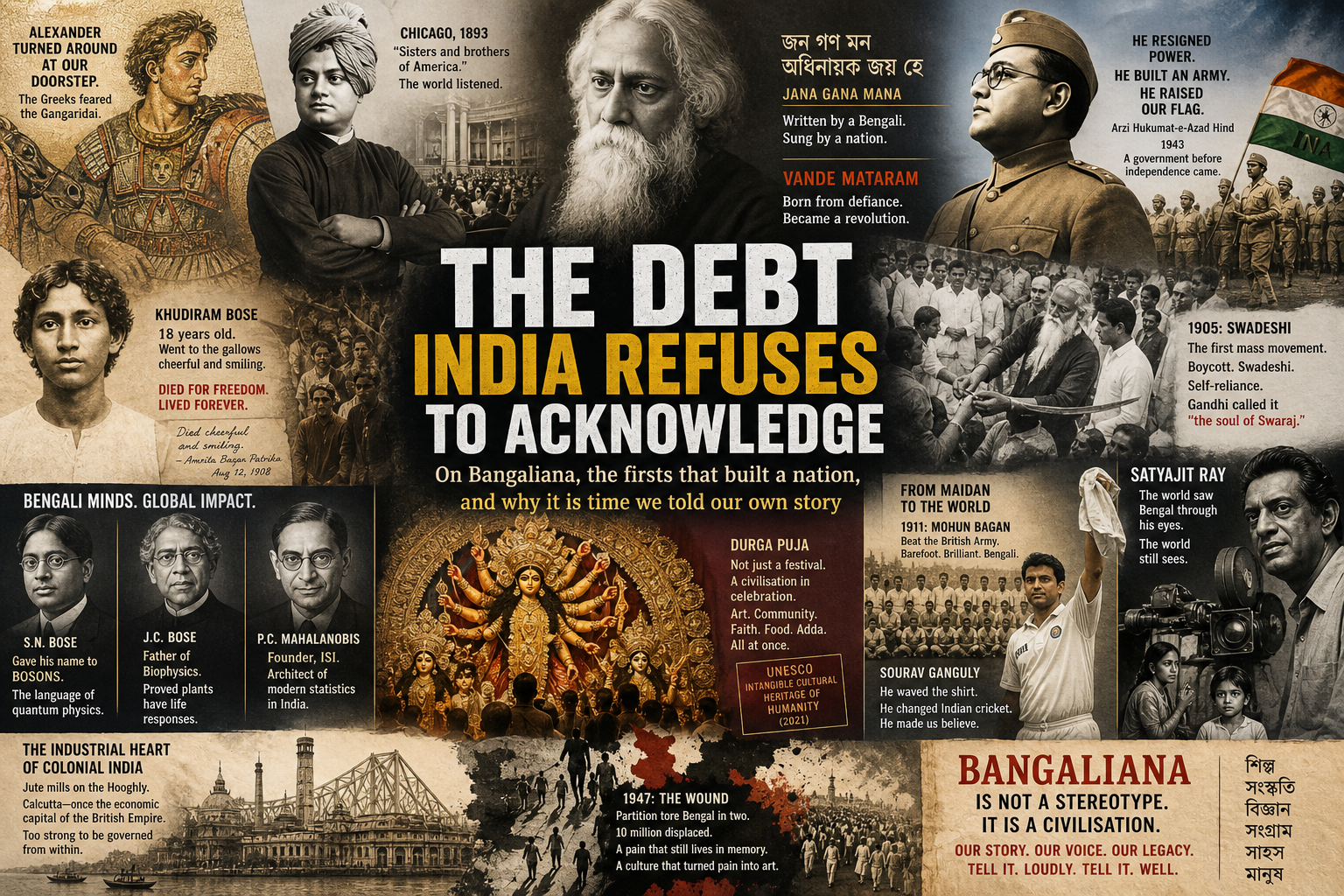
The Debt India Refuses to Acknowledge
Let me start with a Sunday.
Not any particular Sunday. Just a Bengali Sunday. The kind that starts with the smell of mustard oil heating in a kadai before you have even properly opened your eyes. The kind where someone in the kitchen is humming a Rabindra Sangeet without knowing they are doing it. Where the newspaper is fought over before chai arrives. Where the adda at the neighbourhood tea stall has already been going on for two hours and the topic has moved from last night’s match to Tagore’s philosophy to the price of hilsa, all without anyone declaring a change of subject.
That is bangaliana. Not a museum piece. A living, breathing, arguing, singing, slightly-chaotic way of being in the world.
Now let me tell you what has been happening to it.
Somewhere over the last two decades, as Bengal’s political temperature rose and its economy stalled and its best minds left for Bangalore and London, our identity got reduced. Reduced to a political football. Reduced to a stereotype. Reduced to something that outsiders feel comfortable dismissing in two sentences. I have sat at dinner tables in Bangalore where someone casually called Satyajit Ray “too slow.” I have been in rooms where Sourav Ganguly was called “arrogant” with a smirk that had nothing to do with cricket. I have watched the quiet that follows these moments, the Bengali in the room doing the math of whether it is worth the fight.
It is always worth the fight. We just forgot how to start it.
So let me start it. Not with anger. With facts. With story. With the kind of evidence that does not need to shout because it is simply, devastatingly true.
Alexander Turned Around at Our Doorstep
Most people’s knowledge of Bengal starts around 1757, with the Battle of Plassey, the moment the British effectively took control. That is a terrible place to start. It is like reading a biography from the chapter titled “downfall.”
Let us go back further. Much further.
When Alexander the Great marched his army east across the known world, undefeated, unstoppable, burning with the ambition to reach the edge of the earth, it was the report of the Gangaridai that stopped him. The Gangaridai were the people of the Bengal delta. The Greeks wrote about them with something approaching awe: a kingdom with six thousand war elephants, an army so formidable that even Alexander’s battle-hardened generals sat down and refused to march further.
Alexander, who never lost a battle, turned around at Bengal’s doorstep.
This is not mythology. It is recorded in Greek histories. The man who conquered Persia, Egypt, and most of the known world decided Bengal was too much trouble. Think about that the next time someone acts like Bengal is a peripheral place.
Then came the Pala Empire, born on Bengali soil in the 8th century. The Palas hosted the university of Nalanda, spread Buddhism to Tibet and Southeast Asia, and produced advances in sculpture and education that shaped the intellectual map of half a continent. When the Pala king Gopala I was chosen by an assembly of chieftains to lead Bengal, it was arguably the first democratic election in South Asian history. A Bengali king, chosen by consent, centuries before the word “democracy” arrived from the West.
This is the soil from which bangaliana grows. It is very old soil. Very deep roots.
The Boy Who Smiled
I want to tell you about Khudiram Bose. Not the textbook version. The human version.
He was born in Midnapore in 1889, lost both his parents by the age of six, and was raised by his elder sister. He was not a particularly good student. What he was, from very early on, was furious. The specific fury of someone who looks at the world and cannot accept that it is allowed to be this unjust.
By fifteen, he was distributing pamphlets against the British and getting arrested for it. By sixteen, he was planting bombs near police stations. He had decided, with a clarity that most adults never achieve about anything, that slavery was the worst disease people could suffer.
On August 11, 1908, at the age of eighteen, Khudiram Bose was hanged by the British for his role in the Muzaffarpur bombing conspiracy. He was one of India’s youngest revolutionary freedom fighters to be executed. He walked to the gallows holding a copy of the Bhagavad Gita. The Amrita Bazar Patrika carried the story the next day under the headline: “Khudiram’s End: Died cheerful and smiling.”
The weavers of Bengal mourned him the way Bengal mourns its own, by weaving his name into the borders of dhotis. Schoolboys wore those dhotis as a statement. A boy who never finished school became the symbol of a generation that refused to finish the fight.
Khudiram Bose is not a footnote in the independence movement. He is the spirit of it, distilled to its purest form. And he was Bengali.
The Fire That Taught Gandhi
Here is something they do not tell you in standard Indian history textbooks: Mahatma Gandhi’s most powerful tools, the boycott, the mass movement, the economic non-cooperation were not invented by him. He scaled them. He refined them. He gave them his own moral architecture.
But the prototype was built in Bengal, in 1905.
When Lord Curzon decided to partition Bengal, splitting unified people along religious lines in what nationalists rightly called a deliberate “divide and rule” strategy, Bengal did not write petitions and wait. Bengal erupted. On August 7, 1905, from the Town Hall in Calcutta, the Swadeshi Movement was formally launched, the first organized mass collective action in the Indian Independence Movement. People burned British cloth in the streets. They boycotted Manchester cotton and Liverpool salt. They built parallel schools, parallel industries, parallel institutions. In Barisal, a single organizer set up more than 150 branches of a volunteer association in a Muslim-majority district. Hindus and Muslims tied rakhis on each other’s wrists on the day Bengal was officially partitioned, in a gesture Rabindranath Tagore organized himself.
The British were taken completely off-guard. They had calculated that India was too fragmented, too hierarchical, too compliant to sustain mass resistance. Bengal proved them wrong. And then, years later, Gandhi watched how Bengal had done it, and built his own movements on the same foundation.
Gandhi called the Swadeshi movement “the soul of Swaraj.” The soul was Bengali.
The Words That Became a Nation
India has a national anthem. India has a national song. Both were written by Bengalis.
Jana Gana Mana, written by Rabindranath Tagore, was first sung at the Calcutta session of the Indian National Congress in 1911. It became India’s national anthem. Vande Mataram, written in Sanskritised Bengali by Bankim Chandra Chatterjee in the 1870s, became India’s national song.
The story behind Vande Mataram is itself a story of Bengali defiance. Bankim Chandra was a deputy collector returning home in his palanquin when a British colonel playing cricket had him assaulted for disrupting the game. Bankim took him to court. The court ordered the colonel to apologize publicly. And he did in an open courtroom, in front of Bengali lawyers and clerks and witnesses. Out of that moment of refusing to be diminished, out of that insistence on dignity, a man went home and eventually wrote a song that would fuel a revolution and become the national song of a free country.
Every time Vande Mataram is sung at a Republic Day function, every time Jana Gana Mana rises at the start of a cricket match, every time an 18-year-old belts it out on Independence Day there is a Bengali voice at the origin of that sound. Usually uncredited. Always present.
Netaji and the Government That Existed Before India Did
Subhash Chandra Bose ranked fourth in the Indian Civil Service examination. The ICS was the most competitive test in the British Empire. Clearing it meant a secure, prestigious, powerful life guaranteed. He resigned to join the freedom struggle.
That resignation is the man in a single sentence.
On October 21, 1943, in Singapore, Netaji proclaimed the Provisional Government of Free India, Arzi Hukumat-e-Azad Hind. He was its Prime Minister, its Head of State, its Minister of War. Eleven sovereign nations recognised this government. He commanded the Indian National Army, 40,000 strong. The INA planted the Indian tricolor in Moirang, Manipur, in 1944, the first time in the 20th century that Indian soil was claimed by an Indian revolutionary force.
And when Netaji needed an anthem for his provisional government, he chose Rabindranath Tagore’s Jana Gana Mana. He asked his team to translate it from Tagore’s classical Bengali into simple Hindi so every soldier could connect with it. His brief to them, reportedly, was that when the anthem played, it should be so rousing that the auditorium itself should shatter in half to reveal the sky above.
Even the ambition was poetic. That is what Bengalis do, they command military forces and ask for poetry at the same time.
The Bengali Who Stood in Chicago and Changed Everything
September 11, 1893. Chicago. The Parliament of the World’s Religions.
A young Bengali monk walked to the podium and addressed the hall as “Sisters and brothers of America.”
Two-minute standing ovation. Before he had said anything else.
Swami Vivekananda then proceeded to tell the Western world what Sanatan Dharma actually was, not the caricature of superstition and strange rituals that colonial scholarship had constructed, but a profound philosophical tradition that had been teaching religious tolerance for centuries. He said, “We believe not only in universal toleration, but we accept all religions as true.”
The hall had not heard this before. Not from the East. Not with this confidence, this warmth, this clarity.
Vivekananda spent years in America and England after that, lecturing at Harvard, establishing Vedanta centres, writing letters that are still studied today. When he founded the Ramakrishna Mission in 1897, it became the first organisation in India to merge monastic discipline with systematic humanitarian service, hospitals, schools, famine relief because he believed that serving the poor was the highest form of worship.
Today, when people talk about Sanatan Dharma finding a global audience, they are building on what a Bengali built first. In 1893. In Chicago. In a room full of strangers he immediately called his brothers and sisters.
Tagore: The Man Who Was a Civilisation
I will not give you a list of Tagore’s achievements. You can find that in any encyclopedia.
What I want to tell you is this: Rabindranath Tagore wrote approximately 2,232 songs. We call them Rabindra Sangeet. And here is what is remarkable, Bengalis still know them. Not professionally trained singers. Just Bengalis. Your aunt who teaches in school. Your elderly neighbour. The man at the fish market. Hum a few bars of a Tagore song in a room full of Bengalis and the room will quietly, involuntarily, finish it.
That is a cultural depth that is almost impossible to explain to someone who has not experienced it. It is like a language inside a language. A shared memory encoded in melody.
Tagore won the Nobel Prize in Literature in 1913, the first Asian to do so. He founded Visva-Bharati, a university built in open air, with classes under trees, designed to dissolve the boundary between learning and living. He wrote the national anthems of two countries, India and Bangladesh. When the British massacred 379 unarmed civilians at Jallianwala Bagh in 1919, Tagore returned his knighthood in protest. He was one of the first public figures in the Empire to formally reject a colonial honour.
He was also, this part matters to me personally, the creator of Feluda and the literary world that Satyajit Ray inherited. Tagore’s nephew Abanindranath Tagore painted the original Bharat Mata. His grandfather Dwarkanath Tagore was one of India’s first industrialists. The Tagore family alone is a civilisational contribution.
Durga Puja: The Festival That Is Not Just a Festival
Every year, for five days in October, something happens in Kolkata that has no real equivalent anywhere else in the world.
The city stops. Not the way a city stops for a holiday, shops closed, streets empty, people at home. The opposite. The city stops being a city and becomes something else entirely. A six-crore-people family reunion. An open-air art festival. A collective exhale that an entire civilisation has been holding since the previous October.
Durga Puja is not a religious event that also has cultural elements. It is a cultural event that contains religion the way a river contains water, it is there, it is essential, but it is not the whole story. The pandals that go up across Kolkata are not decorations. They are statements. Architects, sculptors, painters, lighting designers, and craftspeople spend months building them. Every para, every neighbourhood competes. Not for prizes, though prizes exist. For the right to say: this year, we made something extraordinary.
I grew up with that competition. Growing up in Kolkata, Puja was the calendar around which everything else was measured. The new clothes. The specific smell of shiuli flowers in the morning air that you only get in October. The dhak starting up at dawn. The way the entire city starts moving differently as Mahalaya approaches, a little lighter, a little louder, a little more itself.
And the food. I cannot write about Puja without the food. The bhog at the pandal, khichuri and labra and chutney served on a dona, sitting on the floor with strangers who are not really strangers because it is Puja and everyone is family for five days. The rolls from the stalls that appear overnight and vanish after Dashami. The mishti that Bengali households send to each other and receive from each other in a loop of sweetness that has nothing to do with calories and everything to do with connection.
What most people outside Bengal do not understand is that Durga Puja is the annual proof of bangaliana. It is where the Bengali relationship with art, with community, with religion, with food, with argument, with adda, with identity, all of it, is expressed simultaneously and at full volume. The UNESCO Intangible Cultural Heritage of Humanity tag that Kolkata’s Durga Puja received in 2021 was not a surprise to anyone who has stood in the Puja crowds at two in the morning, watching a city that should be asleep but is instead awake and luminous.
Tagore wrote about Durga Puja. Rabindra Sangeet is inseparable from its rituals. The same culture that produced the national anthem, the revolutionaries, the scientists, and the filmmakers, it all comes home to these five days every year. Durga Puja is bangaliana gathered into one place and turned up as loud as it goes.
It is also, if you want to understand why Bengalis feel the way we do about our identity, the most honest answer. We are the people who do this. This is what we are protecting. Not just the history, not just the achievements, this. The dhak at dawn. The shiuli on the ground. The bhog eaten sitting with strangers. The feeling, for five days every year, that the world is exactly the right size and we are exactly where we belong.
Science: Where Bengali Names Are Written Into Physics
If you have ever studied quantum mechanics, you have encountered Satyendra Nath Bose without knowing it. A class of subatomic particles, bosons, is named after him. The Higgs boson. The photon. Every time a physicist uses the word “boson,” they are invoking a Bengali name.
In 1924, Bose wrote a paper on the statistical behaviour of photons that was so original no European journal would publish it. He sent it directly to Albert Einstein. Einstein recognised it immediately, translated it himself into German, and got it published. The result, Bose-Einstein Statistics, is one of the foundational frameworks of modern physics.
Then there is Jagadish Chandra Bose, who demonstrated wireless signalling using electromagnetic waves in 1895 before Marconi. Who then turned to botany and proved that plants have electrical responses to stimuli structurally similar to animal tissue. He built instruments sensitive enough to measure a plant growing in real time. He created the field of biophysics. The Bose Institute in Kolkata, which he founded with his own money, was India’s first multidisciplinary research institute.
And P.C. Mahalanobis, who founded the Indian Statistical Institute in 1931, introduced the statistical measure that still bears his name, and designed India’s post-independence economic planning architecture.
Three Bengali scientists. A fundamental particle, the field of biophysics, and the mathematical foundation of modern data science, all carrying Bengali fingerprints.
The Industrialisation of India Was Born on the Hooghly
This is the one people argue with me about. So let me be precise.
The first jute mill in India was established in 1855 at Rishra, on the banks of the Hooghly River near Calcutta. Within decades, the banks of the Hooghly were lined with mills. By the late 19th and early 20th centuries, Calcutta had surpassed Dundee, Scotland, as the world’s premier centre for jute manufacturing. The Bengal Presidency had the highest gross domestic product in all of British India. Calcutta was the capital of the British Indian empire, the commercial, administrative, and intellectual centre of the entire subcontinent.
The British moved their capital to Delhi in 1911. Historians generally agree this was partly because Bengal had become too politically conscious, too organised, too resistant to control from within.
Read that again: the British moved their capital because Bengal frightened them.
Satyajit Ray: The Eye That Saw Everything
Pather Panchali was made in 1955 on almost no budget, shot on weekends, and very nearly abandoned when funding dried up. The Government of West Bengal almost pulled the plug. Ray continued anyway. When it was done, it won eleven international awards, including recognition at Cannes. It went on to be called one of the greatest films ever made.
Ray is the only Indian filmmaker to have won top prizes at both the Venice and Berlin film festivals. In 1992, the Academy gave him an Honorary Award for Lifetime Achievement. They gave it to him in his hospital room in Kolkata, because he was too ill to travel to Los Angeles. He received it propped up in his bed. He gave a speech in that condition that made the room in Hollywood fall silent.
Martin Scorsese has called him one of the greatest filmmakers who ever lived. Akira Kurosawa said something similar. These are not small names handing out compliments lightly.
When someone tells me Satyajit Ray was “just a regional filmmaker,” I think about what the word “regional” is really doing in that sentence. Chekhov was from Taganrog. Tolstoy was Russian. The local detail was the vessel. The humanity was universal. Ray was Bengali. The films belong to the world.
Mrinal Sen. Ritwik Ghatak. Aparna Sen. The tradition Ray came from and the one he created, it is one of the great cinematic lineages in human history. From one city. From one language.
The Football That Once Belonged to Us
I am a Mohun Bagan supporter. Have been since I was old enough to know what football was. And I say this with the full knowledge of what Mohun Bagan means beyond football: it is the club that, in 1911, sent barefoot Indian players onto a field against the East Yorkshire Regiment of the British Army and won the IFA Shield.
Barefoot. Against a professional military team. In colonial India.
The Ananda Bazar Patrika called it a victory that made every Bengali proud. It was not just sport. It was a statement, in the clearest possible language, that Indians could beat the British on a level playing field. The Swadeshi movement was using boycotts and pamphlets. Mohun Bagan used football.
Sailen Manna captained India to the Asian Games Gold Medal in 1951. Chuni Goswami led India to the second Gold in 1962, a player so gifted that Tottenham Hotspur invited him to trial and he chose to stay home. P.K. Banerjee was among the most technically complete footballers India ever produced.
The Durand Cup. The IFA Shield. The Santosh Trophy. For decades, these trophies had Bengali fingerprints all over them. The soul of Indian football was hammered into shape on the Maidan, in Kolkata, by Bengali men who played the game with the same intensity with which their grandfathers had fought the British.
Sourav Ganguly: He Waved the Shirt and Changed Everything
I need to be honest about what Sourav Ganguly meant to me. Not as a cricket fan in general. As a Bengali.
For a long time, Indian cricket had a particular relationship with self-deprecation. We were a home-side team. We were polite visitors overseas. We lost abroad and came back and explained why it was difficult. When Australia enforced the follow-on at Eden Gardens in 2001, I think most of us quietly prepared for the inevitable.
Ganguly did not prepare for the inevitable. He won. He made VVS Laxman and Harbhajan Singh win with him, in what is still considered one of the greatest Test match reversals in history.
Then he went to Lord’s, won, and waved his shirt from the balcony.
That shirt-wave was not arrogance. It was a statement. It said: we are allowed to celebrate when we win. We are allowed to be loud about it. We are allowed to make them feel what they made us feel.
Ganguly was the first Indian captain to build a team that believed it could win anywhere. He was the first to foster the culture that eventually produced Dhoni’s fearless finishers and Kohli’s aggressive red-ball cricket. The tree that grew after Ganguly grew because he changed the soil.
He is Bengali. He never pretended otherwise. Some people have never forgiven him for either.
The Women Who Did It First, When First Was Hardest
Kadambini Ganguly became one of the first female graduates in the British Empire in 1883, then became the first woman to practice Western medicine in India, at a time when the medical establishment was actively trying to prevent her from qualifying.
Asima Chatterjee became the first Indian woman to receive a Doctor of Science degree in 1944. In chemistry. In the middle of the Second World War. In a country that was still under colonial rule.
Ashapurna Devi won the Jnanpith Award, India’s highest literary honour in 1976, the first woman to do so. Arati Saha swam the English Channel in 1959, the first Indian and Asian woman to do it.
These women did not have easy paths. Bengal’s reform movement led by Raja Ram Mohan Roy and Ishwar Chandra Vidyasagar in the 19th century fought for women’s education and against practices like sati and child marriage, decades before most of India had the conversation. The women who broke these barriers were products of that fight. They stood on the shoulders of men who had the decency to demand that the shoulders be offered.
The Wound Alongside the Glory
I cannot write about Bengal without writing about 1947.
When independence came, Bengal was cut in two. It was torn. Families split overnight by lines drawn by a British barrister, Cyril Radcliffe, who had never visited Bengal before he was asked to partition it. He arrived, spent five weeks, drew a line, and left. He later said he had no wish to return to India and see what he had done.
Approximately 10 million people were displaced in the Bengal partition. Hindus moved west, Muslims moved east, and the violence that accompanied the movement was savage on both sides. Entire villages emptied. Families walked for days carrying what they could. The city of Calcutta, already strained, absorbed wave after wave of refugees who settled in shanties that became permanent neighbourhoods.
And here is what I find almost impossible to explain to people who were not part of this tradition: in the same decade that this happened, Bengali culture produced some of its greatest work. Ritwik Ghatak made films about Partition refugees with a rawness that was almost unbearable to watch. Jibanananda Das wrote poetry that captured the grief of losing a homeland so precisely it still feels like an open wound. Bibhutibhushan Bandyopadhyay’s Pather Panchali, on which Ray’s film was based, was a meditation on a Bengal that was already disappearing even before the partition completed its work.
People absorbed a catastrophe and turned it into art. That is not a small thing. That is, in fact, the definition of a civilisation.
A Conversation We Need to Have
The culture of Bengal is under pressure today, not from outside forces alone, but from the slow attrition of disconnection. The generation that grew up on Feluda and Byomkesh is giving way to one that may not have read them. The political noise around Bengali identity has become so loud that it has drowned out the substance of what that identity actually contains.
We have allowed “bangaliana” to become a campaign slogan when it is, in fact, a civilisation.
This article is a beginning. A reminder. A provocation.
Know your history not to live in it, but to be made larger by it. Carry it forward with the same seriousness that Vivekananda carried Vedanta, that Tagore carried poetry, that Ganguly carried a cricket bat in foreign stadiums where people wanted him to fail.
Do not wait for others to tell your story accurately. They will not. They never have.
Tell it yourself. Tell it loudly. Tell it well.

Recent Comments
Related blog posts

Your Q3 Starts on Thursday
Tom found the problem on a Tuesday in the last week of September, which, as it turned out, was about the most expensive week of the year to find anyth
Read More
Nobody Owns It at 2AM
At half past one in the morning, Hannah's phone lit up on the bedside table with a notification from her bank. £18.50, paid to her own company. Tha
Read More
The Phone Isn’t India’s Story
This morning, before the second cup of coffee, I opened Twitter and read nine hundred words from a man I'd never spoken to. Carl Pei had posted an es
Read More
How to Read a Software Quote
Priya had two quotes on her desk and a decision to make by Friday. Priya isn't one person. Like Daniel from last week, she's a composite of CTOs and
Read More
Staff Augmentation vs Hiring: The Honest Guide Nobody Selling It Will Give You
Let me tell you about Daniel. Daniel isn't one person. He's a version of a manager I have sat across from dozens of times over the years, in Kolkata
Read More
Excellent piece.I appreciate your presentation of this unique theme in a very articulate manner.
A thought-provoking piece that reframes “debt” beyond economics into something historical and moral. It highlights how certain losses are quietly normalized while responsibility is sidestepped. The argument challenges the narratives we’ve grown comfortable with. Ultimately, it makes you question not just the past, but who benefits from ignoring it today.