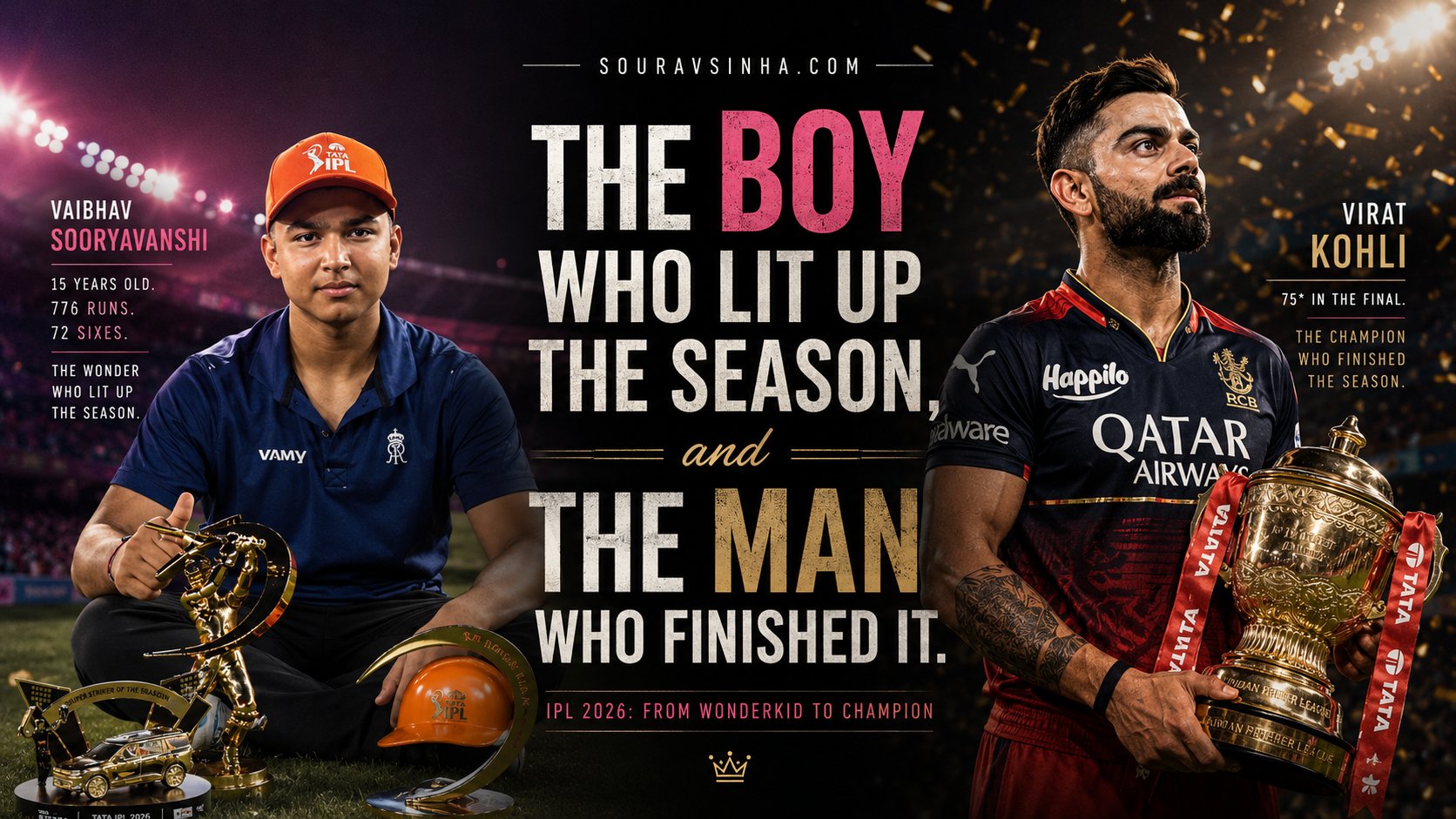
The Boy Who Lit Up the Season, and the Man Who Finished It
There are some seasons you watch waiting for the ending.
And there are some seasons where the ending was always written, even if you didn’t know it at the time.
IPL 2026 was the second kind.
When I wrote the last post in this series, I was sitting with three matches left, three teams fighting for one chair, and a prayer that LSG would do something useful with their dead-rubber game against Punjab. You know how that went. LSG did nothing useful. Rajasthan beat Mumbai at Wankhede with something to spare. KKR and PBKS both finished on 13 points and both went home. RR went through on 16 points, deservedly, because they had earned it the hard way. And in doing so, they gave us a playoff stage that this season needed.
Because if we’re being honest, the league stage had given us flashes and stretches but rarely the sustained drama that made us lean forward. The playoff stage was where the season finally found its pulse.
Let me take you through the four playoff matches that closed out IPL 2026.
Qualifier 1: RCB vs GT, Dharamsala, 26th May
The highest total in IPL playoff history.
Let that sit for a moment before we go further.
Royal Challengers Bengaluru posted 254 for 5 at Dharamsala and then bowled GT out for 162 to win by 92 runs. Ninety-two runs. In a knockout match. Against the team that had been perhaps the most consistent unit in the league stage.
The 254 was built on one of the more astonishing individual innings of the tournament. Rajat Patidar arrived at number five with the score at 104 for 3 and proceeded to hit 93 not out off 33 balls, the fastest innings of 90 or more in IPL history. He was not out because the innings ran out. He was still standing at the end and no one wanted to get in his way. For a man who has spent his RCB career playing second fiddle to Kohli in the popular narrative, this was his night in the light, entirely his own.
Kohli made 43 off 25. Devdutt Padikkal hit 30 off 19. Venkatesh Iyer opened with 19 off 7 before Rabada got him. Jason Holder then produced a double-wicket over to remove both Kohli and Padikkal in quick succession and gave GT brief hope. But Patidar and Krunal Pandya, who made 43, put on a fifty-run stand that broke GT’s back. Jitesh Sharma finished it with 15 off 5. The final ball of the innings was the final statement of the night.
GT chased. Or tried to. Bhuvneshwar Kumar removed Sai Sudharsan in the fourth over. Two overs earlier, Shubman Gill had gone for 2. Gill, who had been the most complete batter of this season, got 2. Jos Buttler swung at 29 off 11 before Hazlewood cleaned him up. By the powerplay, GT were 51 for 3 and the game was functionally over. The one bright spot in GT’s reply was Rahul Tewatia, who kept swinging for 68 off 43 near the death with nobody for company, which told you both about his character and about how comprehensively the top and middle order had collapsed. Jacob Duffy finished with 3 for 39, Rasikh Salam and Bhuvneshwar took 2 each.
RCB were through to the final with four days to prepare.
Eliminator: RR vs SRH, New Chandigarh, 27th May
There is no one in world cricket right now, in any format, doing what Vaibhav Sooryavanshi is doing.
He is fifteen years old. He has never watched a teammate bat from the other end and thought about experience or approach or what a senior player might do. He walks to the crease and plays.
Against SRH in the Eliminator, he scored 97 off 29 balls.
He was one shot away from breaking Chris Gayle’s record for the fastest IPL century, 30 balls, which has stood since 2013 and has started to feel like one of those records that simply cannot be touched. Sooryavanshi got to 97, tried to uppercut a bouncer over third man, top-edged it, and that was that. Out for 97. In a more dramatic sense, out for an innings that will be replayed every time someone talks about what this tournament can produce from a teenager who has not yet sat his board exams.
Jaiswal made 29 at the top before holing out. Dhruv Jurel then played the innings of a man who understood his job exactly: fifty off 20 balls in the middle overs, the platform kept intact after the fireworks at the top. RR posted 243 for 8.
Jofra Archer then made sure it was enough. He removed Abhishek Sharma, Ishan Kishan, and Travis Head to leave SRH at 52 for 3 inside 3.5 overs and the match effectively decided. Nitish Kumar Reddy and Salil Arora tried, a half-century stand in 18 balls was real defiance but once Jadeja removed Reddy in the 11th over the game was over. SRH finished at 196 all out, Archer finishing with 3 for 58. Sooryavanshi himself took the catch that ended the match, diving forward at short third with the instinct of someone who had decided this was his game from the first over.
SRH went home. A good team that ran out of road when it counted most.
Qualifier 2: GT vs RR, New Chandigarh, 29th May
If the Eliminator had been the Sooryavanshi show, the Qualifier 2 was the game where he met his match. And his match was a captain who has spent five IPL seasons proving he is the best batter in the tournament that nobody talks about as the best batter in the tournament.
Shubman Gill made 104 off 53 balls.
RR batted first and posted 214 for 6. Sooryavanshi, again, was magnificent. 96 off 47 balls, his second consecutive playoff half-century, his second consecutive heartbreak just short of three figures. There is something almost poetic, almost cruel, about the pattern. 97 in the Eliminator. 96 here. Both times falling in the nineties when a century felt inevitable. Both times the crowd inhaling sharply as he went. Jadeja held the innings together in the lower middle with 45 not out, Donovan Ferreira added an unbeaten 38 off 11 to push them to 214.
GT, in their reply, completed the highest successful chase in IPL playoff history, 215, surpassing the previous record of 204 set the year before. Gill and Sai Sudharsan put on a century opening stand in 52 balls. The partnership of 167 between them is the highest by any pair in IPL playoff history, breaking a record that had stood since 2011. Sudharsan got out hit wicket, the recurring curse of a batter whose footwork occasionally betrays the quality of his hands. Gill got out after his century. GT won by 7 wickets with 8 balls to spare.
Rajasthan had given everything this tournament had. They had won a last-gasp match against MI to qualify. They had beaten SRH by 47 runs. They had given GT all they could in the Qualifier 2. They went home with dignity. And they gave us the discovery of the season, possibly of several seasons.
The Final: RCB vs GT, Ahmedabad, 31st May
Patidar won the toss and sent GT in to bat, and the decision worked from the first over.
Hazlewood had Gill caught by Patidar off his own bowling for 10 in the third over. Bhuvneshwar Kumar removed Sai Sudharsan for 12 the very next over. Two powerplay wickets. The same top-order collapse as the Qualifier 1, GT seemingly had no answer to RCB’s new-ball attack when the conditions and the moment mattered most. Nishant Sindhu and Jos Buttler tried to rebuild but scoring was slow and wickets kept falling. Washington Sundar stayed to the end, hitting an unbeaten 50 off 37 with his team crumbling around him. Rasikh Salam Dar took 3 for 27, Bhuvneshwar and Hazlewood took 2 each. GT finished at 155 for 8.
The chase was never really about whether RCB would win. It was about watching Virat Kohli do it.
Kohli and Venkatesh Iyer, brought in as impact sub, opened together and put on 62 off 27 balls. It was blistering. It was exactly the kind of powerplay statement that removes all doubt from a chase. Rashid Khan then dismissed Patidar and Krunal Pandya in the ninth over within four balls to reduce RCB to 91 for 4, and for a moment you thought: here we go. Tim David came in and steadied. And Kohli, at the other end with the authority of a man who has done this so many times he no longer needs to think about it, accelerated.
He hit his fastest IPL half-century, 25 balls. He finished with 75 not out off 42. He wrapped up the chase with a six over long-on off the first ball of the 19th over. RCB 161 for 5. Won by 5 wickets with 12 balls to spare. Back-to-back IPL titles. The trophy handed to Kohli first, confetti falling over the Narendra Modi Stadium.
Ee salanoo cup namde. This year’s cup is ours too.
What This Season Left Behind
I said at the start of this piece that the ending was always written. I don’t mean that as a slight against any of the other teams. I mean it as a recognition that this RCB side had something that none of the others quite matched: the ability to produce their best cricket exactly when it mattered most.
The league stage, as a whole, was a bit of a drag. Not terrible, not without its moments, but a touch processional at times, lacking the wall-to-wall drama that the best IPL seasons produce. Too many matches that started and ended as foregone conclusions. Too few genuine final-over finishes.
But the season gave us things worth keeping.
Sooryavanshi. 776 runs in the tournament, the fifth-highest total by any batter in a single IPL edition. The Orange Cap, the MVP award, and the Emerging Player award, the first time in IPL history one player has won all three in the same season. A strike rate of 237.30. 72 sixes, breaking Chris Gayle’s record of most sixes in a single IPL season. He turned every record in sight into a personal matter and then carried it into the playoffs, where he scored 193 runs across two games and still didn’t win a final-eleven century either time. The India cricket pipeline has not looked this full in years, and he is the most vivid example of it.
Prince Yadav gave LSG something to talk about in a season that otherwise had little. Sixteen wickets, pace regularly above 140 kph, the kind of steep angle and raw speed that makes batters uncomfortable even when they get bat on ball. For a team that finished last, he was almost their entire identity for a stretch of weeks. He will be expensive at the next auction and probably worth it.
Saurabh Dubey got three games for KKR as an injury replacement for Akash Deep. He is a 6 foot 5 left-arm seamer from Wardha who had been waiting years for this chance. Three games. He took the wickets of Rohit Sharma and Suryakumar Yadav in the powerplay at Eden in a must-win match and kept the season alive for one more week. There are cricketers with 50 IPL appearances who have never had a moment that clean. Watch him when KKR give him more.
And Kohli. Who hit his fastest IPL half-century in a final. Who made 75 not out to win the title. Who plays 281 IPL games and is still the last person any attack wants to bowl to in the 14th over. Player of the Match in the final. The most decorated run-scorer in this tournament’s history, with a second consecutive title to his name, at a point in his career when lesser men would have settled for legacy.
A Season in a Sentence
IPL 2026 started with RCB retaining the title they won the year before, and it ended with RCB winning it again.
In between, a fifteen-year-old from Bihar made us believe that the next decade of Indian cricket is in safe hands. Several bowlers reminded us that fast bowling is not dead in this country. And the tournament, despite its mid-season drag, produced a playoff stage that justified the entire exercise.
You don’t always get a perfect season. Sometimes you get a season with a perfect ending and a few perfect weeks and one extraordinary child prodigy, and you take it.
This was that season.
See you next year.
Read the previous post in this series here.

Recent Comments
Related blog posts
My Father Bought His Ticket 45 Minutes After the Match Started
On the 2nd of January 1988, India beat the West Indies in a one-day international at Eden Gardens for the first time ever on Indian soil. I was there.
Read More
Where the Men Fell, the Women Rose at Lord’s
It has been a wretched few weeks to be an Indian cricket fan. The kind of stretch where you stop opening the score updates because you already know wh
Read More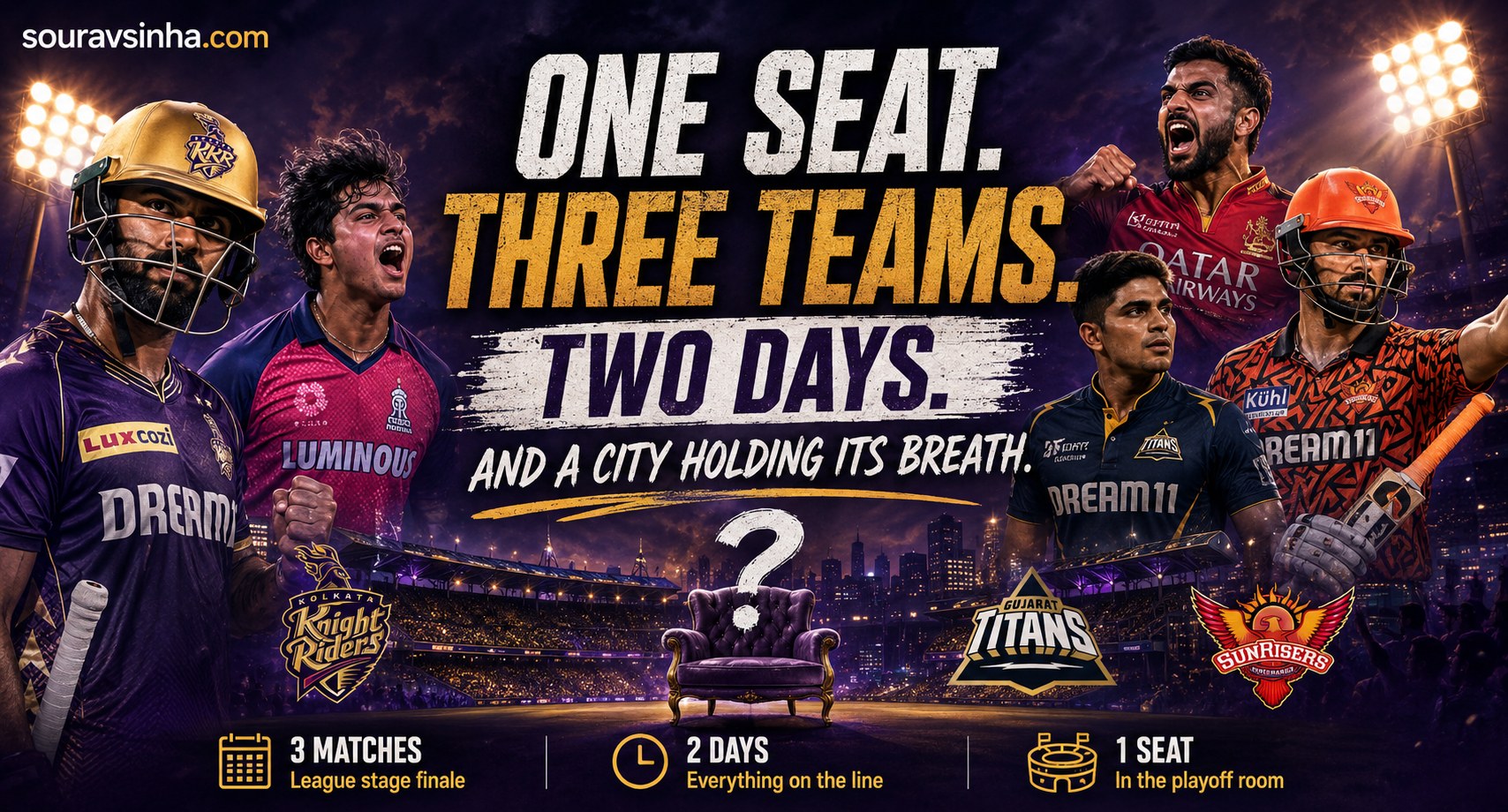
Can KKR Still Find a Way Into the IPL Playoffs?
There is a moment in every great sporting season where the narrative stops pretending it is not a story. Where the coincidences stop feeling random.
Read More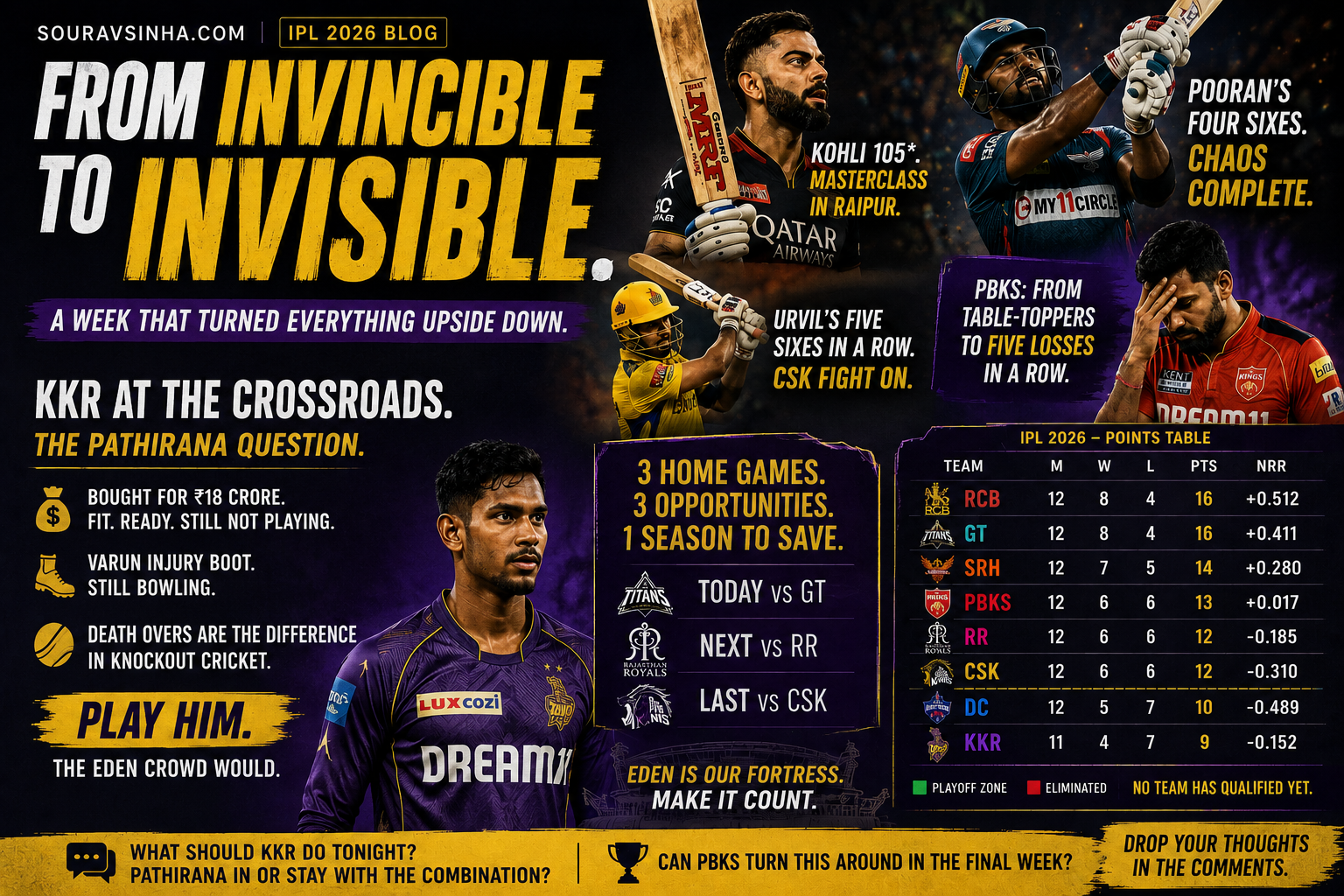
From Invincible to Invisible. And the Team That Still Won’t Play Its Ace.
There is a particular cruelty that only cricket can deliver. You spend eight weeks watching a tournament. You watch teams that were supposed to win f
Read More
When Bowlers Became Spectators. And Fielders Became Comedy.
On April 25, two IPL matches produced 986 runs in a single day. Nine hundred and eighty-six runs. In one day of cricket. Across those two matches, 1
Read More