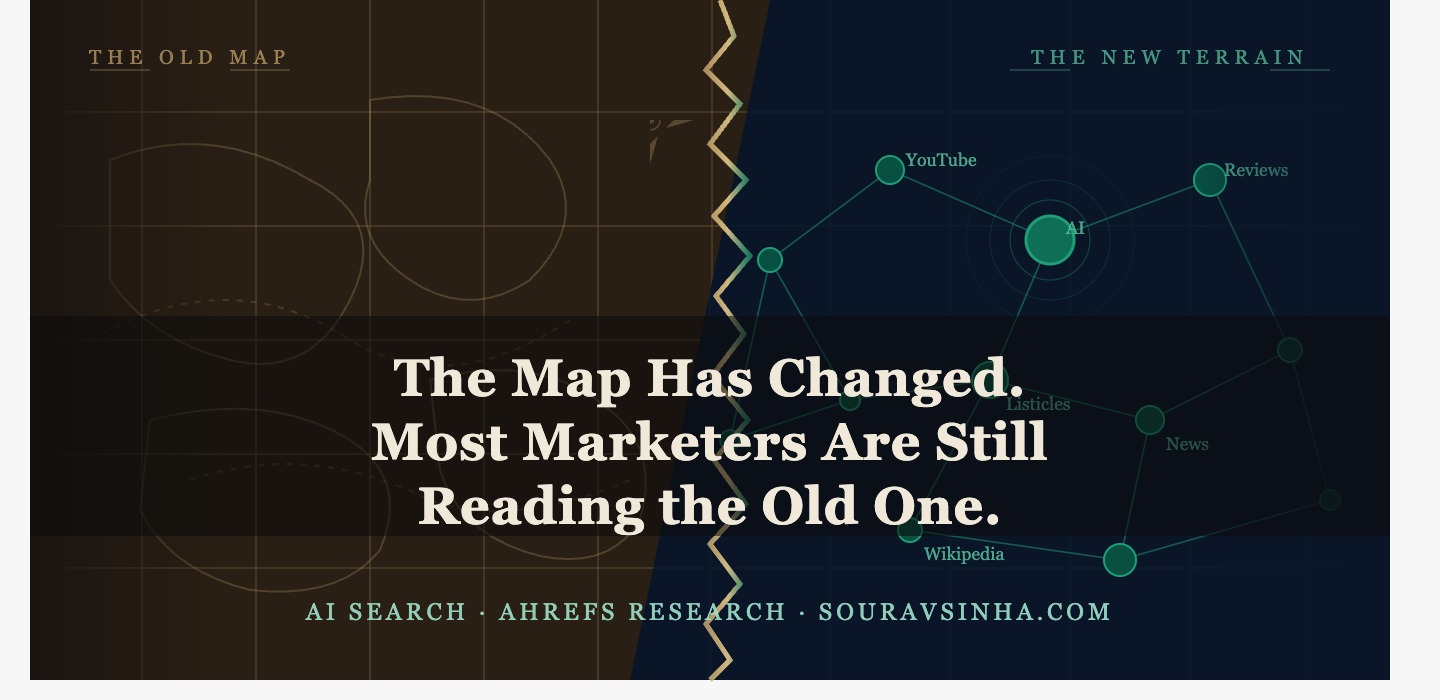
The Map Has Changed
There is a moment in every major technological shift when the rules don’t just bend, they break entirely. We had one such moment in the mid-2010s when Google moved from ten blue links to featured snippets and local packs. Businesses that understood the new terrain early captured audience, awareness, and revenue. Those who kept doing what had worked before spent years wondering why their traffic graphs were trending the wrong way.
That moment is happening again. And this time, the terrain isn’t just shifting, it is being replaced.
The research comes from Tim Soulo, CMO at Ahrefs, who published findings from over a billion data points across fourteen studies on AI search behaviour. Soulo built Ahrefs from employee number 16 to a $100M+ ARR bootstrapped company and when he publishes data on how AI discovers content, it is worth reading slowly. What these findings reveal is not a set of tactical tweaks to your existing content strategy. They reveal that the strategy itself needs to be rebuilt from different foundations.
The Search Bar Has a New Brain
Here is where most brands are making their first mistake. They are treating AI search, ChatGPT, Perplexity, Google’s AI Overviews as a slightly smarter version of the old Google. Optimize for keywords, build backlinks, get ranked. Done.
The data says otherwise.
Nearly 28% of the pages that ChatGPT cites most frequently have zero Google organic visibility. These are pages that a traditional SEO audit would declare invisible, irrelevant, non-existent from a traffic standpoint. Yet AI is referencing them, drawing from them, citing them in front of millions of users every single day.
This means there is an entirely separate discovery layer operating in parallel to everything you thought you understood about digital visibility. Your SEO rank is no longer your citation rank. They are different games, running on different fields, scored differently.
You Can Only Influence a Third of the Conversation About You
This is the data point that should hit founders and brand marketers hardest. Of ChatGPT’s top 1,000 cited sources, 67% come from places that no marketing budget can touch: Wikipedia (nearly 30%), homepages (almost 24%), and app stores. The remaining 33%: educational pages, reviews, news, blog posts is where you actually have a seat at the table.
One third. That is your playing field.
Which means that every piece of content you produce for AI visibility has to work harder, be more precise, and earn citation in a highly competitive slice of an already competitive landscape. The question you need to ask for every blog post, every product explainer, every case study you publish is no longer “will Google index this?” It is “would an AI chatbot find this authoritative enough to surface to a user asking a relevant question?”
That is a higher bar. And most content being produced today isn’t clearing it.
The Format That Actually Gets Cited
If there is one tactical signal in all of Ahrefs’ research that every content team should act on immediately, it is this: “Best X” listicles make up 43.8% of all page types cited by ChatGPT. Nearly half. The format that content marketers have been writing since 2009, the one that senior strategists have been quietly dismissing as low-effort, the one that your editorial team may have deprioritized in favour of long-form thought leadership, that format is dominating AI citations.
This does not mean you start pumping out lazy listicles. It means you write deeply researched, genuinely useful “Best X for Y” pieces and you write them in categories directly adjacent to what you sell. If you are a Shopify brand selling supplements, “Best Magnesium Supplements for Sleep in 2025” is not beneath you. It is the door through which AI walks a potential customer into your world.
Being Retrieved Is Not Being Cited
Here is the nuance that most AI search guides will skip: ChatGPT only cites around 50% of the URLs it actually retrieves. It fetches dozens of pages per query, reads them, uses them as background context and then only attributes half of them in the final response.
What this means is that being findable by AI and being visible to the user are two completely different achievements. You can be doing everything right at the retrieval level and still be invisible to the person reading the answer. The citation gap is real, and it is being driven by authoritativeness, recency, and specificity of the content that gets the attribution.
The implication is direct: produce content that is specific enough to be definitively useful, not just broadly informative. AI cites sources that give it something clean and clear to attribute. Vague, wide-angle content gets consumed in the background and dropped before the answer is written.
YouTube Is Doing More Than You Think
Of all the factors Ahrefs tested for AI brand visibility, backlinks, domain rating, page count, organic traffic, all of it, YouTube mentions had the single highest correlation at 0.737. Not a minor edge. A significant lead. And this correlation held across both Google-owned products and OpenAI products.
Think about what that means structurally. AI systems are not just reading text on the web. They are building an understanding of brand authority from a much richer set of signals, and video presence is near the top of that signal stack. A brand that has built real YouTube presence, genuine tutorial content, product walkthroughs, founder conversations, is being rewarded in AI visibility in ways that a brand with better backlinks but no video presence is not.
If you have been putting off building a YouTube presence because it is hard, time-consuming, and takes months to gain traction: this is the datapoint that should move that task up your priority list.
AI Overviews Are Eating Your Clicks. Faster Than You Think.
Twelve months ago, AI Overviews reduced clicks to the top Google result by about 35%. Now that number is 58%. In less than a year, the click-loss rate went up by more than twenty percentage points. The trajectory is not levelling off.
For transactional queries, someone searching to buy something, this is less of an immediate concern. AI Overviews appear on shopping queries only about 3% of the time. They are almost entirely focused on informational intent searches. Which means the content that is being displaced is the content that was already working hardest to build awareness and educate buyers at the top of your funnel.
This is not a reason to panic. It is a reason to redirect. The audience is not disappearing. It is being intercepted earlier in the journey. The brands that win in this environment are the ones who show up inside that interception, inside the AI answer itself rather than waiting for the user to scroll past it.
The Signal That Never Changes, Even When Everything Else Does
One last thing worth sitting with. Ahrefs found that AI Overviews change their content every 2.15 days on average, with 70% of the specific words and sources shuffling between observations. That sounds chaotic until you see the other number: the semantic similarity between those constantly changing answers stays at 0.95.
The words change. The sources swap in and out. The specific entities rotate. But the meaning, the core of what the AI is saying, stays almost perfectly stable.
What this tells you is that AI has already formed a settled view of most topics in your category. The sources feeding that view are not fixed, which means the door is open to new entrants. But the answer being produced is already shaped. To influence it, you have to produce content that is semantically consistent with the direction that answer is already moving in. You are not trying to disrupt the AI’s understanding. You are trying to become the source it trusts to express what it already believes.
That is a very different content brief than the one most teams are working from.
What to Actually Do
The map has changed. Here is how to read it.
Start by auditing what currently ranks for the “Best X” queries most relevant to your category not to copy them, but to understand the format and specificity that is earning citation. Build a content calendar that produces at least one deeply researched comparative piece per month in your core area.
Invest in YouTube with the seriousness you give to written content. Not production value for its own sake, but consistency and genuine usefulness. The AI visibility dividend from video presence is measurable and it compounds.
Stop measuring your AI strategy by Google rankings alone. Use tools that track AI citation and brand mention across ChatGPT, Perplexity, and AI Overviews. These are not the same metric and treating them as the same will leave you flying blind in the channel that is growing fastest.
And produce with specificity. The vague, wide-angle content that filled content calendars for a decade is the content most likely to be consumed silently by AI and never attributed. Every piece you produce from here forward should be asking: specific enough to cite, authoritative enough to trust, current enough to matter.
The brands who understood that search was changing in 2013 are still reaping the rewards. The window to be that brand in the AI search era is open right now.
It will not be open forever.

Recent Comments
Related blog posts

The Product Page That Pays for Itself
She had built something worth buying. Eighteen months of sourcing. A manufacturer in Surat who finally got the drape right. An Instagram following th
Read More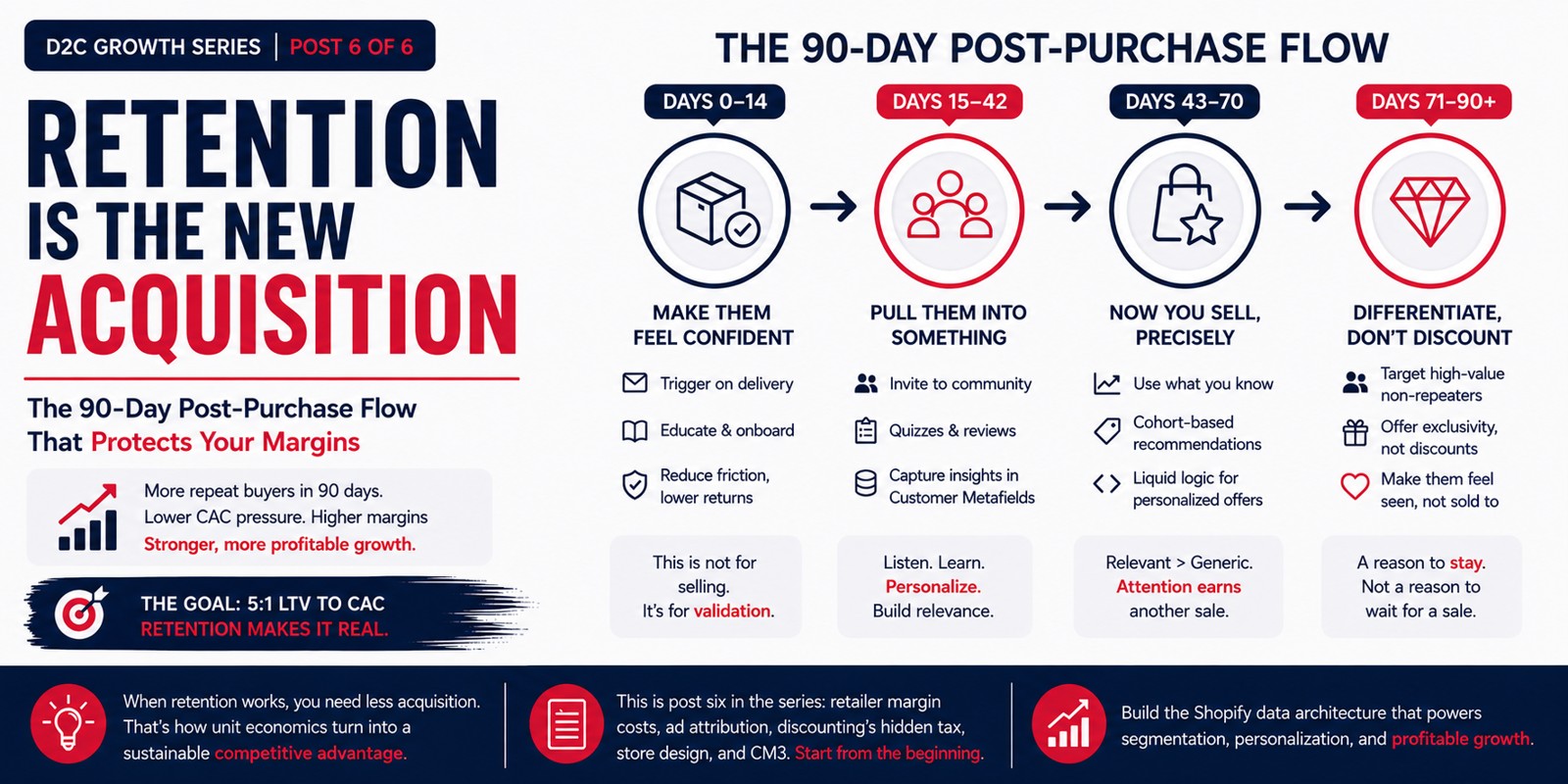
Why Is Retention the New Acquisition for Growing Brands?
Most D2C founders treat the post-purchase experience like a courtesy. A thank you email. A shipping notification. Maybe a review request three weeks l
Read More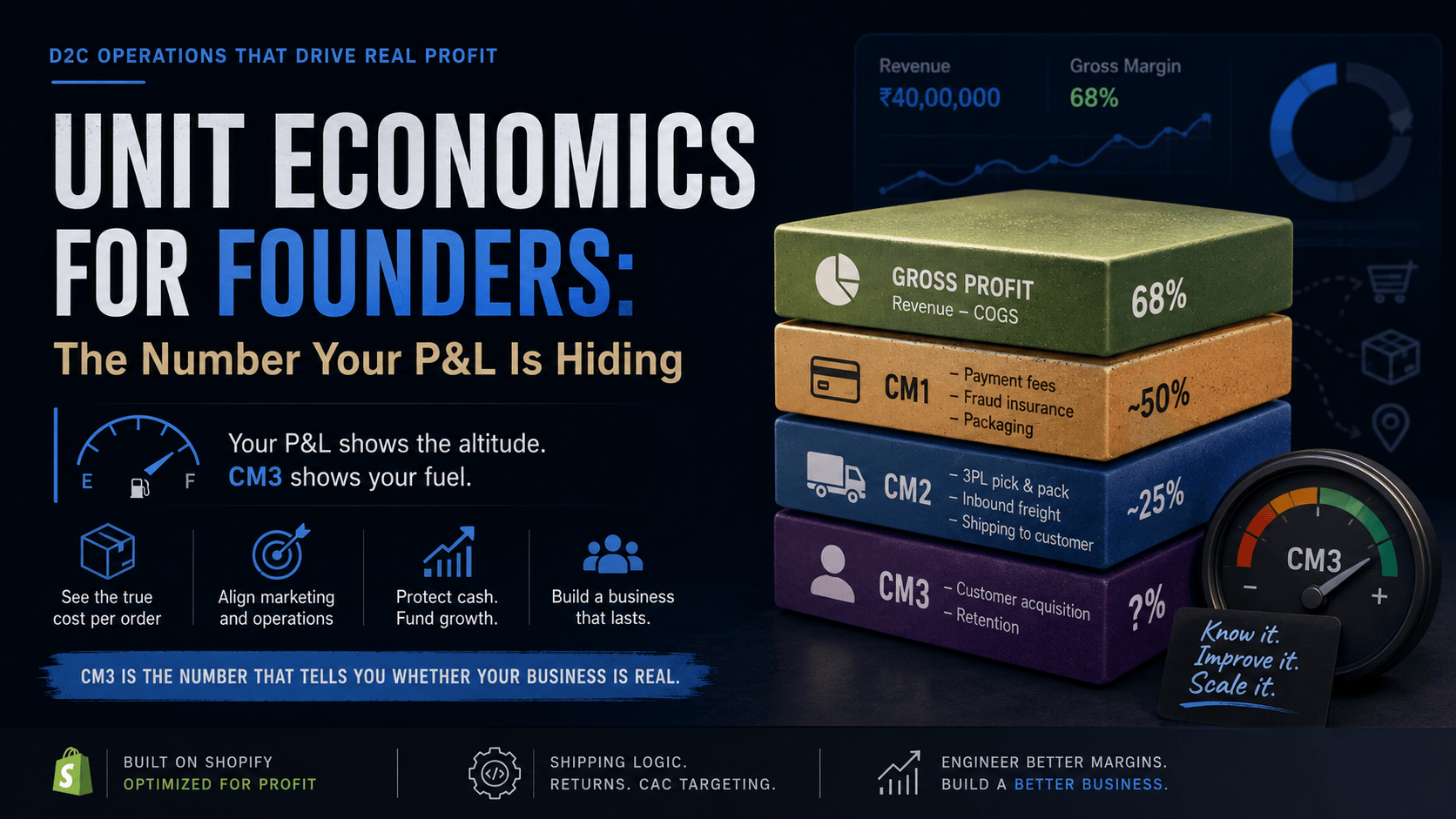
How to Understand Unit Economics: The Number Your P&L Is Hiding
He showed me his numbers on a call last October. Forty lakh rupees in monthly revenue. A gross margin of 68 percent. A marketing team that was hittin
Read More
Fixing the Foundation: An Honest Look at India’s Modern Economic Storm
Imagine a talented, hardworking family running a grand household. Years ago, when the household was small and expenses modest, a bit of overspending
Read More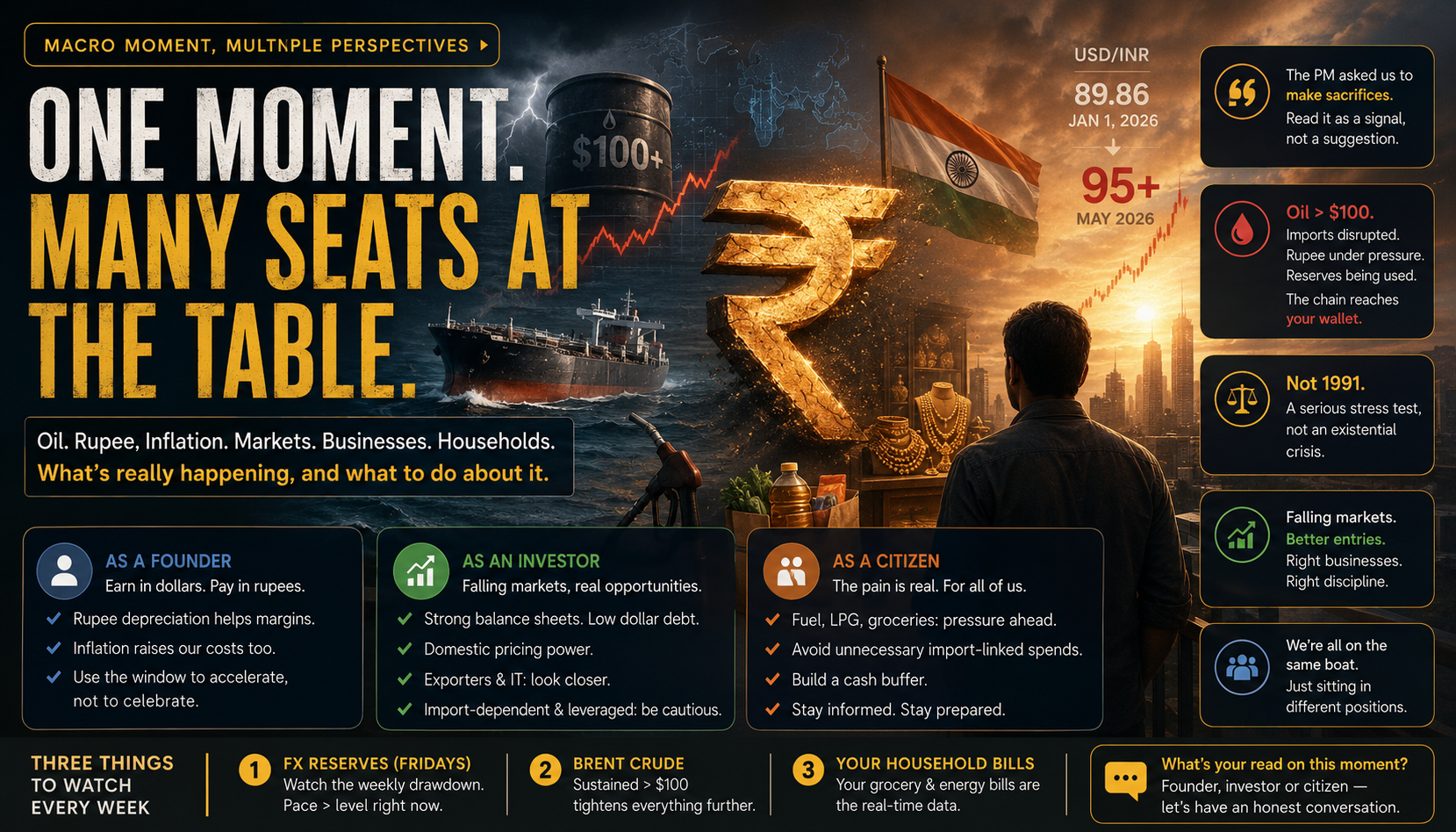
The signal everyone is misreading right now
Let me be honest with you upfront. I am going to talk about this current macro moment from multiple seats at the table simultaneously. As a founder wh
Read More