Why Always Being on Sale Makes Nothing Worth Buying
Open any fashion app on your phone right now.
Go ahead. I will wait.
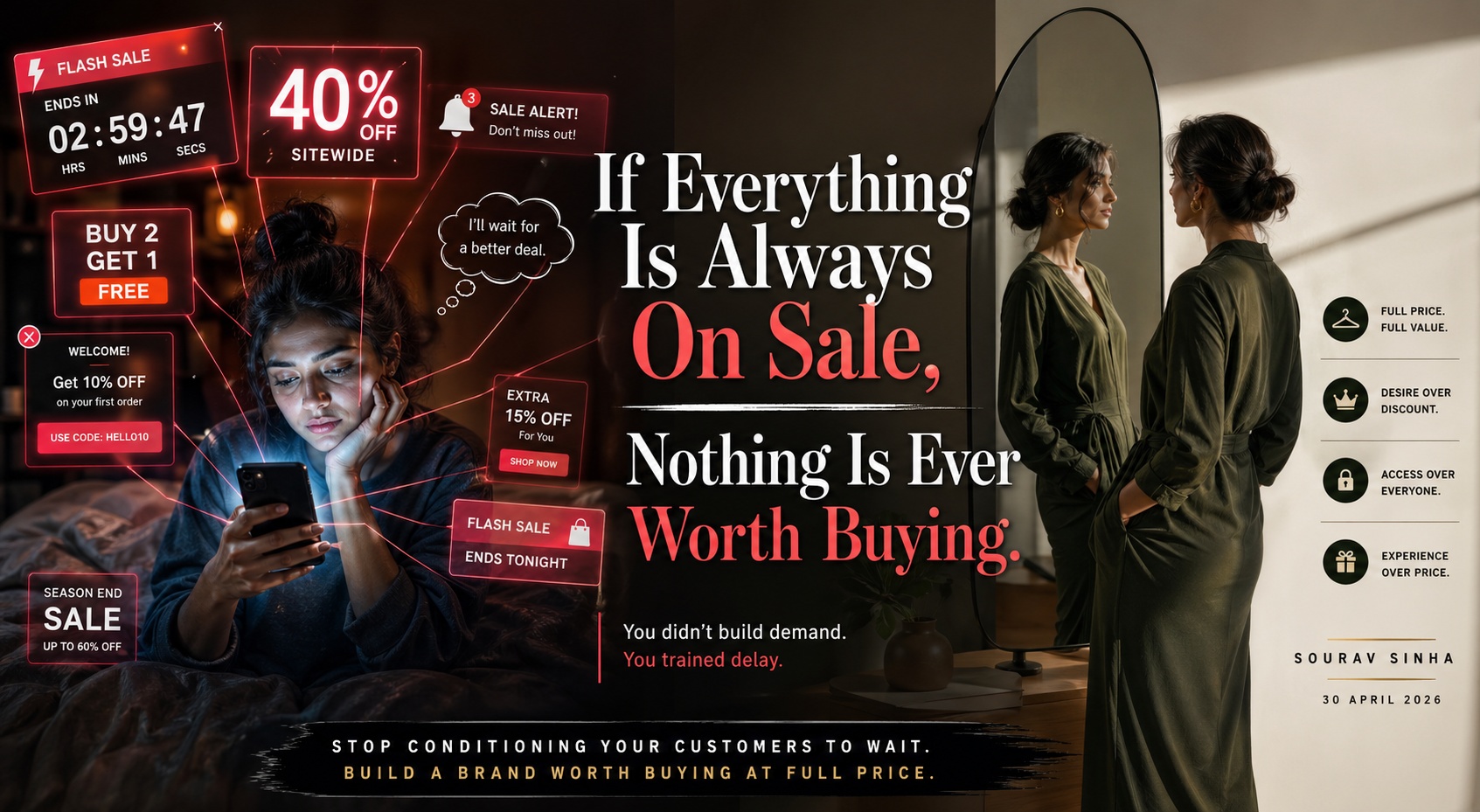
Chances are, within three seconds of opening it, something is flashing at you. A banner. A pop-up. A countdown timer. Forty percent off. Buy two get one. Flash sale ends tonight. Welcome, here is your ten percent off just for showing up.
I have been noticing this for a while now. Not just on one app. On almost every fashion brand’s app or website I open. The discount is not the exception anymore. The discount is the entire experience.
And every time I see it, I think the same thing.
If this brand is always running a sale, what is the actual price of anything they sell?
The Story The Numbers Tell
Here is what is really happening inside these businesses.
A fashion brand launches. They need customers fast. So they offer a welcome discount. Ten percent off your first order just for signing up. Sounds reasonable. It works. People sign up. People buy.
Then the first order ships and the customer gets a follow-up email. Another discount. Come back and get fifteen percent off your next purchase. Because we miss you. It has been three weeks.
Then there is a seasonal sale. Then a birthday sale. Then a clearance sale. Then another welcome offer because somehow the pop-up keeps showing up even for returning customers.
Before long, the brand has trained every single person in their customer base to do one thing.
Wait.
Just wait. Because the sale is always coming. Why would you ever pay full price when you know, with absolute certainty, that a discount code is either already live or just around the corner?
This is not a marketing strategy. This is a slow poison.
The Margin Math Nobody Talks About
Let me show you what a twenty percent discount actually costs a fashion brand.
Imagine a kurta priced at Rs. 1,200. The cost of making it, shipping it, and acquiring the customer through ads is Rs. 900. At full price the brand makes Rs. 300. A twenty-five percent margin. Thin but workable if volume is good.
Now apply a twenty percent discount. The kurta sells for Rs. 960. The costs are still Rs. 900. The brand makes Rs. 60.
That is not a twenty percent reduction in profit. That is an eighty percent reduction in profit.
And this is before accounting for the customer who now believes the kurta is worth Rs. 960. Not Rs. 1,200. That belief does not go away. The next time you try to sell them something at full price, you are fighting a psychological anchor you set yourself.
You trained them. You told them your product was worth less. And now you are surprised they will not pay full price.
I Saw This Play Out With A Brand I Respect
There is a fashion brand I used to admire. Good design. Strong identity. The kind of brand that felt like it had a point of view.
I remember the first time I opened their app and there was no sale on. Everything was full price. And somehow that made me want it more. The absence of a discount made the product feel valuable. Like it did not need to apologise for its price tag.
Then slowly the discounts started appearing. First seasonally. Then more frequently. Then permanently. Now I cannot remember the last time I opened that app and did not see a sale banner.
And here is the honest truth. I trust that brand less now. Not because the product changed. But because the pricing told me something about how they see their own product.
If they do not believe it is worth full price, why should I?
What The Best Fashion Brands Do Instead
The brands that have built genuine equity in fashion do not compete on price. They compete on desire.
Instead of ten percent off, they offer early access. You are on the inner circle list. You get to see the new collection forty-eight hours before anyone else. No discount. Just the feeling of being chosen.
Instead of a flash sale, they do limited drops. Fifty pieces. Gone in hours. The scarcity is real. The urgency is real. And not a single rupee of margin is sacrificed.
Instead of a discount for crossing a cart value, they offer a gift with purchase. A small accessory. A branded pouch. Something that costs the brand very little but feels like a genuine bonus to the customer. Psychologically, a gift feels like a gain. A discount feels like an admission that you were overcharging to begin with.
These are not complicated strategies. They require discipline more than technology. The discipline to say: our product is worth what we say it is worth, and we are not going to apologise for that.
Shopify’s checkout tools today make all of this implementable without heavy custom development. Customer tagging for inner circle access. Dynamic gift triggers based on cart value. Limited inventory controls for drop mechanics. The infrastructure exists. What most brands lack is the conviction to use it.
The Real Question
The next time you are tempted to run a sitewide sale, ask yourself one question.
Am I doing this because it is good for my brand, or because I am scared that without it nobody will buy?
If the answer is the second one, the discount is not solving your problem. It is hiding it. The real problem is that you have not yet built enough reasons for people to want your product at full price. And no amount of discounting fixes that. It only makes it worse.
The fashion brands that will still be here in ten years are not the ones with the biggest sales. They are the ones that made you feel something when you paid full price.
Build that. Protect that. Do not discount that away.
This is the third blog in my series on building smarter D2C businesses. If you missed the first two, read about why your retailer margin is costing you more than you think here and why your ads might be lying to you here.
If you want to build a high margin Shopify store that does not depend on discounts to grow, we can help.

Recent Comments
Related blog posts
Your Q3 Starts on Thursday
Tom found the problem on a Tuesday in the last week of September, which, as it turned out, was about the most expensive week of the year to find anyth
Read More
Nobody Owns It at 2AM
At half past one in the morning, Hannah's phone lit up on the bedside table with a notification from her bank. £18.50, paid to her own company. Tha
Read More
The Phone Isn’t India’s Story
This morning, before the second cup of coffee, I opened Twitter and read nine hundred words from a man I'd never spoken to. Carl Pei had posted an es
Read More
How to Read a Software Quote
Priya had two quotes on her desk and a decision to make by Friday. Priya isn't one person. Like Daniel from last week, she's a composite of CTOs and
Read More
Staff Augmentation vs Hiring: The Honest Guide Nobody Selling It Will Give You
Let me tell you about Daniel. Daniel isn't one person. He's a version of a manager I have sat across from dozens of times over the years, in Kolkata
Read More