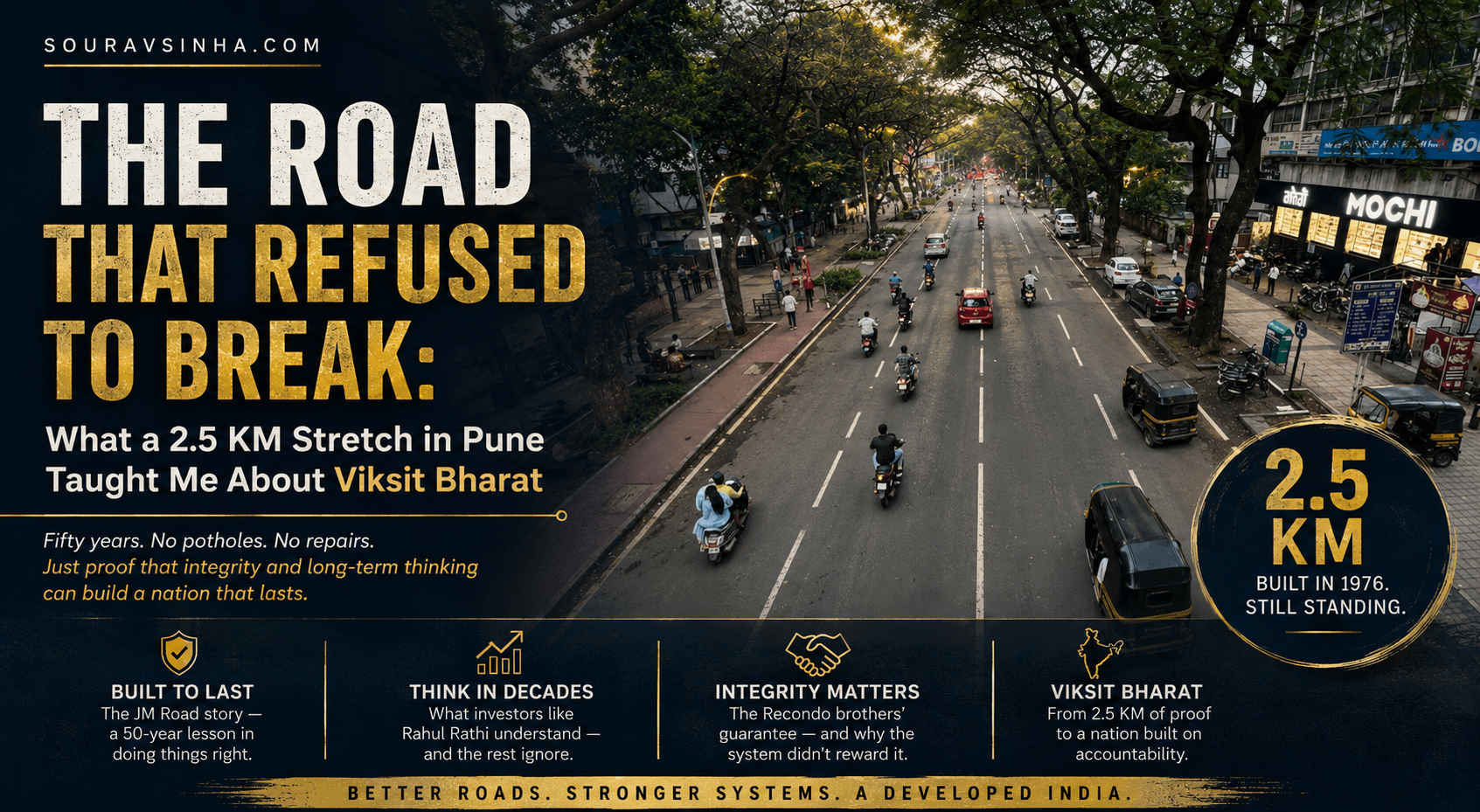
The Road That Refused to Break
It was my second visit to Pune this year. And somehow, both times, the stock market found a way to pull me here.
This time, it was to meet Rahul Rathi, the founder and chairman of Purnartha Investment Advisers, one of India’s most respected Portfolio Management Services firms. Travelling with me was Asif, my co-founder at Brainium and a college friend of over thirty years. Some friendships age like fine wine; ours has survived engineering college, entrepreneurship, and more bad traffic than either of us cares to remember. The agenda was to showcase Brainium’s Agentic AI capabilities, with Diamond Picks as a working example. We also had the pleasure of meeting Hemant Vispute, the Managing Director of Purnartha, separately, at his office. The meeting was facilitated by Tausif Ahmed, Asif’s younger brother and Director of Business and Strategy at Purnartha, who was also our gracious host for the day. Walking into that day, I had no idea that the most lasting insight would not come from inside a boardroom. It would come from a stretch of road outside.
But I am getting ahead of myself.
The Man Who Thinks in Decades
Rahul Rathi has spent over 20 years in investment and risk management, having worked with global funds exceeding $2 billion in AUM. Hemant Vispute, as MD, has been central to scaling the firm to over Rs 2,300 crore in AUM. And Tausif, sitting at the intersection of business and strategy, is very much part of the leadership fabric that holds it all together.
What strikes you about Rahul almost immediately is that he does not talk like most people in finance. There is no noise about quarterly performance, no obsession with the next trigger, no short-term positioning. He is a strong believer in “Vasudevam Kutabakam,” a principle that translates simply as: what is not good for me and my family cannot be good for my clients. It is a philosophy built on integrity and alignment. The investor wins only when the client wins.
Purnartha’s investment approach is built around a concentrated portfolio of 10 to 15 high-quality Indian companies, targeting structurally strong businesses with high growth potential, held with minimal portfolio turnover. The whole philosophy is about staying invested in long-term structural winners rather than chasing the noise of the moment.
Long-term conviction over short-term gratification. Quality over convenience. Patience over panic.
Now, Diamond Picks, the feature Asif and I had carried into that room, was built for early-stage retail investors. It is Brainium’s Agentic AI application that helps first-time investors cut through market noise and identify stocks worth paying attention to. A solid, genuinely useful tool for its intended audience. We had brought it as a demonstration of what Brainium’s Agentic AI stack is capable of building.
What we walked into was a different league entirely.
Rahul, Hemant, and their team were already well ahead of the curve, actively using Agentic AI for deep investment research purposes, integrating it into workflows that professional fund managers rely on daily. Diamond Picks, as expected, was too small a feature in their big scheme of things. And I say that not as a disappointment but as a genuine marker of respect. When the people you are trying to impress have already built the next floor of the same building, you know you are in the right room.
It also told me something important: the serious money in India is already treating Agentic AI not as a novelty but as infrastructure. That is a conversation I will return to in a future post.
For now, a different kind of infrastructure had caught my attention.
A Road That Should Not Exist
As Tausif drove Asif and me to Rahul’s office in his Mercedes, weaving through the bustling, traffic-choked streets of Pune, we crossed a stretch of JM Road. Jangli Maharaj Road, to give it its full name. A 2.5 kilometre stretch connecting the Jangli Maharaj Temple to the Deccan Gymkhana area. Unremarkable to look at. No fanfare. No signboard announcing its legend.
Except this road was built in 1976.
And in fifty years, it has never had a single pothole.
Let that sink in. We live in a country where brand new roads develop craters before the inauguration paint has dried. Where every monsoon becomes a morbid ritual of pothole deaths, viral photos, and outrage cycles that last exactly until the next news story. Where infrastructure spending is measured not by how long something lasts but by how quickly it can be rebuilt and billed again.
And yet, right here in Pune, a road laid fifty years ago stands immaculate.
The story begins with a young corporator named Shrikant Shirole, then Chairman of the Standing Committee, who watched Pune’s roads buckle and crack while Mumbai’s withstood the same rains. He refused to accept the standard excuses and went looking for a permanent solution.
What he found was a Mumbai-based construction company run by two Parsi brothers: Recondo.
Recondo used a technique called Hot Mix technology, where bitumen was heated, mixed with aggregate, laid, and then compacted while still hot to create a surface that was both smooth and extraordinarily durable. The technology was genuinely new at the time. Shirole bypassed the public tendering process entirely because of Recondo’s reputation, sanctioned a budget of Rs 15 lakh, and asked them to build the road.
On January 1, 1976, the road was handed over to the Pune Municipal Corporation with something that had never been seen before: a written guarantee. No repairs needed for a decade, or the company would redo the entire road at their own cost.
The decade passed. The road was flawless.
Fifty years later, other than minor roadside repairs in 2013, the main stretch shows no signs of damage, no matter how heavy the rains.
The Parallel That Stopped Me Cold
Sitting in that car with Asif, something clicked.
Rahul Rathi had spent the entire meeting telling us why he refuses to chase short-term returns. Why he holds 10 to 15 stocks instead of 50. Why low portfolio churn is not a limitation but a feature. Why wealth that is built properly compounds quietly and outlasts the noise.
And here, outside the window, was a road making the exact same argument.
The Recondo brothers did not build JM Road to win the next tender. They built it to last. They used the best available technology. They sourced the best materials. They compacted the surface while it was still hot because that is what the craft demanded, not because anyone was watching. And then they handed it over with a written guarantee, staking their own money on the quality of their work.
That is not how contractors think. That is how investors think. The rare, patient kind.
Rahul’s philosophy at Purnartha is anchored in the idea that the market eventually rewards structural quality over manufactured momentum. Good businesses, held with conviction over long periods, outperform because reality eventually catches up with fundamentals.
JM Road is that thesis in asphalt. Fifty years of reality catching up with fundamentals.
The question that lingers, of course, is why this remains the exception and not the rule.
The Part That Should Haunt Us
After delivering this engineering wonder with a written warranty, the Recondo brothers never received another project in Pune. Shirole himself, in a 2022 interview, candidly attributed the road’s enduring quality to the absence of corruption, noting that political changes and vested interests later prevented the same standards from being upheld. The brothers eventually parted ways, and the company ceased to exist.
Read that again.
They built the best road in India’s post-independence history. They gave a warranty no contractor had ever given. They delivered on it without a single rupee of additional work for fifty years.
And the system destroyed them for it.
Because a road that does not need repair is a road that cannot be billed again. A contractor who does not pay kickbacks is a contractor who does not get contracts. Excellence, in the ecosystem that took over, was not a qualification. It was a threat.
In investment terms, this is what happens when a system optimises for transaction volume instead of long-term value creation. Every churned portfolio generates fees. Every repaired road generates a new bill. The incentive structure punishes durability and rewards churn. And the whole enterprise extracts value rather than creating it.
Today, crores are spent every year on roads that die after one monsoon. The problem is not the rain. The problem is corruption.
The Question That Drives Everything
Why only 2.5 kilometres? Why not the entire country?
It is not a rhetorical question. It is actually the most important policy question facing India right now.
We have the engineers. We have the technology. We have, as JM Road proves, the historical proof of concept. In 1976, with Rs 15 lakh and two Parsi brothers with integrity and a hot mix machine, India built a road that has outlasted governments, corporators, contractors, and entire political movements.
The variable that changed was not technical. It was moral.
What failed was accountability. What failed was the will to reward quality over connection. What failed was the absence of systems that make corruption costly rather than profitable.
Viksit Bharat Starts Here
Prime Minister Modi’s vision of Viksit Bharat, a developed India by 2047, is an ambitious and necessary goal. The India of 2047 cannot be built on roads that crumble in July. It cannot be built on infrastructure designed to fail so it can be rebuilt. And it cannot be built if the Recondo brothers of today are still getting squeezed out while their mediocre, well-connected competitors walk away with the tenders.
The physical infrastructure of Viksit Bharat is not just concrete and asphalt. It is the infrastructure of accountability: procurement systems that reward durability, contract frameworks that enforce warranties, and governance structures that make corruption the riskier option.
Long-term thinking. High-conviction execution. Skin in the game.
That is what Rahul Rathi preaches about investing. That is also, it turns out, exactly what building a nation requires.
JM Road is not just an inspiring story. It is a blueprint. It is evidence, fifty years old and still standing, that India can execute world-class infrastructure when three things align: the right technology, the right people, and a system clean enough to let them do their work.
Two and a half kilometres is proof. A billion kilometres is possibility.
The road exists. We just need the will to build it everywhere.

Recent Comments
Related blog posts

The Man With No Bucket List
At some point in your forties, if you have enough friends, WhatsApp groups become a carousel of quiet intimidation. One school friend just finished a
Read More
The People Around You Are Quietly Deciding Who You Become
I want to tell you about something that happened in a classroom in 1965. A Harvard psychologist named Robert Rosenthal walked into an elementary scho
Read More
Fixing the Foundation: An Honest Look at India’s Modern Economic Storm
Imagine a talented, hardworking family running a grand household. Years ago, when the household was small and expenses modest, a bit of overspending
Read MoreTo hold or not to hold: The ICSE exams 2021
As leaders, one of the most important traits that you need to have is to take decisions. If you don’t have the confidence to make decisions and alwa
Read MoreDurga Puja Special: Stree Shakti: Sarojini Naidu
Today is Maha Ashtami, the most auspicious day in the Durga Puja festival. As we pray to Maa Durga (the symbol of Stree Shakti) - I pay my homage
Read More