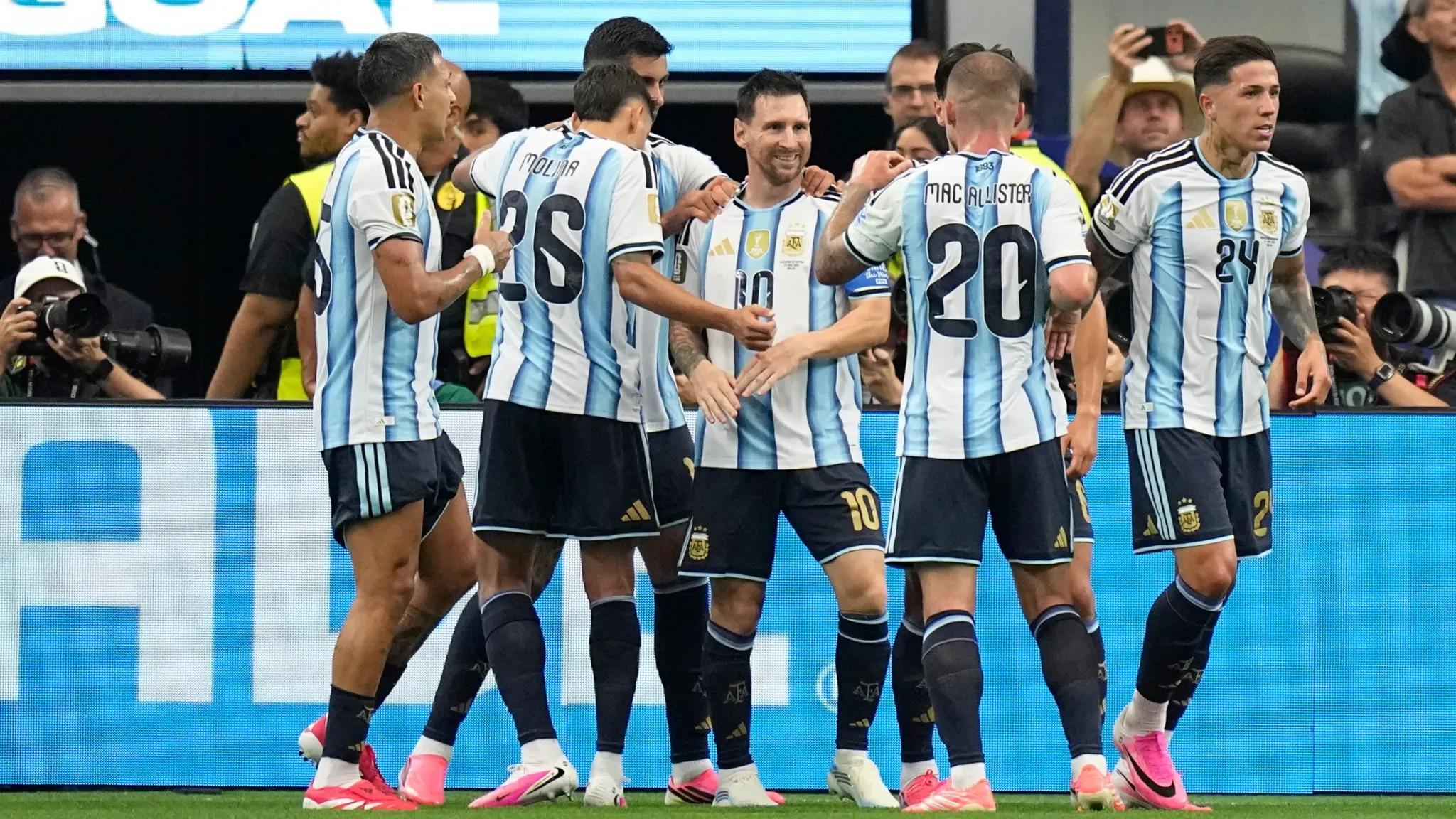
The Man Who Scored His Way Into Forever
Today, June 24, Lionel Messi turns 39.
Two days ago, in Dallas, he became the highest scorer in the history of the FIFA World Cup. Eighteen goals across six tournaments spanning two decades. He is the only man, in the long, complicated, beautiful history of the game, who can say that.
I want to tell you what those eighteen goals actually mean. Not as statistics. As a story.
Where It Started
June 16, 2006. Gelsenkirchen, Germany. A skinny eighteen-year-old with long hair comes off the bench for Argentina against Serbia and Montenegro. Argentina are already winning comfortably. The young substitute has exactly one job: don’t make a mess of this. He provides an assist, then scores. Six-nil final score.
He was 18 years and 358 days old that afternoon. He became Argentina’s youngest World Cup scorer in history.
Exactly twenty years later, on June 16, 2026, at Kansas City, the same man scored a hat-trick against Algeria to draw level with Miroslav Klose’s all-time record of sixteen World Cup goals. Same date. Different century, almost. First goal to record-equalling goal, twenty years to the day.
Football does not do symmetry like this. It just doesn’t. And yet here we are.
The Weight He Carried Into Kansas City
What nobody in those Kansas City stands fully knew was what Messi was carrying when he walked out against Algeria.
His father, Jorge, the man who had packed up the family’s life in Rosario and moved to Barcelona when Lionel was thirteen so that the club could pay for his growth hormone treatment, was back home dealing with a health situation the family had asked everyone to treat with discretion. After Messi scored that first goal against Algeria, he pulled his shirt over his face and wept. Teammates stood around him confused, then gentle. They understood something was wrong. “It wasn’t related to football,” Messi said afterward. “I had some tough days. My teammates gave me a lot of strength.”
He still scored three.
I have watched Messi play football for the better part of my adult life, and I genuinely do not have the language to tell you what it takes to do that. To be that far from someone you love, carrying that kind of private weight, on the biggest stage the sport has, and still produce a hat-trick. His first at a World Cup. In his two hundredth international appearance.
Then Came Austria
Six days later in Dallas, Argentina faced Austria.
In the ninth minute, Messi stepped up for a penalty. The record, Klose’s sixteen goals, was one goal away. He stuttered his run-up. The ball went wide right. I imagine every Argentinian watching the game aged slightly in that moment.
Here is the thing about Messi that separates him from everyone else I have watched play sport. He does not carry a missed penalty into the next action. There is no visible sulking, no head dropped, no body language of defeat. He simply recalibrates.
Thirty-eight minutes in, Thiago Almada let a pass from Facundo Medina roll through his legs untouched. This looks careless until you realise it was a decision, made because Almada had already seen what Messi had seen: the Austrian goalkeeper was leaning. Messi’s left foot met the ball and curled it into the corner. Seventeen World Cup goals. Record equalled. Record broken. History.
Deep in stoppage time, he added an eighteenth. Not a spectacular goal. A scramble inside the box, a shot blocked, a rebound, a finish through a crowd of Austrian bodies. The kind of goal that requires presence, timing and the absolute refusal to stop moving. That refusal is the thing. At 38, in his sixth World Cup, after a missed penalty, after days of private anguish about his father, he was still moving.
What Eighteen Means
The number eighteen sits alone now at the top of a list that contains the names of every great striker who has played this tournament since 1930.
Miroslav Klose, whose record Messi broke: sixteen goals across four World Cups, a disciplined, intelligent German forward who made a career out of being exactly where the ball was going to land. Kylian Mbappe, who on the same evening that Messi set the record of eighteen, scored twice against Iraq to pull level with Klose on sixteen. He is twenty-seven years old. He has time.
Behind them: Ronaldo, the Brazilian one, on fifteen. Gerd Muller, fourteen. Just Fontaine, thirteen, all in one tournament in 1958.
Messi has twelve World Cup goals since turning thirty-five. He has done the majority of the work of this record in what should have been the decline phase of any footballer’s career. He scored seven in Qatar 2022, winning Argentina the title, winning the Golden Ball, doing the one thing his entire career had told the world he could not do until he finally did it.
Now five more in two games at this tournament, with Jordan still to come.
What I Keep Thinking About
There is something about watching greatness at this stage of a life that hits differently when you’re watching it in real time.
I am a football fan, but I am also someone who runs a business, who tries to build things, who thinks often about what it means to keep going when the easier decision is to slow down and let someone else take the weight. Messi did not have to be here. He said himself before the tournament that he wasn’t sure if his body or his mind would let him. He had a hamstring problem. He is 38. Normal people at 38 are thinking about their knees on stairs.
He decided to show up anyway. And then, carrying grief he hadn’t asked for, he showed up inside the showing up.
The tears after the first goal against Algeria moved me more than the goal itself. Not because I am sentimental about footballers crying, but because it told me something true. He is not a machine. He is not performing invincibility. He is a man who loves his father, who was far from home when his father needed him, who had nowhere to put that except into the only thing he has done with his body since he was six years old.
He put it into goals.
Eighteen of them, across twenty years, across six World Cups, from the skinny substitute in Leipzig to the man who writes his name at the top of the only record in football that nobody will now approach in any of our lifetimes.
Happy birthday, Leo. Go win the thing, AGAIN.

Recent Comments
Related blog posts

India’s tryst with Olympics Glory
When I previewed the Indian contingent for Tokyo Olympics 2020, a few weeks back, I had a distinct hope that it would be India's best Olympics perform
Read More
Why France
As France started their Euro 2020 campaign a couple of days back, I was met with a similar question which I have got used to over the years. And the q
Read More
The Gap Keeps Widening
I used to love the tennis matches involving Steffi Graf during my school days. Initially, it used to be with Martina Navratilova, then Monica Seles, a
Read More
IPL 2020: Match 38: Dhawan’s century goes in vein as Kings XI rises from the ashes
After the high adrenaline match on Sunday, Kings XI Punjab has been flying high. And why wouldn't they? They beat RCB a couple of days earlier and aft
Read MoreWhere did we lose the cup?
Its been almost 4 days and I am still thinking, "what if". As a neutral cricket fan if I am thinking so much, imagine what must be going on in the h
Read More