
When Bowlers Became Spectators. And Fielders Became Comedy.
On April 25, two IPL matches produced 986 runs in a single day.
Nine hundred and eighty-six runs. In one day of cricket.
Across those two matches, 16 catches were dropped. Sixteen. That number alone explains the 986 runs more than any discussion about pitches or power-hitting.
I have been watching cricket since 1983. I have loved this game through every era. The seaming tracks of the 80s. The spin duels of the 90s. The T20 revolution that began in 2008. I have always believed cricket is at its best when bat and ball are fighting each other honestly.
What I watched this week was not always a fight. Sometimes it was an execution. And the people being executed were the bowlers.
But this is not a simple story. Because this week also gave us a Super Over that had me out of my chair at midnight. And a Monday evening in Delhi where two world-class seamers reminded everyone what this game looks like when the bowlers have something to work with.
This is the story of a week that could not decide what kind of cricket it wanted to be.
Seven Days. Eight Matches. Let Me Take You Through It.
Saturday April 26. A double-header. Two matches. Two completely different stories.
The first at Chepauk. CSK versus GT. Not a run-feast. A chess match.
Kagiso Rabada took 3 for 25 and broke the CSK top order open in the powerplay. Ruturaj Gaikwad was left stranded, batting through the innings to finish on 74 not out while wickets tumbled around him. CSK managed only 158 for 7.
In that second over, Samson was beaten three times in four balls by Siraj. When he did finally get a boundary off Rabada, it was his 5000th IPL run, making him the fastest Indian batter to reach that landmark. But losing him early cost CSK everything. Twenty-four percent of their runs this season have come off his bat. When Samson goes cheaply, the rest of the lineup shows its limitations.
Sai Sudharsan then made it look childishly simple. 87 off 46 balls, targeting the mid-wicket and long-on boundaries with contemptuous ease. GT chased 159 with 20 balls to spare.
And then the second match. Lucknow. LSG versus KKR. And the most dramatic finish of my week.
I need a moment here.
Mohsin Khan walked in and took 5 for 23. The best bowling figures of the season at the Ekana. KKR were reduced to 31 for 4.
At that point I had already started accepting another defeat.
Then Rinku Singh walked in. And everything changed.
83 not out off 51 balls. Alone. Completely alone for most of the innings. He dragged KKR from 31 for 4 to 155 for 7, absorbing pressure, taking the game deep, refusing to accept that it was over.
And then the last ball. Mohammed Shami, of all people, swung and hit a sixer off the final delivery to tie the match at 155 and force the first Super Over of IPL 2026.
I aged ten years in that moment.
Sunil Narine walked out to bowl the Super Over. Thirty-seven years old. The most experienced man in the pressure situation. He conceded just 1 run and took the wickets of Nicholas Pooran and Aiden Markram in three balls. The lowest total in Super Over history. Rinku then hit the winning runs off the very first delivery.
Here is what that match was. A genuine cricket match. A bowler dominated. A lone batter refused to surrender. A match went to the final ball, then to a Super Over. Tension from the first over to the last. No flat pitch. No 265-run carnage. Just cricket at its purest, most honest best.
That is what this game can be. That is what it should be.
Monday April 27. Delhi. DC versus RCB. And another reminder of what cricket looks like when bowlers have something to work with.
Josh Hazlewood and Bhuvneshwar Kumar bowled DC out for 75. DC registered the lowest powerplay score in IPL history, 13 for 6. Bhuvneshwar set the tone. Hazlewood dismissed KL Rahul and Sameer Rizvi in the second over. Tristan Stubbs, Axar Patel, Nitish Rana followed in quick succession. DC were bowled out inside 15 overs.
RCB chased it in 6.3 overs. Nine wickets in hand. Eighty-one balls to spare. The second fastest victory in IPL history in terms of balls remaining.
Kohli pushed one down the ground and became the first batter in IPL history to score 9,000 runs. Even the milestone felt almost incidental.
The DC humiliation highlighted something important. When conditions are even slightly bowler friendly and world-class seamers are operating, the same batters who had been smashing centuries were suddenly playing and missing, edging, and walking back having scored 2 or 3 runs.
Tuesday April 28. Mullanpur. PBKS versus RR. And Punjab Kings finally tasted defeat.
PBKS posted 222 for 4. Marcus Stoinis came in late and blazed 62 off 22 balls, taking 24 off the final over to push them to a total that looked formidable.
But here is what the data says about this match that most people missed. Punjab Kings are the worst fielding side in IPL 2026 this season, having dropped 13 catches in 7 games, 8 of which were easy chances. Their catch efficiency sits at just 77.7%. They have been winning despite themselves. Their batting has been so extraordinary that it has masked a fielding unit that would have been punished by any other team.
Suryavanshi hit 43 off 16 balls. Jaiswal scored 51 off 27. Ferreira finished on 52 not out off 26 and Dubey hit 31 not out off 12 as an impact player. RR chased 223 with four balls to spare by six wickets.
Punjab’s first loss. And it came from RR simply batting better at the death than PBKS bowled.
Wednesday April 29. Wankhede. MI versus SRH. The match where a man scored 123 not out and still lost.
Ryan Rickelton’s unbeaten 123 off 55 balls was the highest individual score ever by a Mumbai Indians batter in IPL history. MI posted 243 for 5, their highest first-innings total.
And then Travis Head walked out.
Head scored 76 off 30 balls. He and Abhishek Sharma put on 129 runs in the opening partnership with 93 coming in the powerplay alone. Bumrah went for 28 in his first two overs. Klaasen then came in and smashed 65 not out off 30. SRH completed the fourth-highest successful chase in IPL history with 8 balls to spare.
Jasprit Bumrah. Went for 28 runs. In two overs. Let that settle in your mind for a moment.
The pitch at Wankhede offered absolutely nothing for the bowlers. A flat, dry, lifeless surface where every ball sits up and begs to be hit. And dew in the night match made the ball wet and harder to grip in the second innings, reducing spinners’ effectiveness and making life even harder for the pacers.
Rickelton’s 123 not out. In any other era, that innings wins you the match comfortably and gets talked about for years. In IPL 2026, on that pitch, on that night, it was not enough.
Thursday April 30. Ahmedabad. GT versus RCB. And the defending champions were undone.
Jason Holder was omnipresent. Five dismissals in total, two wickets and three catches including a breathtaking diving grab off Patidar while running back from deep backward square. Arshad Khan took 3 for 22. RCB were bowled out for 155 with four balls unused in their innings.
Shubman Gill then welcomed Hazlewood with 24 runs in the opening over, the most expensive over Hazlewood has ever bowled in an IPL match. Gill made 43 off 18 balls before Kohli grabbed a sharp catch at cover. Buttler smashed 39 off 19. GT got over the line with 25 balls to spare.
RCB’s third defeat. The race at the top is genuinely tightening now. PBKS, RCB, RR and SRH all locked in a brutal fight for the top four spots.
May 1. Jaipur. RR versus DC. And DC finally found their way back to winning. KL Rahul scored a fifty and Nissanka also made one as DC chased down 226 to register a much-needed victory and return to winning ways.
And finally last night. May 2. Chepauk. CSK versus MI. A match that was notable not just for what happened but for what did not.
MI posted 159. CSK chased it down with eight wickets to spare. Gaikwad closed in on a fifty. CSK did the double over Mumbai Indians this season. Both Rohit Sharma and MS Dhoni were absent. Two men who have defined their respective franchise and this tournament for fifteen years, both watching from the sidelines.
Hardik Pandya confirmed there was still no Rohit Sharma. Ruturaj confirmed Dhoni was still recovering from his calf injury.
That last detail sits uncomfortably. Dhoni, absent from every match day this season. His disembodied voice played over stadium speakers at Chepauk every time CSK hit a boundary. The legend reduced to a DJ sample. That feels wrong on a level I cannot quite articulate.
The Big Question This Week Cannot Stop Asking
Are the bowlers even playing the same game?
The honest answer is: sometimes yes. But increasingly, no.
IPL 2026 has produced a lot of venues with flat, batter-friendly tracks offering minimal seam activity. The conditions tighten the margin of error for bowlers to almost nothing. No ball is safe from extreme punishment.
Dew in night matches makes the ball wet and harder to grip. Spinners get less turn. Pacers struggle to control their line and length. The chasing team has a distinct advantage built into the very conditions of the game.
But it is not just the pitches. It is the fielding.
On April 25 alone, 16 catches were dropped across two matches. In the DC versus PBKS game, Karun Nair dropped Shreyas Iyer twice in quick succession. Mukesh Kumar turned a catch into a six by stepping on the rope. If Iyer is removed when he was dropped, the chase could have collapsed. Instead he batted on, settled, and took the game away.
In the RR versus SRH match the same day, Jadeja, of all people, spilled one of the easiest catches imaginable. He overran left, adjusted late, lost balance, and dropped Abhishek Sharma. Abhishek had already given two chances before that.
The bowlers are not all having bad seasons. Bhuvneshwar Kumar has 17 wickets. Jofra Archer and Anshul Kamboj have 14 each. These are world-class performers doing their job. But they are doing it without a safety net. Flat pitches. Dew. Batters who have studied every variation. And fielders who are dropping catches that should be taken in their sleep.
This week gave us both extremes. The Wankhede carnage where 243 was chased. And Monday in Delhi where a pitch with a little grass and two world-class seamers reduced the same IPL batting universe to 75 all out.
The game is not broken. But the conditions are being selected inconsistently. And until that changes, bowlers will keep running in hard, hitting their marks, and watching the ball disappear over the rope.
KKR. Two Wins From Eight Matches. But Something Is Shifting.
Two wins from eight matches. Eighth on the points table. After five consecutive losses, back-to-back victories to close the first half of the season.
The Super Over against LSG was not just a result. It was a statement about what this team has in its belly when the game gets desperate. Rinku does not panic. Narine does not panic. When the lights are brightest and the margin is thinnest, KKR have shown twice now that they can hold their nerve.
KKR need to win most of their remaining six games to be safe. Five wins might still get them through on net run rate. It is tight. It is uncomfortable. But it is not over.
Today KKR travel to Hyderabad to face SRH, who are on a five-match winning streak and are perhaps the most dangerous team in the tournament right now. Head and Klaasen at the top are a nightmare for any bowling unit. And KKR’s death bowling, without Harshit Rana and with Pathirana only just finding his rhythm, remains the biggest question mark.
But I will be watching. I always will be.
Tell Me What You Think
Here is the question I want to leave you with this week.
Is the IPL losing its balance? Are we getting batting exhibitions instead of cricket matches? Or do you think the bowlers just need to be smarter, stronger, more inventive?
And what was your moment of the week? Rinku’s 83 not out followed by Narine’s Super Over masterclass? Rickelton’s 123 in a losing cause? The Delhi humiliation where the batting lineup that collapses for 75 early in the week and then chases 225 the next? Or Holder’s five-dismissal performance that reminded us what a complete fielding display looks like when someone actually takes their catches?
Drop your thoughts in the comments.
And to the KKR fans who have been suffering with me all season. Two wins. Six to go. We are not done yet.
If you missed last week’s blog, read it here.

Recent Comments
Related blog posts
My Father Bought His Ticket 45 Minutes After the Match Started
On the 2nd of January 1988, India beat the West Indies in a one-day international at Eden Gardens for the first time ever on Indian soil. I was there.
Read More
Where the Men Fell, the Women Rose at Lord’s
It has been a wretched few weeks to be an Indian cricket fan. The kind of stretch where you stop opening the score updates because you already know wh
Read More
The Boy Who Lit Up the Season, and the Man Who Finished It
There are some seasons you watch waiting for the ending. And there are some seasons where the ending was always written, even if you didn't know it a
Read More
Can KKR Still Find a Way Into the IPL Playoffs?
There is a moment in every great sporting season where the narrative stops pretending it is not a story. Where the coincidences stop feeling random.
Read More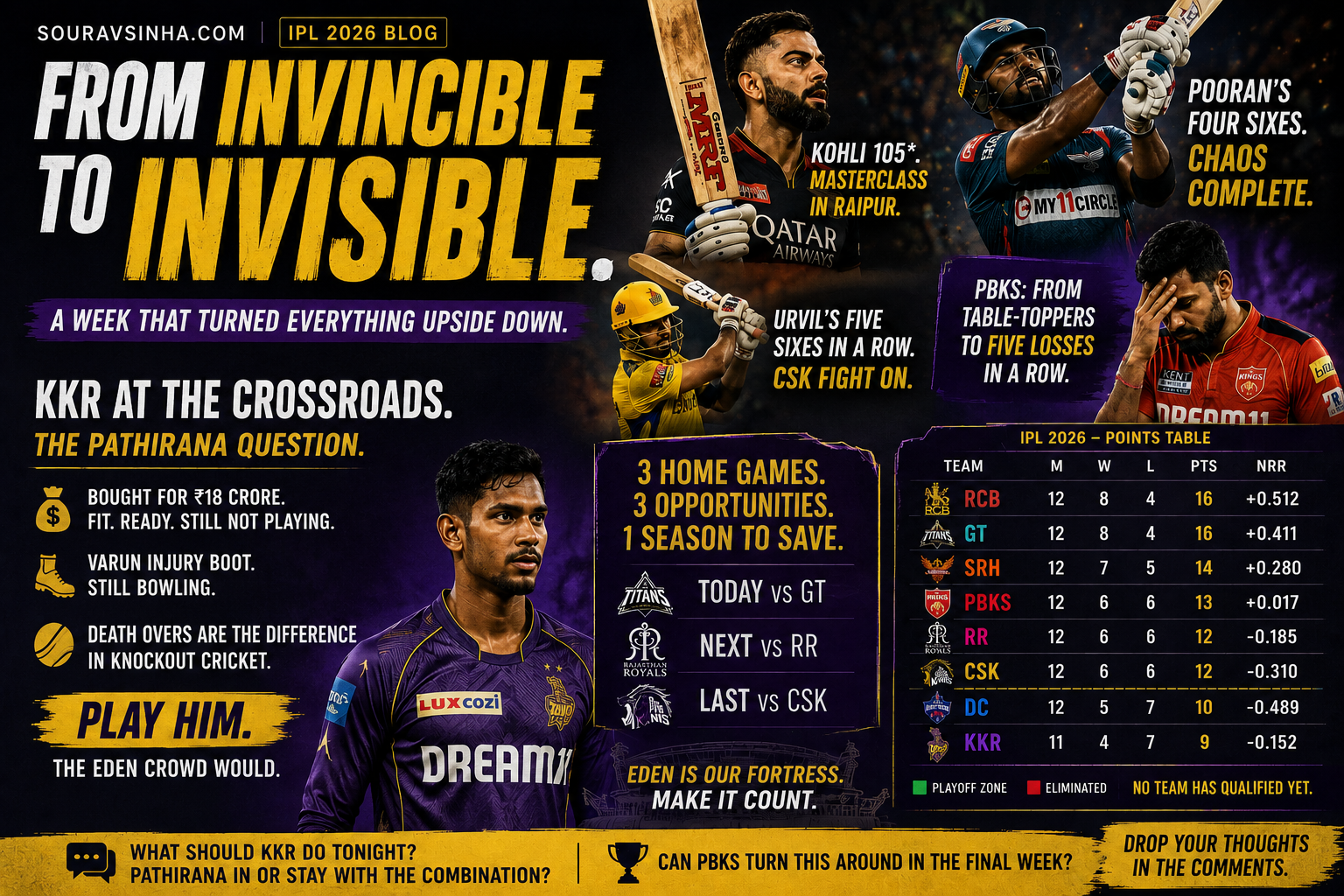
From Invincible to Invisible. And the Team That Still Won’t Play Its Ace.
There is a particular cruelty that only cricket can deliver. You spend eight weeks watching a tournament. You watch teams that were supposed to win f
Read More
The piece cleverly highlights how modern cricket’s batting dominance has sidelined bowlers, turning them into bystanders rather than game-changers. The humorous take on fielding lapses adds depth, showing how pressure and chaos have crept into even the basics. Beneath the wit lies a sharp critique of how entertainment has overtaken balance in the sport. It subtly questions whether cricket is losing the contest that once made it compelling.
986 runs didn’t scare me.
16 dropped catches did.
We’re not watching batting dominance… we’re watching missed chances turning into highlights.
Give bowlers half a chance, and suddenly this “batting era” looks very different.