Your Ads Are Lying To You. And You Don’t Even Know It.
I met them at a networking event a few weeks ago.
A young couple running a fashion brand. Sharp eye for design. Passionate about their product. The kind of founders who know exactly what they are making and exactly who they are making it for.
We got talking. And somewhere between the second cup of chai and the background noise of the room, they told me something that stopped me mid-sip.
Their sales were growing. Good months, consistently. Customers coming back. Word of mouth picking up. All the signs of a brand finding its feet.
But their ad platform was telling them the opposite.
Declining conversions. Campaigns that looked like they were dying. Numbers that made no sense when they looked at their actual bank account.
So they did what any sensible founder would do. They started cutting ad budgets. Pausing campaigns. Second-guessing every decision.
They were about to slow down a machine that was actually working. Because the dashboard was lying to them.
I asked them one question.
Have you ever heard of server-side tracking?
The blank look told me everything I needed to know.
The Dashboard That Lies
Here is what was actually happening to this couple’s business. And if you run a D2C brand in 2026, there is a real chance it is happening to yours too.
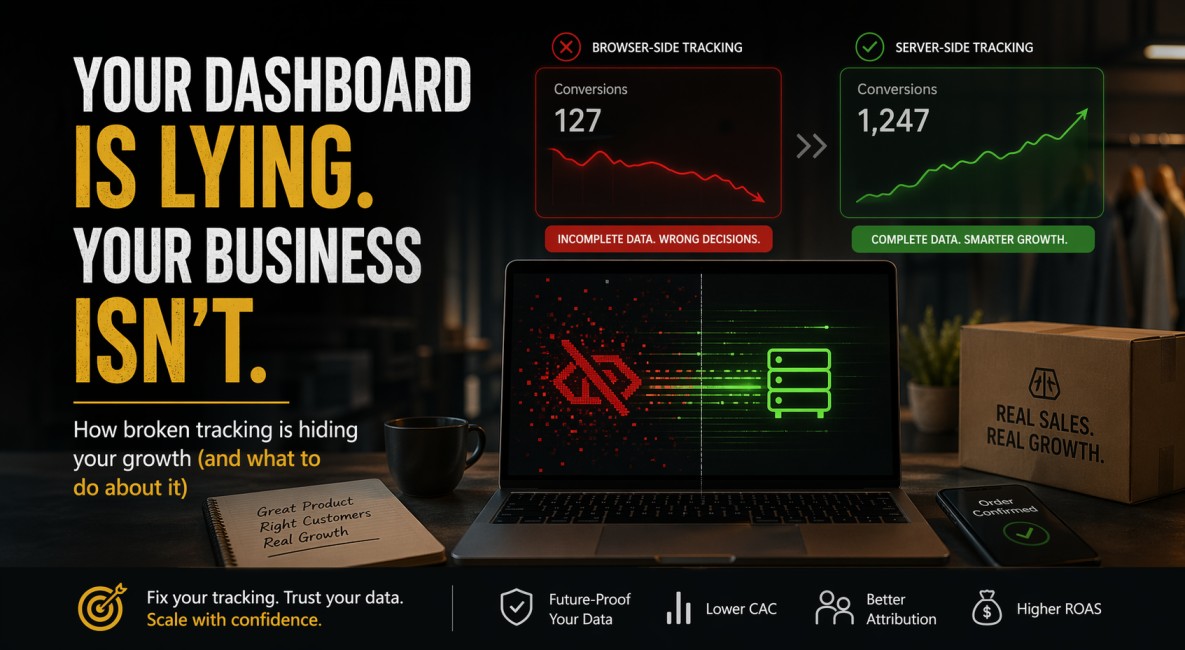
When you run ads on Meta or Google, those platforms track your results using something called a pixel. A small piece of code that sits on your website, watches what your customers do, and reports back to the ad platform.
The problem is that this pixel lives in the customer’s browser. And the customer’s browser in 2026 is a very hostile place for that pixel to live.
Ad blockers kill it. Apple’s privacy settings quietly strangle it. Slow mobile connections cause it to simply not fire at all. And even when it does fire, the cookie it leaves behind often expires within 24 hours. If your customer sees your ad on Monday and buys on Friday, that sale simply disappears from your attribution data. The platform never connects the dots. It thinks the campaign failed. It tells you to stop spending.
Meanwhile your actual business is doing fine.
This is what was happening to my new friends at that networking event. Their sales were real. Their growth was real. But their data was broken. And broken data was about to make them break something that did not need fixing.
The Fix Is Simpler Than It Sounds
Server-side tracking moves the entire conversation away from the customer’s browser. Instead of the pixel trying to survive on the customer’s device, your own server talks directly to Meta or Google. Browser to server. Clean signal. Complete data. Nothing gets blocked. Nothing gets lost.
Every purchase recorded. Every add-to-cart captured. Every customer journey stitched together properly, even if it spans seven days and four devices.
What this does to your business is transformative.
Your ad platform suddenly has accurate data to work with. Its algorithm stops making decisions in the dark. It starts finding the right customers more efficiently. Your cost of acquisition comes down not because you spent less but because the machine finally knows what it is doing.
And that 5:1 LTV to CAC ratio we talked about in the last blog? You cannot even calculate it properly if your tracking is broken. You are essentially flying a plane with a broken altimeter and wondering why you keep nearly crashing.
What I Told Them
I did not give them a technical lecture at that networking event. That would have been the wrong thing to do.
What I told them was simple.
You know your product. You know your customer. You know your numbers. What you do not know is what is happening in the background between your customer and your ad platform. And that gap, that invisible layer between your business and your data, is costing you money and causing you unnecessary panic.
They were relieved more than anything else. The confusion that had been building for months suddenly made sense. The campaigns they had been about to shut down were not failing. They were simply invisible.
We started working together after that conversation.
And the first thing we did was fix the tracking.
Everything else became clearer after that.
The Question To Ask Yourself
If your sales are growing but your ad platform is showing declining conversions, do not panic. And do not cut your budgets.
Ask yourself one question first.
Is my tracking set up to capture the full picture? Or is it leaving half the story on the table?
Because in 2026, the brands that win are not necessarily the ones with the biggest ad budgets. They are the ones with the clearest data. The ones who know exactly what is working, what is not, and why.
The ones who stopped guessing.
This is the second blog in a series I am writing on building a smarter D2C business. If you missed the first one on why your retailer margin is costing you far more than you think, read it here.
If you want to find out whether your tracking is leaking revenue, we can help you audit it.
Recent Comments
Related blog posts
Why That Retailer Margin Is Costing You Far More Than You Think.
A few weeks ago I was on a call with a founder. Smart person. Passionate about the product. Running a niche FMCG business that genuinely deserved to
Read More
The AI You Were Promised Is Already Obsolete
Let me ask you something. When was the last time you were genuinely surprised by what AI could do? Not impressed. Not curious. Actually surprised. T
Read More
IPL is Back. And Week 1 Has Already Given Us Everything.
Last night, I was barely breathing. Tushar Deshpande. Final over. Gujarat Titans needing 11 runs. Kagiso Rabada on strike. Rashid Khan at the other e
Read More
Collaboration amidst the new normal
Creativity needs collaboration. But Covid-19 has created a massive challenge in this aspect. Let's think of the good part. You no longer need
Read More
Cheap is expensive
What seems cheap is expensive! What’s perceived as expensive actually ends up being cheaper! We talk long term but think short term! I bought a fl
Read More
Thought-provoking piece. The idea that ads don’t just sell products but subtly shape perception and behavior really stands out. It’s a strong reminder to question not just what is being shown, but why it’s being framed that way and how easily familiarity can be mistaken for truth.
The scariest part is that ads no longer just sell products, they sell choices and quietly convince us those choices were ours all along. Somewhere in that process, we lose a little trust in our own instincts, and that feels more expensive than anything they’re trying to sell.