 There is no bravery in working for 12 hours every day and in the process compromising your health and family life.
There is no bravery in working for 12 hours every day and in the process compromising your health and family life.
You should have a clear distinction between your work life, family life, and yes “ME” time.
How to go about it?
First things first: YOU have to take control.
People around you can only give advice but for effective changes to happen, it’s you who will have to DO it.
The human study tells us that your concentration remains at the optimum level for 50 minutes at a stretch. Ideally, it’s best that you work for 50 minutes and then take a 5 minutes break. And let me add you can’t work at a stretch for more than 4-5 hours. This means you need to take a longish break after 4 or 5 hours. Even after following this protocol the best you can give in a day is 10 hours of work including all your breaks. And by best, I mean worthwhile work.
Today most people are working from home. I see many people taking this event too casually because they fail to keep a proper routine when working from home. Just because you are working from home doesn’t mean you should change your work schedule and be too flexible with your timetable.
So how do you plan your day?
This is what I suggest!
Creating this plan is good but what will really help you is when you stick to the plan!
I have seen colleagues telling me that it’s not possible to make and stick to such plans because they have a lot of unknown work that keeps popping up.
I tend to agree with this argument.
Every day something new or unwanted stuff comes up which is mainly fire fighting, especially for managers. By the time they douse that fire a lot of time gets lost and then they struggle with their time management. This eventually leads to them working long hours! But, the fact is that you will lose steam and stop loving your work if you follow such a rigorous routine.
One hack that I can suggest to you, is to follow the Eisenhower matrix in your work schedule.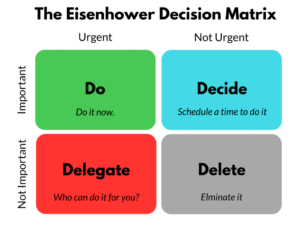
As you can see if you can prepare a matrix in this format and keep updating daily you will be able to eliminate a few tasks which don’t need your immediate attention. People fail to plan this and when you fail to plan properly you will end up putting up long hours at work.
Extended hours at work is very bad for your physical and mental health. It also creates havoc in your family life. Did I tell you that your quality of work also reduces when you do too much work in a day?
If some unknown activities come up on a particular day, rework the task priorities using the Eisenhower matrix but ensure that you finish the most important tasks without fail. People fail to prioritise their activities because they do not have a mental model at hand. With the Eisenhower matrix, you can very well schedule your priorities or reschedule them at any point in time.
Remember the golden rule:
And each of the above activities should be part of your routine every weekday.
Do not show your frustration in front of your colleagues that you are working long hours or on weekends because you can control your work hours IF you want to control. What’s needed is a little bit of focus in planning your day and activities better.
How do you plan your day? Are you wasting your time on activities that are of less priority? Have you used the Eisenhower Matrix before? Did it help? Or do you have some other suggestions?
Please do share your views and thoughts – I am all ears!
 It’s been one year and many companies are still struggling with managing employees who are working remotely.
And this is happening across many companies around the world.
Software companies in India who have thrived on the outsourcing model are struggling with managing their own employees! This is the biggest irony.
There are various reasons why this is happening. I thought about the same and here is my understanding of the whys!
I will dwell on all these points in detail but first I want you to look at the issues that are happening across the board.
What I hear and what I gather from numerous conversations on WhatsApp, Twitter and LinkedIn are that companies are forcing people to get out of their homes and work from office. This of course right now doesn’t hold true for India because many of the states are in lockdown and so you are forced to stay indoors. But when India was opening up late last year many companies more or less forced employees to work from office and if they didn’t, salaries were being deducted. A very clingy effort from the management of these companies I have to say.
All the onus won’t be with the management of these companies of course because if the employees are seen going for vacations then there is no reason why he or she shouldn’t come to the office once or twice a week. One thing is for sure that to build great relationships you need face-to-face casual meetings and discussions. And with the virtual onboarding of employees, it’s difficult to build such rapport over Zoom and Google meets. So it’s not such a bad idea to meet in small groups in the office once or twice a week (of course with all safety measures in place). But if there are employees who are not mentally confident to go out of their homes why force them? Especially those who didn’t go on vacations for more than 12 months? It shows that these employees have given particular importance to follow protocols till the COVID-19 ravage doesn’t stop. These people shouldn’t be forced. I do understand that there are employees who have taken advantage – these employees have gone out for vacations from November-March and when they were being called to the office they came up with excuses. Right or wrong we can keep them aside but these people don’t have an excuse because they had already taken the risk of going off to far-flung places during the pandemic. That’s why I said that the problem lies with both parties.
The thing that bothers me most is why didn’t companies develop systems and protocols on how to manage a remote workforce. Especially software companies! As a software outsourcing company if you are making money by selling man-hours and telling your clients to manage projects/employees remotely then why you yourself are struggling to do the same? This is food for thought because if you are struggling to manage employees remotely sitting in India, then imagine the struggle the clients had been facing for so many years, and for them, there is a culture gap and a language barrier too.
As humans we tend to never look inside for our answers, we always look for answers outside. We will never accept the problems that lie within us – we will always blame situations and we will always blame others. We tend to forget that when you point one finger towards others, another 3 fingers are pointing towards you but we keep ourselves blinded from this fact.
MS Dhoni made this very important comment once, “control the controllable”. So whatever is in your control you should always look at improving on those. Your employees will follow the process you set, they will follow the benchmarks you set. So you follow those yourself and make sure that you inspire others to follow them. In fact, when you do walk the talk I am sure people will follow the path. Most would.
Now let’s look at the various reasons why companies have been struggling to manage their employees remotely during this pandemic.
1. Communication
In Work from home format, the most important aspect that all parties should look into is communication. I always harped on this fact more than 14 months back when India was planning for the nationwide lockdown. I told in an email to all our employees to communicate openly and if required over-communicate. Most people across various organisations didn’t follow this properly because there is a problem when it comes to open and honest communication and that’s transparency. So as leaders, you need to ask yourself, have you been communicative enough during the start of the lockdown? Have you tried to give confidence to all your team members so that they can openly communicate? Or have you been hands-off? It was a new way of working and it was important for all the leaders to take the first step. If you have then I am sure you would have got reciprocating team members too. I do understand a hand has 5 fingers of different shapes and sizes and even after you try your best some might still try to do their own way. Well, in those cases you will have to believe that these people are not a culturally fit for your organisation and they will have to be unfortunately shown the door.
2. Lack of empathy
Building relationships is not easy! And building them when everyone is working remotely – it’s more difficult. If communication plays an important part, showing empathy and being compassionate towards your colleagues is equally important! As a manager when you call your team member you can’t just call her and assign tasks – you should first ask how is she and how is everything going at her family front before coming to the work-related things. We are not robots, we are humans and we expect basic empathy when we are communicating with humans. I feel in many cases the relationship breaks because the manager and the team member do not synchronise properly. A simple thank you works wonders. A simple question, “how are you doing today? or How is family?” makes the person connected with you. Try it and you will see that you will be able to build a team environment where everyone feels for each other. And when that happens it reflects in the quality of work too. A happy mind gives better results.
How do we change it? The leadership has to take the onus to speak to the managers and follow this principle as stated above. When the managers see how the leaders are speaking with them, then the same will be reflected back to the team. Once again communication is the key. And that’s why I kept communication as the first point in this discussion. We as leaders have to walk the talk. People will learn from us so how we show up will be grasped by the managers and they will follow those principles down the line.
A little show of empathy and compassionateness will go a long way to build a rock-solid team. Working remotely won’t stop your team members to give their best because they know they have a great leadership team and a caring manager. They will give their best even in very difficult situations!
3. Due Diligence
Hiring the right people is a challenge for any company and it’s even more challenging when the entire activity is being done remotely. But, we have to accept the situation and do the best we can. Recently I wrote about team building and in that, I focused on not having a team of more than 10 members. In the current work from home scenario, any team which is having more than 10 members is a recipe for disaster. This is where many companies are doing it wrong. All team members won’t be similar and hence if managers are managing a team of more than 10 people then it would become highly improbable for them to do justice to their work. This will eventually lead to customer dissatisfaction – worse still, the team members and their manager would also be stressed out. All companies must have a proper plan in place as far as the team break-up is concerned.
4. Proactiveness
Everybody understands the challenges we are facing today and hence all team members must show that they care. Things can be under control if we stop the last-minute surprises. If you are unable to work for a couple of days or your conditions at home stops you from giving full attention to work, then it’s your duty to inform your reporting head in advance so that they can plan accordingly. What is happening with Work from home scenario is that people are not being proactive enough to let the customers or their reporting head know about their problems in advance. This is leading to a scenario where the trust factor takes a beating. Other than the stress of missed deadlines, the manager now has this additional pressure of managing the client as well as the management because both these important stakeholders are hardly getting to see the real picture.
I offer the following solution:
Create a group on Skype or WhatsApp (Now we have Google Rooms too) and if anyone is having any problem or issue it should be raised in the group immediately so that a senior colleague or a manager will come to know in advance. Once again communication is the key and that’s why I put that as the number one problem. Many people have this apathy of communicating transparently. But the fact is if you communicate openly things get better for all parties.
This of course starts from the top. The management should be transparent in their communication and should let people know what are the expectations. And if someone is bypassing the rules which are affecting the company’s work culture then it should be handled quickly rather than sitting on it. Important decisions should be taken quickly and should be communicated transparently.

5. Sense of responsibility
As a professional, you should have a responsibility towards your work. There will be situations where you might not be able to finish a particular task within the set time – it’s OK – just let all the stakeholders know about it without being followed up. If you are accountable for your own work, I am sure, you will do it. So it’s important that as managers you instill this in all your team members. Give them freedom so that they can talk openly. Many times people go inside a cocoon and look for excuses only because the managers don’t communicate effectively. Give the team members the authority to plan their work and deliver. You will get better results when you stop micro-managing. This doesn’t mean you won’t check in with your team member once a day. As a manager, your duty is to see that your team member is happy at work. If there is any botheration – which you can only feel if you have a regular conversation with them – proactively solve their problems.
Team members will be happy with their managers when they see that their leader is going out of their way to help them out. When this happens proactively across the length and breadth of the team, you will see that people taking more ownership at work.
Yes, indeed, some will still take advantage of the situation. Unfortunately, you need to realise that people who do not have accountability and who only give excuses, are bad for your company and hence you will have to replace them. Never delay the fire because if you do that, you will find the good people getting frustrated because these people are now taking more pressure because of a couple of bad apples. Never let this happen because your company is going to suffer in the long run if you do that.
6. Proper usage of systems
Collaboration and communication tools saw an uptick post 2020. Online tools for sales, project management, human resources management, etc saw increased demand, and companies who didn’t invest in such tools earlier had to change post Covid-19. Also, real-time online video meetings like Zoom, Google Meet, etc saw an increase in demand too. Having tools in place is one thing but that doesn’t guarantee smooth work if people do not use these systems properly. If you get into a video call and switch off your video then how will the other people know if you are available online or not? Trust is a very important factor in any relationship and it starts with transparent communication. Managers need to ensure that all team members have their video switched on while having the meetings. People feel shy about the background since all are working from home. There is a simple hack for this: Get a custom banner designed as a background and use it for all your meetings. It can be a good branding exercise too.
Similarly, CRM and Project Management tools should be used properly and all senior people in the organisation should ensure that all are maintaining this as a habit. Responsibility comes with accountability. All are working from home and hence it is the duty of everyone to maintain these protocols so that there is seamless work across the teams and the clients don’t suffer.
But all this starts from the leadership and how they communicate to their teams. When you communicate the company’s goals and align them to the individual’s goals, things get easy. This is not an easy task because more than 50% of your team might not align so easily and this is where decision-taking becomes so important.
Are you able to communicate your brand’s why with your team’s why? If not, you will keep on struggling to maintain any decorum with remote workforce management. We are living in strange times and I do not see normal office work resuming for another 12-15 months in India. Businesses will be crushed to the ground if people do not pull up their socks and take stock of the above 6 measures.
But first things first – communicate.
Communicate doesn’t mean telling. It means engaging. You need to listen to the real problems and solve their issues – the genuine issues. If you aren’t able to do that then unfortunately competitors who are doing it will go too far ahead of you.
Are you able to turn this crisis into an opportunity? Are you thinking of Growth or are you thinking of survival?
 Board exams were canceled and suddenly my son had a lot of free time on his hand. The lockdown inculcated some bad habits and one of those was the usage of mobile phone where he spent too much time watching Netflix. As the exams approached he reduced that and involved his time in studies but with exams getting canceled he suddenly had too much time in his hand. That was the precursor to his dilemma of what to do!
We had got his class XI books a few days ago before the cancellation notice came (good he was proactive on this). So he took out one of his literature books and started reading one of them. It was a book written by Vijay Tendulkar: Silence, The court is in session. He spent about 4-5 days finishing that book and then told me to read it because he liked it a lot.
I said if you liked it why don’t you try some other storybooks in fiction? He never read books and though my house is filled chalk a block with books and I am a voracious reader I failed to motivate him thus far. That day something changed and he said ok if you have any mystery novels give me. I jumped out of my workplace and went to some of the recent purchases and pulled out One Arranged Murder written by Chetan Bhagat. I had purchased it earlier this year but didn’t read it yet. To my surprise, for the next 2 days, I could see him always with the book in hand and on the third day he returned it saying he loved it and that’s why he could complete it so fast.
I was secretly amazed. Two books in one week! Human minds can do amazing stuff if you just think you can do it. My dream of making my son read was slowly getting fulfilled.
I waited for him to come to me and the very next day he came asking for another book. I was ready and this time, I asked him to read The Alchemist. A few days later he told me he is enjoying it and feels it’s better than Chetan Bhagat’s book. Not surprising, I told him because that’s why The Alchemist is known as a classic. After finishing that book, I knew he will come to me again and this time I handed to him Shoe Dog by Phil Knight. That’s the one he is reading now. His summer vacations are on so he has the time to read as much as he can.
The only way you can learn from others’ experiences is by reading books. Read any genre. Read whatever you feel you like to read but just read. You will eventually move to non-fiction, biographies, science, etc but to start just read. It’s a good habit to have and it opens up a new world for you.
After seeing my son reading so many books over the last few weeks, I realised that the best way to start making reading a habit is by reading whatever you like to read.
I have been a voracious reader right from my childhood days. Growing up as an introverted child, books were my best friends. Those days, I used to read a lot of comics which was followed by children’s books mainly in Bengali written by Upendrakishore Roychowdhury, Sukumar Ray, later Satyajit Ray, and others. I also read a few books on cricket. As I started growing up, I got hold of Tintin and I also used to have a stack of Nancy Drew and Hardy Boys in my house during my school days. So if you are starting as a reader and you feel bored after reading a few pages of business or self-help books, then first think like a child and pick up the genre of books which you love to read – it could be fiction or it could be biographies of some personality whom you have high regard for. I know a colleague, who started reading Sachin Tendulkar’s autobiography when I first asked him to read books. That was 5 years back – now he has started reading business and self-help books.
Just like you graduate from school to college to university, reading is similar. If you do not have a habit of reading books then do not start with business or self-help books right away. Graduate yourself from fiction to non-fiction to business and self-help books. Reading is a journey and so plan your journey. Do not get into the numbers, just take one day at a time. Give yourself a goal of reading 6 books in the first year and start reading them.
As always, you need to start first. You can’t just plan and sit on it. Plan a time for yourself when you will read the book and stick to it. Do not stress yourself too much. Try to tell your mind that you are going to enjoy this activity. If you do not like or feel bored after reading a few pages of a particular book – keep that aside and pick up something else. I have more books on my shelf than I have read. There is no harm in keeping a lot of books – this way you can pick up something else when a particular book doesn’t give you the thrill. The reading process should be enjoyable. Do not force yourself in doing something which you do not like. But if you say you want to be a great business leader but I won’t read books then I am sorry to disappoint you – that’s not gonna happen. If you are ambitious and if you want to make something bigger than yourself before you die then you will have to learn and there is no better place to learn different things than books.
Can you become a great salesman without learning about persuasion, psychology of influence, or negotiation? You can’t because you need to understand how human beings evolved and how you can predict better. These books help you to understand the human mind. There are tons of books on various subjects and frankly, we all have so little time but so many things to learn.
I hope to write more on how you can read better in my future posts and I also hope to share some of my favourite books on various topics in the coming months.
I hope you will be motivated to start reading. I kept reading and writing in front of my son for the last year and finally, he picked up. It’s one of my happiest moments in life to see my son picking up books from my shelf. If he can do it, I am sure you can too. It’s just the first step that’s important. Are you willing to take that?
 I used to love the tennis matches involving Steffi Graf during my school days. Initially, it used to be with Martina Navratilova, then Monica Seles, and later a few others. She was a champion and I was a fan.
Those days I never understood the money part in professional sports but when I later came to know about the gap in pay structure between men and women, I felt awkward.
Simply, think in this way.
The match between Boris Becker and Stefan Edberg in the 1988 Wimbledon finals was a classic.
Just one day before that match we were witness to another classic. It was the match between Martina Navratilova and Steffi Graf.
I loved both the matches. The crowd loved both the matches. But the pay gap between both the champions was close to 15%. Things changed over the years and from 2007 onwards the gents and the ladies champions both get the same prize money.
Ok, that was the 80’s. A sport primarily played in western nations.
Let’s come forward and look at what’s happening in a different sport in India.
Let’s look at cricket.
 Indian ladies team in the last few years have been finalists in two world cups and have reached the semifinals on another occasion. Gone are the days when the Indian ladies were pushovers. They are as good as any team, especially in white-ball cricket today.
But why then is the pay gap between men’s and women’s teams? And the pay gap is not small – it’s more than 90%.
Why so?
Women fail to raise their voices. They fear that by raising their voice, politics could see them sidelined from the team. Career s will come crashing down. So they take whatever is being given and play the game.
Wrong choice!
Indian men’s cricket has grown leaps and bounds over the last 2 decades by getting more and more opportunities! Have we given similar opportunities to our women’s team? There are two problems as I see it:
1. Men don’t care
2. Women don’t raise their voice
Women get easily satisfied with whatever they are getting. They start comparing with what women used to get in comparison 2 decades back. Well, then why don’t people compare what their men counterparts used to get in the same period?
You will find men are earning much more and women’s growth has been far lower!
 What Sachin Tendulkar is to Indian cricket – Mytheli Raj is to women’s cricket (She is the highest run-getter in Women’s ODIs and the only Indian ladies cricketer to score more than 10,000 international runs)! Think of Jhulan Goswami – she is the world record holder of taking maximum wickets in ODI cricket. But do they get similar respect? Forget finances – respect is not even close to IPL cricketers. Why such disparities are being allowed?
We are in 2021 and such a mindset is not right.
Women’s game in India and across the world has improved leaps and bounds. With more opportunities, we are seeing skillful cricketers coming to the fore. Look at Hamanpreet Kaur, Smriti Mandhana, Deepti Sharma, Shafali Varma, Richa Ghosh, Rajeshwari Gayakwad – exceptional talents across the board. But look at how they are treated! Women cricketers had to arrange their trip to Mumbai personally whereas the men were given chartered flights! Why such disparity?
Our society will only improve when we remove this disparity. It all starts with the mindset.
I hope we in India raise our voice against such disparity! I have seen educated friends not accepting this! Many feel women should be paid lesser than men. I feel sad for these people – they have not grown in their minds. These friends have daughters at home – my question to them – will you accept if your daughter gets a lesser salary than her colleague only because she is a lady? If not then why don’t you raise your voice now?
The problem is most people are selfish. As long as it doesn’t hurt them directly they don’t realise. Very few people have the maturity to think of the greater good or raising a voice for society. But we need to change. Today women are equal partners in the nation’s growth and it all starts at home!
Let’s change our mindset! Let’s change ourselves for a better society.
Read 25 pages a day and you will end up reading 36 books in a year.
Write one page a day & you will be able to publish a book at the end of the year!
Walk for 5 Kms per day and it can lead to reducing 8 Kgs of your weight in a year (Caveat: control your diet – remove sugar and carbs).
Saving Rs. 100 per day means Rs 36,500 saved by the end of the year. If the same money is invested in a balanced advantage fund this savings will become Rs. 50,000 by the end of 3 years.
All the above data is amazing, isn’t it?
All these start from simple and ordinary habits which I call micro habits.
Micro habits are very ordinary habits and can be picked up very easily by anyone but the best part is that they can lead to extraordinary results.
Human beings are slaves to habits. So how about becoming slaves to those habits which can help you grow both from the mind as well as from the pocket?
We look too far ahead and get disappointed thinking that the goal is too tough to achieve.
If you weigh 100 Kgs and your target is to become 80 Kgs, it’s a tough road ahead but if you have a proper diet chart and give 30 minutes of your time in the mornings and evenings you can reach that goal within 24-30 months.

I find people hate reading books. I know it’s crazy because people who are reading this post must be having reading as a habit otherwise you wouldn’t have come this far but how about having a simple target of reading 2 pages per day? You can finish a 200-page book in 100 days which would easily translate to 4 books in a year. It’s a positive step, isn’t it? From 0 books the previous year to 4 books this year!
Then bring in the power of 1% and have a slightly higher goal for the next year. 2 pages per day can now become 4 pages per day for the next year. This is how you improve. This is how you utilise the power of 1%. This is how you build up ordinary habits. This is how you end up with extraordinary results.
Think of an iceberg! People only see 10% but it’s the 90% that’s below the surface of the water that matters. People don’t see it. Success is also similar. People see the successful you but they don’t see the hard work that you do behind the scene.
Hard work begins small and then you build on it. When you start it’s difficult. But soon you will get used to it.
The first book that you read would be tough to complete. Give yourself a prize when you finish it. Always enjoy small victories!
Saving Rs. 100 per day doesn’t look like a big deal but if you think of Rs. 50,000 it definitely does. Now when you see that saving Rs. 100 per day and investing that money in a mutual fund can get you to Rs. 50,000 in 3 years, doesn’t that excite you? Now think, as the money grows, you in the second year save another Rs. 36,500 and then again in the third year and in actual you will have more than Rs. 1.3 lakhs by the end of three years. Cool isn’t it? I told you, people see only the tip of the iceberg. It’s the simple habits and doing it daily that makes you successful.
Then, why do people avoid these habits?
Successful people do boring activities daily. This is how they build up their habits! They have a focused goal in front of them and they make sure that they won’t stop till they reach their goal. The funny part is that by the time they reach their goal they have already shifted their goalpost because goals are always aspirational.
If you think too far ahead you will not reach your goal because you are bound to get disappointed since success doesn’t happen in a linear curve. You will have days when you are down but if you are focused on your goal you will get up every day to go for your goals.
Why I tell people to read books is that it’s never possible for anyone to learn everything alone. So it’s better to learn from the experience of others. Books teach you. The author’s experience should be understood and one needs to grasp the understanding and try to put that to good use. Remember reading just for the sake of reading will not help. You need to put that in use to gain the benefits. That’s why I advise reading slowly.
I also advise people to write because of two reasons:
There is another reason. By writing down the important points you get into the habit of writing. A 200-word LinkedIn post of your yesterday’s learning can easily be posted as 5 tweets the next day. It’s that simple.
We are lucky and we should be grateful for the same.
I see so many people who are struggling around me. I can’t help everyone but I try to help some. So if all of us help a few people around us, things will get better in our society. Always pay it forward.
By gathering knowledge, by garnering wealth we might be able to help others. I keep saying there is no use in being an influencer if you can’t help others.
Count the “thank you” not the money in your bank account.
You can achieve this stage by first building habits.
But before “more” first start! It’s the first step that matters and then it’s all about the game of consistency.
 We, humans, fail to turn up every day. Since you feel the activity is boring you won’t turn up every day or won’t want to turn up every day. But to be successful you will have to do boring activities daily.
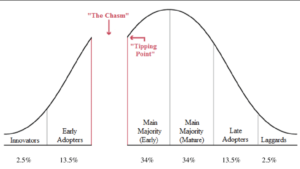
Rome was not built in a day and you too won’t be successful overnight. But one day the tipping point will come but it will only come for those who believe in themselves – Who creates good habits and become the slave of such habits and who are relentless to achieve their small goals. I call these goals small because I want you to believe that they are easy to achieve. Reading 2 pages per day for one month is an easy goal to achieve. But by the end of the 100th day, you will become a slave of this habit. And if you can continue it for one year then you will not look back. You might look back but only in amazement of yourself because you will realise how far you have travelled and you will find that it’s a different you.
 Did I ever think to write a book? Probably yes but I never got myself to put in the hard yards. Then I decided to write 1000 words per day. Believe me, most of the days I ended up writing close to 1500 to 2000 words. These include my LinkedIn posts and tweets. Then voila one day I realised my book has crossed 70,000 words. I was amazed at myself that I could write so much in 6 months. People who know me very closely will vouch that I didn’t have the patience of this magnitude to finish a book. I could do it and I believe anyone of you can do it too.
My weight loss journey is still a work in progress. It’s less than 6 months since I am into this regime and my wife told me the other day that you are now habituated to go for your morning walks come what may. I realised it’s true. My sleeping habits have changed. My waking habits have changed. And I am discovering a new me. You can do it too.
It’s the small simple micro habits that you need to focus on.
You can do it. I know you can. Do you believe in yourself? What’s stopping you?
A leader gives a vision and shows the path.
To follow the path and to understand the vision and connect to it, is very challenging. As a leader, you have a very important role to play to inspire your team so that they follow the path towards your set goal.
One important aspect of all this is goal creation. Each of your team members has a personal goal for sure. Some say it. Some don’t. As a leader, you need to develop an environment where your team members can speak with you frankly. When your team members believe that you are working for “their” growth, they will surely open up and speak with you from the heart.
Communication plays an important role. With good and transparent communication, your team members will open up. They will tell you their likes and dislikes. Then you will come to know what makes your team member happy and what’s her personal goal in life. People feel shy talking about their goals. People feel that if they speak of personal goals that are not connected to her current business goal then she won’t be given a patient hearing. That’s why “listening” is so important. As a leader when your team member speaks, you should focus and listen rather than snapping in between. I have seen many times that candid conversations get broken because the leader snaps in between which makes the team member jittery and soon she goes in a cacoon. To have a candid environment it’s important that you let your team members speak.
It’s very important to be a good listener too.
Now, to be a good listener doesn’t mean that you stop talking altogether. You need to listen and ask relevant questions in between or validate or amplify what your team member is saying – that way your team member understands that you are part of the conversation. This is an activity that will take a lot of time investment but it’s worth it because knowing your team member and her goals is a part of your team-building exercise. Once you know your team member’s goals, you will be able to align her goals to your team’s and organisation’s goals.
Once your team member gets candid and shares with you, her goals and her passion, you will then be able to understand how you can connect it with her career. I had spoken about the 3Ps to success in one of my blog posts previously. It would be a good time to read that once again.
Finding your purpose in life is not so easy because you need to connect the dots going backward. You will not be able to connect the dots forward. Simply because no one can predict the future. Hence, go back to your early teenage years and think about what work used to make you very happy.
I once won an essay competition in school – that’s the only competition that I ever won in my life but that win made me happy and that inspired me to write small essays about my daily life. This turned into a dairy which I continued for quite some time before leaving that habit (wrong decision) after a few years. Today if I am writing so much it’s only because I was able to connect the dots and realise that writing makes me happy – it makes me connect to my soul – it helps me to talk to the world.
Sometimes teenage years might not give you the right purpose. Sometimes it’s in the 20s so whatever be the age, find out what made you truly happy.
Everyone is talented but some do certain things very easily than others. – That’s your special talent. That’s what you are good at.
What you love to do (Purpose) and what you are good at (Passion) complete your 2 Ps. That’s your purpose and passion. Once that’s defined now connect your profession to it.
Say you love to write and you write well then see if you are into the Content Development work by any chance? If not are you associated with sales or marketing? Media? Digital agency? Advertising? If yes, then the third P (Profession) gets connected and you will be happy at work.
This is the work of the leader – to help you connect your dots – to help you in aligning your goal to the company’s goal and in turn, she helps you lead a purposeful and happy life at work.
Few things happen when this is accomplished.
In a corporate set up another aspect that bothers employees, is growth. Many feels stagnated after a few years. The question is why? Is it the money? If yes, then one should openly talk to her reporting head because you should be paid what you deserve and I am sure any company will pay the best possible salary for their superstars. Are you a superstar? If yes, then definitely your personal goal is aligned to your company’s goal and when you speak with your reporting head about your finances you will get a patient hearing.
So let’s recap.
Nobody wants to lead a stressful life and to remain stress-free at work, you need to align your personal goal to your company’s goal.
For that to happen you need to find your purpose and passion in life by connecting the dots and see how your current profession can help you reach your goals. If it’s not connecting then this is not the right place for you. Do not stay in a company just for money because this will only lead to stress and unhappy life.
When you work, which makes you happy and you get paid as per your satisfaction then the world feels like a better place to live in. This work satisfaction will automatically help you in having a happy life at home too. This is an ideal work-life integration. People feel that you can’t reach that stage or most don’t reach that stage. Indeed, most do not reach this level of happiness because people measure happiness wrongly. People measure success wrongly. It should never be measured with the amount of money one has. What’s most important is are you leading a good life? Are you happy in your current profession? Is it helping you in finding your true purpose? Is the job helping you to reach your goals? Are you stressed? Are you having a lovely time with your family? When you have a positive answer to these questions – it means you are happy and finally that’s what matters.
As a leader, if you can help your team members find their true purpose in life and help them to be happy at work – remember you are doing an awesome job.
Point to note: People working under great leaders are happier, more productive, and more connected to the company’s goals. Your company’s bottom line will be positively impacted if you as a leader invest in your team’s well-being.
I keep telling, “Your NETWORTH is not the amount of money you have in your bank, nor the number of connections you have in social media but it is the number of Thank You’s you receive every day”.
That’s how I measure success!
How do you measure? Have you been able to understand your true purpose in life? Do you want any help in connecting the 3Ps? Please reach out – I am always available.
Take Care everyone! God Bless!
Some talk a lot. And some talks less.
When you are angry – do you talk more or do you talk less?
Does shouting when you are angry help? Or does being silent get the message across better?
These are some questions that kept bothering me for many years.
 I was an individual who over a period of time from being “a not-so-reactive” person turned into a very reactive one. As this shift happened over the last decade, a few of my friends kept pointing this out to me. I initially denied it as a problem but then I sat down and gave it a deep thought and I realised that reacting to situations is hampering me mentally as well as physically. Yes, when I am reacting, for that moment I could stop the conversations, I could stop the criticisms but in the long run, problems were not getting solved.
One way to stop reacting is by becoming better listeners and another way is to do deep meditation.
I have now realised that silence is the best medicine. Silence is more powerful than shouting or reacting or arguing. Let’s look into some pointers on how you can improve your life with the power of silence:
1. Never Defend Yourself
No single individual can be found without faults. Our vulnerabilities are what defines us and how we accept that and improve ourselves define our growth.
Weak people give excuses, strong people accept their mistakes and improve on them. The first step towards growth is to accept your mistake. When you accept, don’t think that you have lost a battle. This has nothing to do with your ego – it just shows that you are matured enough to learn and improve.
Defensive people give excuses and shouts at any given opportunity or under any criticism but by accepting your mistake, you move up the ladder because now you are ready to learn. Once you learn, you will get better.
2. Never Complain
Very early in life, one of the most important things that my parents taught me was to never complain. My father always told me that remember you are lucky to have whatever you have because there are millions of people who don’t even get their basic needs fulfilled. My father struggled financially to meet ends meet but I never saw him complaining or blaming his luck. He accepted the truth, accepted the reality, and worked hard for a better future for his family in which he eventually succeeded.
To know more about him, you may wish to read this blog post which I wrote last year.
A complaining attitude is a useless habit because it’s just a waste of time. Either build power to change the situation or change your perception because nobody has the time to spend on your complaints. And it’s only possible if you believe in the power of silence. People who do not believe in the power of silence are generally the ones who give excuses and raise complaints!
When people do harm to you or you feel you have been given a raw deal, don’t complain – take a step back, try to understand why the situation came up, and ask yourself how and what you can do to change the situation in your favour.
3. Don’t Argue
What you say and what you do should be in alignment – Always.
As I keep saying – Walk the Talk.
Your point of view might not ring a bell with me but that can’t be the reason to argue.
People who do not believe in the Power of Silence get into arguments. Successful people don’t argue because they know an argument is a waste of time. Nobody wins an argument but you lose valuable time. What you also lose is your mental peace. Be at peace with yourself and that’s only possible if you can hear your inner voice. Your inner voice will never tell you to get into argument or a fight. I am not advocating that you should not fight for your rights but what I am saying is that do not get into fruitless arguments. Put your points forward based on data and logic but don’t let your emotions take over. When you get angry and get into a fight or argument, you lose your inner peace which will hamper your work as well as your body. Finally, you need a good night’s sleep and when your mind is not at peace you won’t get a good sleep which finally will lead to work-life imbalance.
The argument doesn’t get you kudos because it’s only the results that count. When you can deliver results without getting into arguments, people around you will realise who is more important and at that time you and others will realise the Power of Silence.
4. Don’t React
Respond to situations – don’t react to situations. I had this habit of replying to hostile emails too fast. This led to email wars. Over time, I have understood that it’s better to respond to hostile emails after 24 hours or after a good night’s sleep.
Many people respond too quickly when they get a scathing email from colleagues or clients. It’s important to understand the perspective first before reacting. Both of you are wearing different hats and definitely, her perspective must be different from yours. But does that mean you have to react with another scathing email? If you start, what will result is a big email chain with no final solution as both of you will try to win the battle. The bigger cause will be lost.
5. Choose your words
If you believe in the Power of Silence, you will listen more and talk less. Wasting time on needless gossips or arguments will never take you far. You need to learn to speak only when needed. If you speak out of turn without ascertaining all the facts, you will end up with more enemies and your mental peace will lie in shatters.
It takes years to build a relationship so never destroy it by using words that might hurt the other person. Mentally strong people can speak through their eyes and through their silence. Try to do that, it would be difficult initially but once you are able to do it, you will find that the world is a better place to live in. Do not think that people will take you for granted if you do not speak much because the quality of words matters not the quantity.
6. Think & Sit Alone
Are you able to sit alone in a room for 30 minutes and do deep thinking? This is not something that people generally follow but it’s a fantastic habit. You can do it early in the morning or before going to bed. You are all by yourself and you will think about your problems and when you think aloud, you will hear your inner voice giving you the solution.
I know it’s a boring activity for some and I am sure right now after reading this many would like to move to the next paragraph but believe me, try this for 1 week and I am sure you will come to know how powerful, silence is. When you are all by yourself, thinking deeply about your problems, you are in meditation mode, you are in focussing mode – it’s a mode that is very difficult to trigger but it gives you solutions. Talking to others might temporarily solve your problems but real problems will remain. Real problems have to be resolved and you are the only one who can resolve those problems. So sit still, think deep and your mind/body/soul will tell you what you need to do to get out of the problem.
7. Seek Truth
There is your truth, there is my truth and finally, there is the Real Truth. Always understand that by telling, I am truthful – you do not become one. Hence, it’s important to always seek the real truth. We human beings are biased and that makes us blind to the real truth. We make ourselves believe that all is ok even when it’s not and our system rots inside.
You can reach towards truth only when you believe in the power of silence. Because when you are silent and when you are thinking deep, you will be able to get to the real truth and when you get the real truth you will understand that life is worth living by positive and ethical values.
We all want to be respected.
We all want to lead a great life.
But we can only reach there if we are truthful. Nothing can be won over false ethos because nature takes it back.
Karma bites – and bites hard! It’s a truth which you should never forget!
More words are spoken in silence and when you understand and follow the path to attain this power, you will find something changing inside you and this change will make you a better person – a better human being.
Do you believe in the Power of Silence? Do you have any points to add?
After reading this do you think introverts are people who believe in the Power of Silence? Do you think introverts or people who believe in the Power of Silence can become great leaders?
Please share your thoughts as I plan my next blog post which would be about leadership or any associated topic around leadership.
Stay safe friends.
PS. India is going through an unimaginable crisis. 2021 is now even worse than 2020 and we thought we had seen the worst last year. It’s vital that you stay positive and try helping others in whichever way you can. Simple retweets and liking posts related to the Covid crisis can help people. Please keep following your heart. Wear your masks & get vaccinated as soon as you can!
 I and Neel were talking about the changes that KKR could do for the game against RCB when news filtered in that two players from KKR, Varun Chakravarthy and Sandeep Warrior has tested positive for Covid-19. It was a piece of very surprising news because we have been continuously told that all the teams are in a strict bio-bubble. That the virus could breach such a bubble showed that none of us are safe from this pandemic.
The tournament as a whole was just about to turn around after a couple of upsets and close encounters and this news worked as a big dampener for me. I had become used to the cycle of watching matches at 7.30 PM every day and hence getting back to the old cycle without cricket is a bit difficult.
There was hope though that only one camp was affected and hence the Delhi leg would continue unabated. It turned out to be wrong as more players and officials started falling sick, namely Wridhiman Saha and Amit Mishra. That was the final nail in the coffin and IPL 2021 was officially postponed for an indefinite period.
The organising authorities are yet to come out with the reason for the bubble breach but I guess that will come at a later stage. As of now what was important was to get all players and officials to be sent back safely to their homes.
With India getting crushed under the hammer of the second wave, many countries have locked their doors and no one coming from India is welcome in developed nations. The foreign players have to now either go to the Maldives and stay there for 14 days before heading back home or go to UK and self-quarantine for 2 weeks. It’s a tough situation but the fact is that it was bound to happen.
Why do I say so?
Air-Travel was not a very smart decision from the organizers. The Chennai and Mumbai leg went about pretty well and the problem occurred within one week of the teams traveling to new locations, namely, Ahmedabad and New Delhi.
I also understand that the entire Bio-Bubble was managed by a company that used tracking devices that were faulty. Quite clearly cost was minimised and quality was compromised by the IPL Governing Council. This shouldn’t have happened when it comes to the world’s richest cricket body in the world’s richest cricket league.
Mumbai has 3 world-class stadiums and if UAE could host the entire IPL last year in 3 stadiums why couldn’t they do the same this year too? Someone needs to answer this question. The playoffs could have been planned for Pune or Ahmedabad. Trying to be too professional they ended up with eggs on their faces. Anyways, spectators were not allowed inside the stadium so how did it matter if the entire tournament was held in one city?
This bubble breach was something many people were talking about when Adam Zampa and Kane Richardson left IPL midway. Zampa was quite vocal after reaching Australia where he said that he didn’t feel safe. People in India criticised him but I guess he was right. There were problems in the bubble which was not disclosed or were shoved under the carpet. Hundreds and Thousands of people are involved in this mega tournament and how could the organisers show so much laxity? Will we see some accountability from the BCCI? Will they come up and accept their mistakes?
It’s high time they did it. Because lives have been put at risk by running a tournament under such prevailing conditions. Every day India is seeing more than 3.5 Lakhs of infections and it’s far worse than even the pessimistic estimates.
Will IPL happen this year?
I don’t think so. Officially BCCI is claiming that the tournament is postponed but when can they organise it? India goes to England in June for WTC finals and that is followed by a 5 match test series. Within a month of coming back, we have the WT20 which would be followed by New Zealand and South Africa series. So I think this is the end of IPL 2021. Bad luck to CSK, Delhi Capitals, and RCB who looked good but then, we are living in strange times, and strange things are bound to happen.
I hope all players go back safe to their homes and as for me, I will have to get over this cricket hangover and wait for a month when India travels to England.
This bubble breach will definitely mean that the WT20 tournament won’t be held in India and I guess it will move to UAE. Does that make India vulnerable? I don’t think so because India has a very good team to definitely reach the semi-finals. Will they win it after 2007? Well, that’s anybody’s guess.
Till we meet again and talk about cricket, Goob Bye All.
Take Care, Stay Safe, Double Mask Yourself, and Stay Indoors as much as possible. Hopefully, this shall pass soon!
 With Rajasthan Royals winning against Sunrisers Hyderabad, our focus now moved to the next match in the evening which was between Delhi Capitals and Punjab Kings. Punjab Kings upset the apple cart of RCB in their previous match to turn around their fortunes but they were laid low yesterday by the news of KL Rahul who was diagnosed with Appendicitis which ruled him out for the rest of the tournament.
Rahul’s absence was a big void to fill and it would be extremely difficult for Punjab Kings going forward. With Pooran not in form, their batting looks very thin on paper and they would need some stellar performances from gayle and Mayank Agarwal to see them through.
So what were the hits and misses from ye sterday’s match in Ahmedabad? Let’s find out.
The Hits:
With a very slow start, Punjab Kings was on the back foot from the word go. Gayle couldn’t last long and the onus was on Mayank Agarwal to play a long innings. With the Delhi Bowlers not giving anything away and wickets tumbling at the other end, Mayank had to play the safety-first approach. Only towards the end, he brought out his aggressive strokes and it was because of his final push that Punjab Kings were able to post a total of 166 runs. It was never going to be enough but Mayank’s innings was a bright spot for the team. He remained not out on 99 and it was one of those rare matches where a player from the losing side won the man of the match. Punjab Kings will be hosting that he plays like the way he did for the rest of the tournament.
Shikhar Dhawan is having a great IPL 2021. He has been excrement consistent and his strike rate has been much higher than what it has been in previous years. Prithvi Shaw’s good form has helped him too and yesterday both of them once again gave Delhi capitals a great start.
The final figures of Avesh Khan might look anything great but the fact is that 23 runs came off his last over when Mayank Agarwal went after him in the 20th over. Otherwise, it was another good performance from him. Avesh Khan has been the find of the tournament this year. Kagiso Rabada finally got into wicket-taking form yesterday picking up 3 wickets. The team will be hoping that he continues picking up wickets consistently from here on. Rabada was a big factor last year and his performance is extremely critical for the team.
The misses:
Shahrukh Khan and Deepak Hooda both showed a lot of promise in the first few matches but they are suddenly going through a very lean patch. Hooda in particular is a good all-rounder and Punjab Kings will be hoping that he gets back his batting form soon. Shahrukh Khan needs to be sent higher up in the order because most of the time when he is coming to bat he doesn’t have time to look in. This is something the team management needs to look into.
Yesterday Shami looked very off-colour and was seen missing the length quite often. For Punjab Kings to succeed they would need Shami to pick up wickets upfront. At the moment it’s not happening and quite naturally his team is struggling. Shami post-2019 has been a very different bowler and I hope he gets his mojo back in the future matches.
What to look forward to?
For Punjab Kings, things are looking very bleak because you can’t have a ready-made replacement for KL Rahul. They could probably look into giving Mandeep Singh a chance because they need solidity in the middle overs. Hardeep Brar played well once again and that has been a bright spot for the team.
For Delhi Capitals they are on a roll and I do feel that they will be in the top 2 once again. Their batting and bowling all are well set and most of their players are in good form. They do not need to make any changes to the team and they will hope that Rabada continues with his wicket-taking form.
Do you think Punjab Kings can turn around their campaign this year? Please do write in as KKR tries to turn around their campaign tonight against RCB.
PS. Allocate resources to improve quality of life!
 It was a doubleheader Sunday in IPL today and the first match was between two struggling teams, Rajasthan Royals and Sunrisers Hyderabad. In a surprising decision, Sunrisers Hyderabad dropped David Warner and made Kane Williamson the captain of the team. These midway change of captains never works out well in tournaments like IPL but the struggling team s still keep on making these decisions. There is a saying that when you look for excuses you never succeed and in Sunrisers case it was the same. David Warner was not the reason why Sunrisers have been struggling because after all, he is the only player in IPL history who has hit 50 half-centuries – it’s their weak middle order which has been letting them down. Unfortunately, they can’t get reinforcements in the middle of the tournament!
I thought they might bolster their middle order by picking Holder in place of Warner or get Jason Roy but inexplicably they replaced him with MD. Nabi. It was a clear case of not understanding the situation because Nabi at best is an average cricketer whereas Jason Roy or Jason Holder can win you matches and they have proved it in the past.
Rajasthan Royals have been troubled with a weakened squad due to injuries but they always fight back strong with weak teams! They have some genuine match-winners especially in their batting unit and players like Samson and Buttler can win you matches single-handedly. That’s what exactly happened yesterday as Jos Buttler brought up his maiden century in IPL to help Rajasthan win against the Sunrisers.
Let’s look at the hits and misses from yesterday’s match.
The hits:
Mustafizur Rahman had an excellent season in 2016 when he was the wrecker in chief for Sunrisers Hyderabad. He and David Warner were the primary architects along with Rashid khan which ensured Sunrisers winning the IPL that year. Mustafizur has not been in good form over the past couple of seasons but he is getting an extended run this year because of lack of personnel in Rajasthan Royals. This has worked well for him because over the last few matches the old “fizz” is back. Yesterday he bowled like the old Mustafizur that we know of. Sunrisers needed to chase 221 runs but Mustafizur didn’t allow any leeway and the batters struggled to take him for runs. In the process, he picked up 3 wickets too. His performance would be critical for Rajasthan royals as we move towards the second half of the tournament.
The match will be remembered for Jos Buttler. He was the difference between both the teams yesterday. Midway into the innings, it didn’t look like Rajasthan would be able to cross 180. Jos Buttler was 35 off 33 balls. It was Sanju Samson who was keeping the run rate ticking. But then he broke loose and in one over of MD. Nabi took out 21 runs and from there on there was no looking back. He finished at 124 runs off 64 balls to take Rajasthan Royals to 220 runs which was too much for Sunrisers to chase.
 The misses:
Sunrisers have been struggling with the bat and it has been compounded further by not having a settled lineup. When Sunrisers have won matches on the previous two seasons it has all been about Bairstow and Warner with Williamson providing solidity in the middle. But with Warner not playing and Bairstow not in a big run making form it was expected to be a struggle for Sunrisers and that’s how it played out. They have tried out everyone without playing Priyam Garg once – guess it’s time to get him into the playing XI.
Bhubaneswar Kumar has been struggling throughout this IPL. This has been very surprising because he played very well against England recently. With Natarajan out with injury, too much pressure is on Rashid khan. But you can turn a match with 4 overs most of the time. No wonder the team is struggling because none of the bowlers other than Rashid khan is performing as per expectation. The problem is not David Warner – the problem is the rest of the team members who are having a very bad season.
What to look forward to?
Rajasthan Royals have to expect that Sanju Samson and Jos Buttler keep playing the way they are. They will also hope that Yashasvi Jaiswal doesn’t throw away his wicket after making a good start. Their seam bowling is doing well though their spin bowling department looks weak! They will hope that Rahul Tewatia plays a stellar role in the second half of the tournament. It was great to see Karthick Tyagi bowl yesterday. He was consistent with his line and length and he was able to generate good pace. He spent three months with the Indian team in Australia and I think that experience is showing. It’s a good omen for Indian cricket.
 For Sunrisers Hyderabad they must be hoping the tournament to end asap. The playoffs look out of reach for them and their only hope would be to win some matches to bring some enjoyment to their fans. Can they do some turnaround like the one CSK did last season?
Let’s wait and watch!
What do you think? Will Rajasthan Royals be able to make the playoffs? Do write in as we await the next match which would be between KKr and RCB later tonight.
PS. We are not an object! We are a process!